
French film permit types: your complete guide to navigating the decentralized system (3 key steps)
Introduction
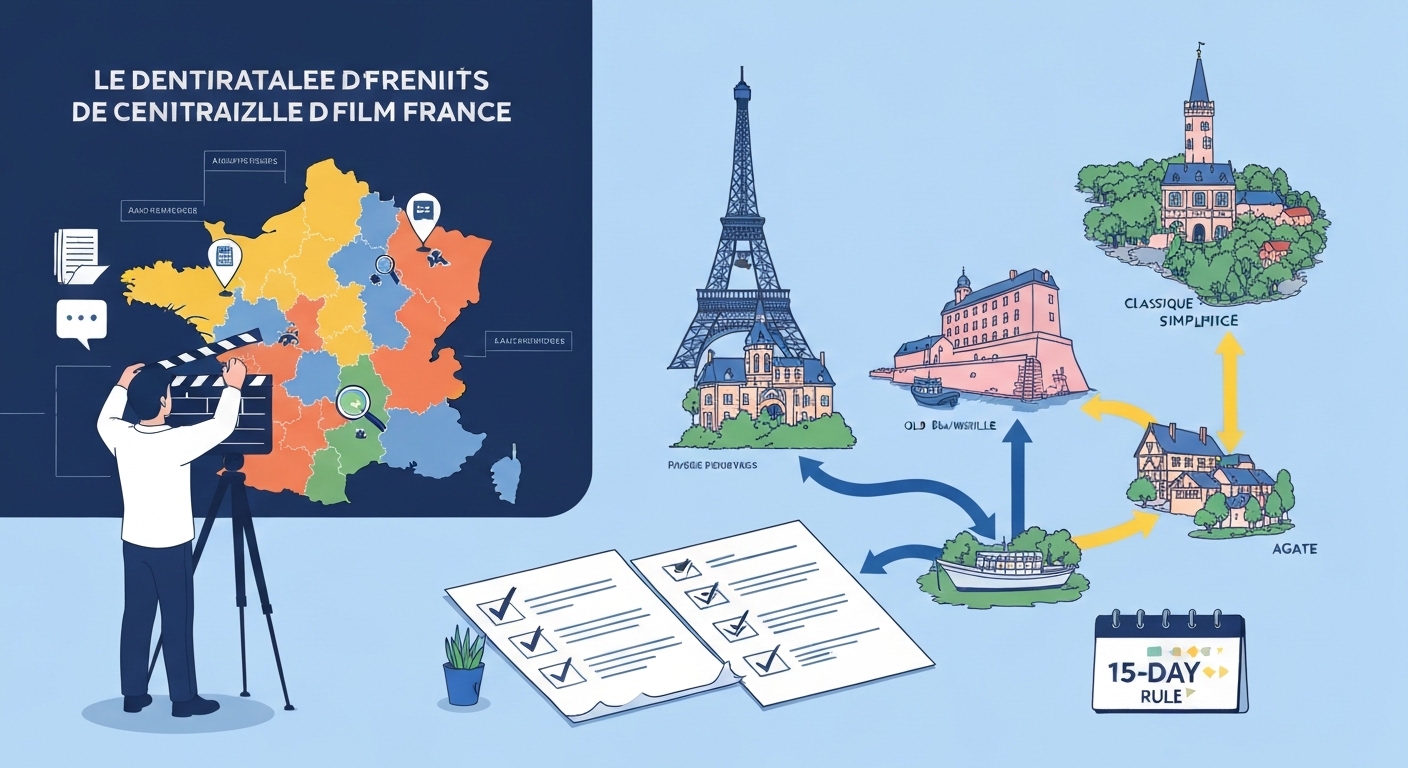
Forget a single French film permit. You need 3+ authorizations, starting 15 days out.
As a producer who has navigated the Marseille Mission Cinéma and the Paris AGATE platform, I’ve secured the hidden benefit: a streamlined path through France’s decentralized system. This guide maps it in 5 key sections.
Misidentifying your required authority—mairie, préfecture, or site manager—risks a full shoot cancellation. The 2025 VHSS charte mandate adds another compliance layer.
Will you navigate the Classique vs. Simplifiée split? Can you decode the 15-day rule? Does your project trigger the AGATE platform?
We analyzed the latest municipal decrees and 2026 platform closures. Our methodology provides your 5-step authority identification checklist.
Your 7-minute read starts now. Let’s get your shoot the green light. 🎬
Why there's no single 'french film permit' (and what you really need)
Many international producers arrive in France expecting a single, national filming permit. The reality is different. France operates a decentralized authorization system, meaning there is no one-size-fits-all document. Instead, you must secure separate permissions from each relevant administrative level governing your chosen locations.
For example, a shoot in a Parisian park requires authorization from the Mairie de Paris (city hall). If that same shoot involves stopping traffic, you'll also need a permit from the Préfecture de Police. Filming on a historic site managed by a national institution adds a third, site-specific authorization. This layered approach, confirmed by the Ministry for Europe and Foreign Affairs, is the standard. Your first step is always to consult the local Charte des tournages (filming charter), a mandatory document in cities like Marseille and Paris that outlines local rules and often requires a signed commitment against sexual and gender-based violence (VHSS).
Understanding this decentralized landscape is your strategic advantage. It transforms a vague search for a "permit" into a targeted process of identifying and contacting specific authorities, which we will map out next.
The 15-day rule: your timeline for a smooth authorization process
Your most critical deadline is the 15-day rule. For standard procedures—like the autorisation classique in Marseille or an AGATE application in Paris—you must submit your complete dossier a minimum of 15 working days (roughly three calendar weeks) before your first shooting day. This is not a suggestion; it's a strict municipal deadline with no guarantee of approval for late submissions.
The exception is the streamlined déclaration simplifiée, available in some cities for very small crews. In Marseille, for instance, if your shoot involves 10 people or fewer, is on a public street only, and requires no parking or traffic stops, you may qualify for this fast-track process with a reduced lead time of 5 working days. However, this option is highly specific. Choosing the wrong procedure is a common pitfall that leads to delays. Furthermore, you must account for platform closures, like the AGATE system in Paris being inaccessible from December 25, 2025, to January 2, 2026. Planning around these administrative calendars is essential for a smooth 2026 shoot.
Adhering to these timelines is the non-negotiable foundation. With that clock started, your next move is to systematically identify who exactly you need to apply to.
How to get your filming permission: the 5-step authority identification checklist
Navigating the decentralized system is methodical. Follow this five-step checklist to pinpoint your required authorities and build a compliant application.
- Pre-Consult the Local Filming Charter. Before anything else, find and review the Charte des tournages for your filming city (e.g., Marseille, Paris). This document is your rulebook, listing prohibited sites, mandatory procedures, and required attachments like the VHSS charter.
- Classify Your Primary Location Type. Is it a public street, a park, a municipal building, or private property? This determines your procedure. Streets may allow for a simplified declaration, while parks and buildings typically trigger the classic 15-day process.
- Identify the Managing Authority. For public spaces, this is the local town hall (Mairie). For Paris, remember the dual system: the Mairie for the public domain and the Préfecture de Police for any impact on public order or traffic. For private or iconic sites (museums, train stations), identify the site manager.
- Gather Your Core Documentation. Prepare a dossier including your signed VHSS charter, detailed project summary (dates, crew size, equipment), proof of image rights for recognizable locations, and insurance certificates.
- Submit via the Official Channel. Use the designated platform (like AGATE for Paris) or contact the dedicated office (like the Mission Cinéma in Marseille). Never assume emailing a generic city hall address is sufficient.
By executing these steps, you transform complexity into a clear action plan. The cornerstone of a successful submission is a complete dossier, which hinges on having the right documents ready from the start.
4 documents you must have ready before you apply
A complete application dossier is your key to approval. Based on 2025-2026 requirements from major urban film offices, these four documents are non-negotiable:
- The Signed VHSS Charter: A signed commitment to prevent sexual and gender-based violence, now mandatory for productions in Paris and strongly recommended nationwide. This is often required before platform access is granted.
- Detailed Technical Rider: A precise document outlining your shoot dates, exact locations, crew size, and all equipment (including generators and vehicles). Ambiguity here is a primary reason for requests for clarification and delays.
- Proof of Image Rights or Authorization: For filming architectural works still under copyright or identifiable private property, you must provide authorization from the rights holder. This is separate from the public filming permit.
- Valid Insurance Certificates: Your production must hold civil liability insurance (assurance responsabilité civile) with a certificate naming the relevant public authority as an additional insured party, covering the entire filming period.
Having these prepared before you even access an application portal will save you days. With your dossier compiled, your success then depends on how you communicate with the approving authorities.
Contacting town halls: the communication strategy that avoids delays
Initiating contact with a town hall or film office is a strategic step, not a mere formality. A common mistake is sending an incomplete inquiry to a generic address, which often leads to silence or slow, fragmented responses. The professional strategy is to leverage the dedicated Mission Cinéma or film office present in most major cities. These offices act as facilitators and single points of contact.
As one location manager noted, "The difference between contacting the general press office versus the dedicated film mission can be a week of back-and-forth versus a confirmed meeting in two days." Your initial communication must be comprehensive: introduce your project, state desired dates, specify crew size and locations, and explicitly mention that you have consulted the local filming charter. Attach your preliminary technical rider. This demonstrates professionalism and allows the officer to immediately assess feasibility and potential roadblocks, such as conflicting events or prohibited zones.
This proactive, detailed approach is the communication strategy that avoids delays. It builds a collaborative relationship with the authority, moving you from being an unknown applicant to a prepared partner. Once you understand this process, the final piece is decoding the specific types of permits you'll ultimately be applying for.
Classique vs. simplifiée vs. agate: decoding the 3 main permit types
Understanding the terminology is crucial for selecting the correct procedure. These are the three main permit types you will encounter in the French system:
- Autorisation Classique: The standard permit. Applies to most shoots in municipal areas (parks, buildings), requires a 15-working-day lead time, and involves a full review by the town hall.
- Déclaration Simplifiée: A simplified declaration for minimal-impact shoots. Eligible only for crews of ≤10 people on public streets with no parking or traffic disruption. Lead time is reduced to 5 working days.
- Autorisation AGATE: The specific online platform and procedure for Paris. Required for any shoot in Paris with 10 people or more. It integrates the needs of both the Mairie de Paris and the Préfecture de Police but still requires the 15-day deadline.
Choosing correctly from the start is the final, critical step in efficiently navigating France's authorization landscape.
Conclusion
You now possess the complete map to navigate France’s decentralized filming authorization system. You’ve moved from the initial misconception of a single permit to mastering the targeted identification of specific authorities, which is the true key to a green-lit shoot.
With this framework, your next project secures more than just permission. It gains predictability. By correctly applying the 15-day rule for a Classique permit or the 5-day window for a Simplifiée declaration, you lock in your timeline. By pre-emptively submitting the mandatory VHSS charter and a complete dossier via the correct channel—like the AGATE platform for Paris—you transform a potential administrative maze into a streamlined process. This is how you protect your budget from costly delays and ensure your first day on set is about creativity, not compliance crises.
Remember, this system operates on strict municipal calendars. The AGATE platform closure from December 25, 2025, to January 2, 2026, is a concrete example. For shoots in early 2026, inaction now means missing that critical submission window, potentially pushing your entire production schedule back by weeks. The cost isn't just a rescheduling headache; it's lost location bookings, crew availability, and a direct hit to your production's financial viability.
Before you finalize your plans, ask yourself three critical questions based on your project's specifics: **First, does my shoot on a Parisian street with 12 crew members trigger the dual Mairie and Préfecture de Police requirement, or can it be streamlined? Second, have I obtained signed image rights for that iconic private façade, which is a separate legal requirement from the public permit? Third, is my insurance certificate correctly formatted to name the local authority, a common technicality that causes last-minute rejections? Getting these details wrong doesn't just risk delay—it risks cancellation.
The good news is that the perceived complexity is now manageable. You are ahead of the curve. You have the checklist to identify authorities, the document list for your dossier, and the communication strategy for town halls. For projects with multiple locations, large crews, or complex logistics like traffic stops, this guide provides the framework, but applying it to your unique variables is the final, crucial step.
Ready to translate this framework into your specific shooting schedule and locations? Let’s analyze your project’s needs against the Classique, Simplifiée, and AGATE requirements to build your guaranteed application path. 🎬**