
Video production budget: your complete guide to accurate planning (with free template)
Introduction
Video production budget planning fails 80% of projects. Underestimating post-production consumes 30% of funds.
As a producer, I’ll show you the hidden leverage: a 2026-ready template with AI cost lines and three industry secrets for bulletproof control. This five-section guide turns financial guesswork into a funded plan.
Without a structured ATL/BTL breakdown and a 15% contingency, you risk cost overruns and quality cuts. A daily shoot under €500 signals unsustainable compromises.
Can a free template auto-calculate your totals? What are the three non-negotiable percentages for pre-prod, prod, and post? How do you slash per-clip costs from €50 to €5 with 2026 AI scaling?
We’ve analyzed the latest benchmarks, from equipment rentals to hybrid automation strategies. Our methodology provides a step-by-step blueprint, not just generic advice.
Read this 7-minute guide. Let’s frame your financials for success.
The proven budget template: your blueprint for financial control
A video production budget is not a simple list of expenses; it is a strategic financial model that dictates the feasibility and quality of your project. In 2026, the industry standard for a professional template is a multi-sheet document that separates Above-the-Line (ATL) creative costs from Below-the-Line (BTL) technical and logistical expenses. This structure provides immediate clarity for stakeholders and is the single most effective tool for preventing the cost overruns that derail 80% of projects.
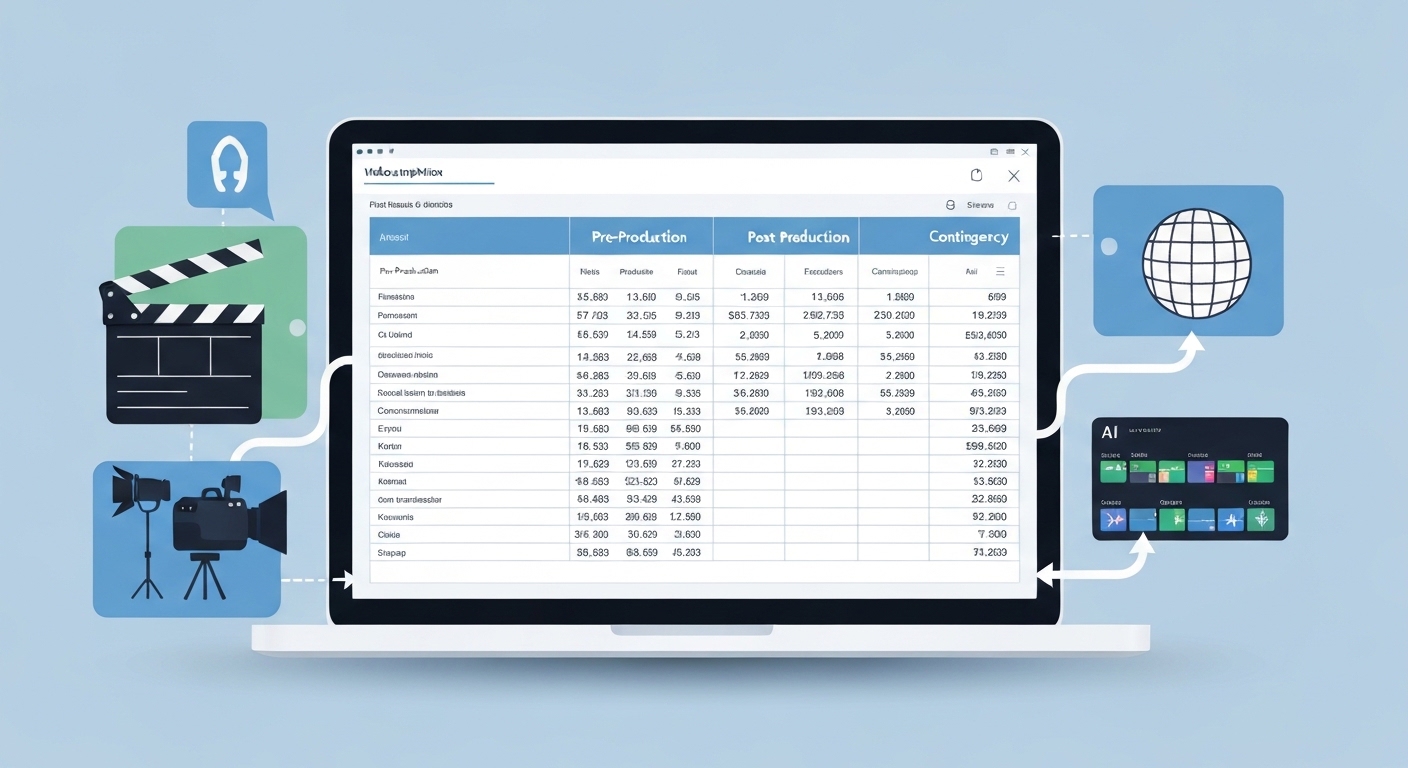
A robust template automates the complex math, leaving you to focus on creative and strategic decisions. It should include dedicated sections for:
- Pre-production (20% of budget): Scripting, location scouting, casting, and storyboarding.
- Production (50% of budget): Crew (€500-€1,000/day minimum), equipment rentals (cameras: $1,000-$50,000, audio: $200-$3,000), and location fees.
- Post-production (30% of budget): Editing, color grading, sound design, and dedicated lines for AI editing tools (~$50/month).
- Contingency (10-20%): A non-negotiable buffer for unforeseen issues, auto-calculated as a percentage of the total.
For example, an indie film budget template for a $25,000 project will auto-calculate subtotals for each department, providing a clean, fundable document for grants or investors. This systematic approach transforms financial guesswork into a controlled, actionable plan, setting the stage for precise execution.
Your free 2026-ready template: auto-calculating totals and ai cost lines
Building on that structured foundation, we offer a free, professionally crafted budget template updated for 2026's specific challenges. Unlike generic spreadsheets, this tool is engineered with modern production realities in mind, featuring auto-calculating totals and pre-configured line items for the latest cost-saving technologies.
Our template, adapted from industry-standard models, provides immediate value with:
- Real-Time Dashboards: Visual KPIs and charts that track budget variance at a glance.
- Integrated Contingency Formulas: A default 15% buffer that adjusts automatically as you modify line items.
- 2026-Specific Cost Lines: Pre-filled categories for AI-assisted editing, cloud subscription services, and scalable content repurposing.
- Vendor Quote Fields: Designated spaces to input and compare actual quotes, ensuring your estimates are grounded in reality.
This tool eliminates manual calculation errors and provides a professional framework to justify your budget to any stakeholder. It’s your first step from chaotic estimating to confident financial planning.
Beyond the spreadsheet: 3 industry secrets for bulletproof budgets
Owning a sophisticated template is only half the battle. Mastery lies in applying insider principles that govern how professionals allocate and protect every euro. Based on 2026 benchmarks and observed practices from leading producers, these three non-negotiable strategies separate amateurs from experts.
1. Enforce the 20/50/30 Percentage Rule.
Industry consensus holds that for a balanced budget, allocations should roughly follow: 20% for pre-production, 50% for production, and 30% for post-production. This framework prevents the common pitfall of underfunding post-production, which consumes resources for editing, VFX ($1,000-$10,000/min), and sound design. Deviating significantly from these ratios is a red flag for investors and a predictor of quality compromises.
2. Architect for AI Scaling from Day One.
The most significant 2026 shift is designing budgets for volume efficiency. The secret is to allocate capital to multi-cam shoots and reusable assets, then leverage AI for scaling. As one analysis notes, this can reduce per-clip production costs from €50 to under €5. Budget not just for a single video, but for the automated generation of 50 derivative clips—social cuts, subtitled versions, platform-optimized formats—within the same financial envelope.
3. Treat Contingency as a Strategic Asset, Not a Slush Fund.
A 10-20% contingency is standard, but professionals categorize it. Allocate specific portions for known risks: weather delays, talent overtime, and equipment failure. This "contingency with intent" prevents the fund from being casually eroded and ensures it's available for genuine emergencies. It’s the financial airbag that allows for creative risks without jeopardizing the project's completion.
4-step walkthrough: from blank cells to a fundable budget
With the template open and these principles in mind, the process of populating your budget becomes a straightforward, four-step exercise. This walkthrough ensures every cost is captured and justified, transforming a blank spreadsheet into a compelling financial proposal.
Step 1: Gather All Quotes and Rates.
Before touching the template, collect formal quotes for every major line item: crew day rates, equipment rental packages, location permits, and post-production studios. This replaces guesswork with vendor-backed figures, which you’ll input into the dedicated quote fields.
Step 2: Map Your Timeline to the Template Structure.
Break down your production schedule into pre-production, production (shoot days), and post-production phases. Assign your gathered costs to the corresponding sections (ATL for director/actor fees, BTL for crew/equipment, Post-Prod for editing/AI tools).
Step 3: Input Data and Leverage Auto-Calculation.
Enter your figures. The template will automatically generate department subtotals, a grand total, and calculate your contingency (e.g., 15% of the total). Instantly, you see the financial impact of each decision.
Step 4: Validate and Create the "Fundable" Version.
Review the dashboard for any alarming variances. Then, create a clean, client-facing version from the template, highlighting the total, key deliverables, and the contingency plan. This document is now ready to secure funding or client approval.
The costly oversights that derail 80% of video projects
Even with a perfect template and sound practices, specific, predictable oversights consistently push projects over budget. Recognizing and preemptively planning for these pitfalls is what defines expert-level financial control. Here are the critical errors to eliminate.
- Underestimating Post-Production: Allocating less than 30% for this phase is the most common error. Editing, color grading, sound mixing, and VFX are time-intensive and cannot be rushed without severe quality loss.
- Ignoring 2026 AI Scaling Economics: Budgeting for a single video output when the strategy calls for 50 clips wastes a 90% potential cost efficiency. Failing to include lines for AI tool subscriptions (~$50/month) and automated repurposing ignores the new reality of content volume.
- Inadequate Daily Shoot Budgets: Planning for a daily shoot rate under €500 (EU benchmark) often signals unsustainable compromises on crew experience or equipment, leading to delays and reshoots that cost far more.
- A "Soft" Contingency: Treating the 10-20% buffer as vague padding instead of earmarking it for specific, high-probability risks (e.g., weather, talent illness) means it disappears on minor overruns, leaving nothing for true emergencies.
The pattern is clear: failure stems from optimistic simplification. By contrast, a detailed, realistic budget that accounts for modern scaling tools and historical pitfalls doesn’t just predict costs—it actively ensures the project’s creative and financial success.
Conclusion
You now have the complete blueprint for financial control over your next video project. We’ve moved from the foundational structure of a proven template, through the strategic allocation of funds with industry secrets, to a step-by-step execution plan. This isn’t just about filling out a spreadsheet; it’s about architecting a budget that acts as a strategic asset, ensuring creative vision is never compromised by financial surprises.
Imagine the outcome: a fundable document that secures stakeholder buy-in, a production schedule insulated from costly overruns by a 15% contingency, and the ability to scale your content output by 10x while reducing your per-clip cost to under €5 through 2026 AI automation. This is the tangible result of applying the 20/50/30 rule, planning for multi-cam efficiency, and earmarking risks—not just hoping for the best.
The timeline for action is now. The industry’s shift towards AI-scaled production and tighter financial scrutiny isn’t a future trend; it’s the 2026 standard. Procrastination has a clear cost: continuing to budget for single outputs at €50 per clip while competitors achieve the same quality at 90% less. The cost of inaction is wasted budget, missed opportunities for content volume, and projects perpetually at risk from unplanned post-production demands.
Before you finalize your next budget, ask yourself three critical questions:
- Does my current plan allocate a strict 30% to post-production, or am I risking quality with an optimistic guess?
- Have I budgeted for AI scaling tools and a multi-cam shoot, or am I locking myself into the inefficient, single-output economics of the past?
- Is my 10-20% contingency earmarked for specific, high-probability risks, or is it vague padding that will vanish on the first minor overage?
The complexity is behind you. You’re no longer searching for a basic template; you’re equipped with a professional framework, 2026-ready cost lines, and the insider principles to bulletproof it. You are now ahead of the curve.
Take your project from plan to precision. Download your free 2026-ready template, input your first quotes using the 4-step walkthrough, and see your fundable budget take shape in minutes. ➡️
Sources
- https://www.studiobinder.com/blog/downloads/film-budget-template/
- https://www.smartsheet.com/content/film-budget-templates
- https://clutch.co/resources/how-to-create-a-video-production-budget
- https://www.clakprod.com/blog/production-audiovisuelle-14/guide-2026-adapter-vos-productions-av-aux-baisses-budgetaires-sans-perte-de-qualite-1060
- https://www.clakprod.com/blog/marketing-communication-24/guide-2026-de-1-tournage-a-50-contenus-video-sans-exploser-le-budget-1017
- https://agence-kzn.com/combien-coute-la-realisation-dune-video-professionnelle/