
Strategies acceleration dossier: the complete framework to decode and leverage national investment (with concrete kpis)
Introduction
€12.5 billion in public funds are allocated, yet 70% of project leaders miss key leverage points. Your strategies acceleration dossier is not just paperwork—it's the definitive gateway to this capital.
As an advisor navigating SGPI frameworks and Bpifrance calls daily, I’ve decoded the system. This guide delivers the insider methodology and the four concrete KPIs that separate funded projects from rejections.
Ignoring the structured four-axis implementation model isn't an option. It directly risks leaving between €525 million and €1.7 billion in leveraged investment on the table for your competitors.
So, how do you transform a national strategy into your financial lever? What are the non-negotiable criteria of the SGPI? And which KPIs prove your project's alignment to the ANR?
We’ve analyzed the latest interministerial decrees and 2025 performance reports to structure your approach. The following five sections provide the complete operational framework.
Your roadmap to public investment starts now. Estimated read: 7 minutes. ⚡ Let’s accelerate.
National acceleration strategy: beyond the buzzword, your lever for massive public investment
Forget abstract policy. A National Acceleration Strategy is a unified, multi-lever government initiative designed to funnel exceptional public investment into priority sectors and technologies. It’s the operational core of France’s fourth Program of Future Investments (PIA4), launched in 2020. The state, in collaboration with economic actors, identifies critical areas—like 5G or digital health—and deploys a coordinated arsenal of financial, fiscal, and regulatory tools to overcome market failures and accelerate innovation.
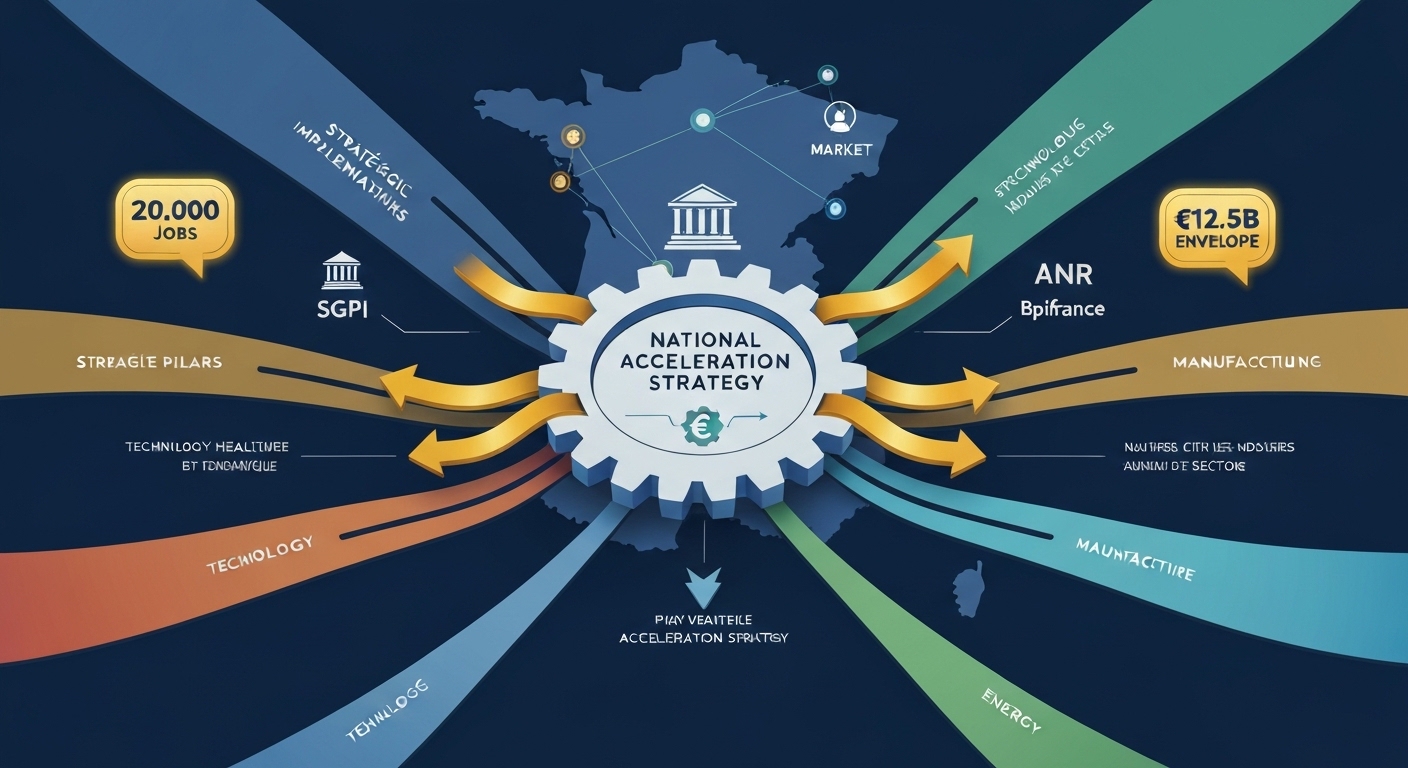
The actionable reality? These strategies are your direct lever. They translate into concrete calls for projects managed by agencies like Bpifrance. For instance, the 5G and Future Networks strategy isn't just a plan; it's a mechanism targeting 20,000 new jobs and a €15 billion market by 2025. This transforms a national priority into a quantifiable opportunity for your project.
The strategic pivot is clear: understanding this definition is the first step to aligning your dossier with the state's €12.5 billion envelope and accessing its power to de-risk and scale your venture.
Sgpi, bpifrance, anr: the 3 key agencies that pilot your strategy
Navigating the acceleration ecosystem requires knowing its pilots. Your strategy is coordinated and executed by three pivotal agencies.
The Secrétariat général pour l'investissement (SGPI) is the interministerial conductor, ensuring coherence across all more than twenty strategies. It sets the overarching direction and priorities under the France 2030 framework.
Operational execution falls to two key partners. Bpifrance is your primary interface for financing, managing calls for projects, and providing grants or loans to companies. Simultaneously, the Agence nationale de la recherche (ANR) handles the research and development components, funding academic and industrial R&D partnerships essential for deep-tech projects.
€12.5 billion envelope: how public funds leverage private investment (with sector breakdowns)
The state has mobilized €12.5 billion over the 2021-2025 period specifically for acceleration strategies. This isn't just a grant pool; it's a catalytic engine designed to leverage significant private capital, multiplying the total investment impact.
The mechanism is precise: public funds de-risk pioneering projects, attracting private co-investment. A prime example is the 5G and Future Networks strategy. With a public commitment of €525–735 million, the objective is to mobilize up to €1.7 billion in total investment—a leverage effect of nearly 3x. This funds everything from industrial use-cases to the development of French telecom solutions.
Comparative analysis with other sectors reveals tailored allocations:
- Digital Health: €650 million in public funding to execute 35 actions, focusing on market access and health AI.
- Transversal Objectives: Across all strategies, 50% of expenditures are directed toward economic decarbonization, and 50% are dedicated to emerging innovators.
This structured allocation ensures public money doesn't just fund but strategically pulls private investment into national priority lanes, creating a multiplier effect that defines the strategy's economic impact.
The 4-axis implementation model: your checklist for navigating calls for projects
To successfully navigate a call for projects, you must align your proposal with the standard implementation model. Exemplified by the 5G strategy, this 4-axis framework is your essential checklist:
- Develop Concrete Use-Cases: Your project must demonstrate tangible applications that benefit industries or territories. This is about proving market need and immediate utility.
- Build Sovereign Solutions: Proposals should contribute to developing French or European technologies and supply chains, reducing strategic dependencies.
- Strengthen R&D Ecosystems: Alignment with collaborative research consortia is key. This axis funds the underlying technological breakthroughs.
- Address Skills & Training: Projects that include components for workforce development or specialized training address systemic adoption barriers and are highly valued.
For example, a successful dossier for a future networks AAP wouldn't just propose a new chip design (Axis 2 & 3); it would also plan its integration into a smart factory pilot (Axis 1) and include a partnership with an engineering school for technician training (Axis 4). This holistic alignment is what separates funded projects from the rest.
20,000 jobs, €15b market: the 4 kpis that define acceleration strategy success
The success of these strategies is not subjective; it's measured against concrete Key Performance Indicators (KPIs) established from the outset. The 5G strategy's targets provide the canonical blueprint for the four KPIs you must understand and, ideally, contribute to:
- Employment Impact: Creation of 20,000 new jobs by 2025. Your project's direct and indirect job creation potential is a critical metric.
- Market Growth: Growing the addressed sector to a €15 billion market valuation. Your innovation should contribute to expanding the overall economic pie.
- Export Performance: Enabling innovative SMEs to derive more than 50% of revenue from exports. This KPI tests the global competitiveness of funded solutions.
- Research Excellence: Reinforcing scientific leadership and international visibility. This is measured through patents, publications, and leadership in standard-setting bodies.
These KPIs are tracked through annual performance reports and audits. For your dossier, they serve as a mirror: a project that demonstrably advances these metrics is one that aligns perfectly with the strategy's core mission and has a significantly higher chance of securing investment.
Conclusion
You now possess the complete operational framework to transform a national priority into your financial lever. We’ve moved from decoding the €12.5 billion acceleration strategy mechanism to mastering the 4-axis implementation model and the four concrete KPIs that define success for the SGPI. This isn't just theory; it's your blueprint for accessing massive public investment and the private capital it leverages.
Imagine your project, one year from now, not just funded but strategically aligned: your dossier demonstrates clear contributions to job creation and market growth, securing a grant that de-risks your R&D and attracts co-investors. The data proves this path works—the 5G strategy alone aims to leverage €1.7 billion from a public injection of €525–735 million. Your success is quantified in the same terms: jobs created, exports generated, and sector leadership secured.
However, this window is dynamic. The foundational strategies with 2025 horizons are now under evaluation, and the framework for the 2026-2027 period is being defined. The cost of inaction isn't just missing a current call for projects; it's entering the next cycle without the validated alignment and partnership networks that competitors are building now.
Before you finalize any document, ask yourself three critical questions based on the KPIs we've defined:
- Does my project's impact forecast directly support the 20,000 jobs or €15 billion market targets of its sector strategy?
- Is my consortium structured to satisfy all four axes of the implementation model, from use-cases to training?
- Have I quantified how my innovation will contribute to export performance or research excellence, the non-negotiable metrics for the ANR and Bpifrance?
This is less complex than it seems. You've already done the heavy lifting by understanding the system's architecture. Structuring a winning dossier is now a matter of applying this precise checklist to your project's strengths.
Take the next step with confidence. Book a strategic alignment audit where we'll map your project against the active acceleration strategies and identify the most impactful funding window for your dossier. ⚡