
What is video production? the complete process from concept to screen (3 essential stages)
Introduction
Video production is not just filming. It's a multidisciplinary process where 80% of success is locked in before the camera rolls. This is the video production reality most glossaries miss.
As an industry insider, I'll show you the hidden mechanics that separate amateur clips from professional content. This guide breaks down the complete 3-stage framework and the six critical sections that follow.
Neglecting this structured approach risks budget overruns, missed deadlines, and a final product that fails to engage your audience.
Ready to move beyond the basics? We'll answer: What defines the multidisciplinary creative process? Why is pre-production the non-negotiable foundation? How do you adapt the workflow for digital distribution?
This analysis is built on the latest industry standards for 2026, dissecting the roles, stages, and strategic types with a producer's methodology.
Estimated reading time: 7 minutes. Let's roll camera on the complete process. 🎬
Video production: beyond the camera, a multidisciplinary creative process
Video production is the complete process of creating video content, encompassing all stages from initial concept and planning through filming to final editing and delivery for various platforms including cinema, TV, web, and streaming. This definition, stable in industry glossaries through 2026, reveals a multidisciplinary creative process that synthesizes art, technology, and project management. It requires a convergence of skills in narrative design, visual composition, sound engineering, and advanced technical execution to transform an abstract idea into a polished final product. The scope is comprehensive, moving far beyond simply operating a camera.
The 3-pillar framework: why 80% of success happens before the shoot
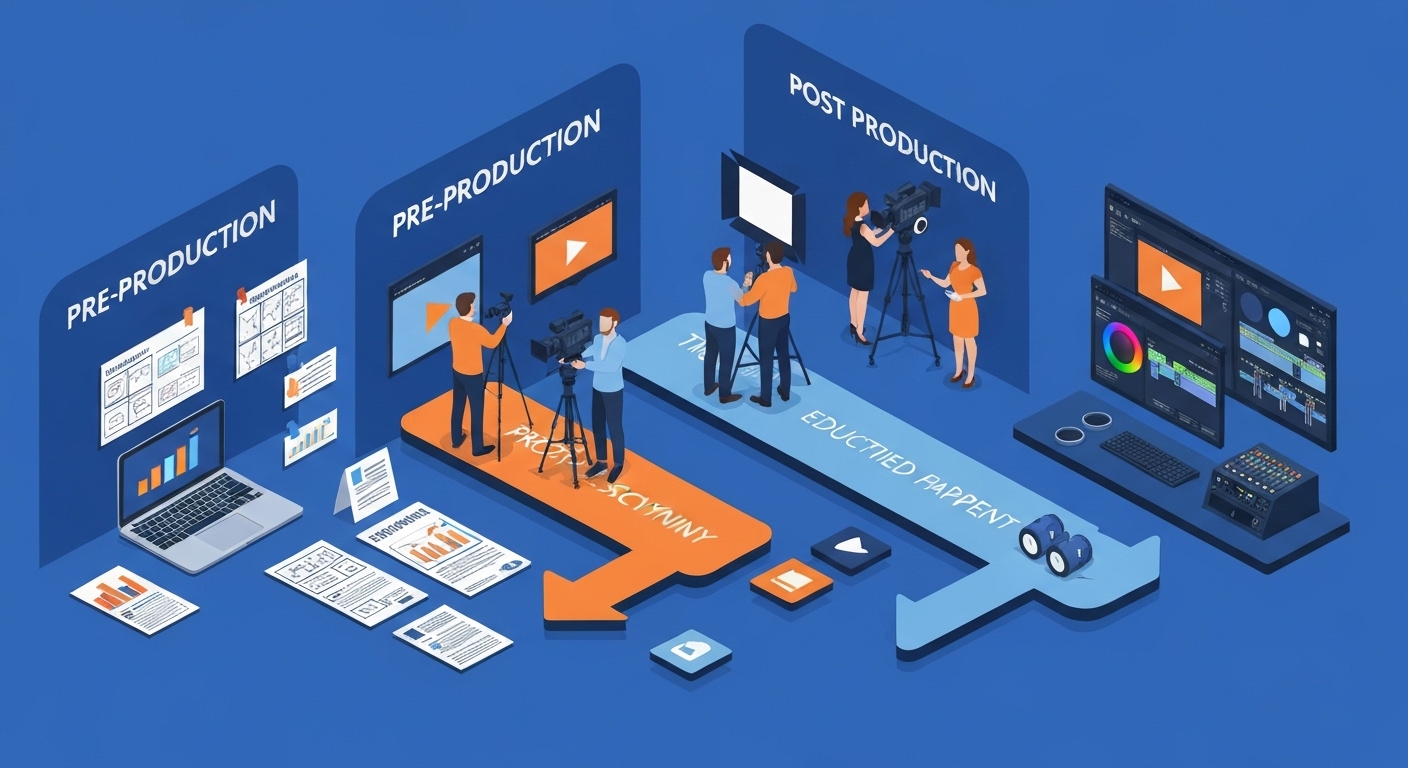
The industry adage that 80% of a project's success is determined before filming begins is rooted in the structured, three-stage framework of professional video production. This process-driven methodology is designed to mitigate risk, control budget, and ensure creative vision is realized.
- Pre-production (Planning): This foundational phase locks in the creative and logistical blueprint. Activities include script and storyboard development, casting, location scouting, detailed budgeting, scheduling, and securing permits. According to observed practices in 2026, this phase increasingly utilizes cloud-based collaboration tools, but its core purpose—meticulous preparation—remains unchanged.
- Production (Filming): This is the execution phase, where the plan is captured. It involves directing talent, managing camera and lighting setups, recording high-quality audio, and overseeing on-set logistics to adhere to the schedule and budget. The integration of remote production technologies has become more standard by 2026, allowing for hybrid shoots.
- Post-production (Assembly & Polish): Here, the raw footage is crafted into the final story. Editors assemble the narrative, colorists grade the image, sound engineers mix audio, and visual effects are added. AI-assisted editing tools are now prominent, streamlining workflows, but the creative decision-making process of the editor remains central.
For example, an agency producing a product launch video would follow this flow: Concept → Pre-production planning → Filming day → Post-production editing/effects → Final delivery. Mastering this framework is the strategic pivot from amateur recording to professional, reliable content creation.
Educational videos: the 2 critical adjustments for effective learning
Producing videos for education, such as e-learning modules or software tutorials, requires two critical adjustments to the standard workflow to prioritize knowledge transfer and retention.
- Instructional Scripting Over Narrative Scripting: The script must be pedagogically structured. This means defining clear learning objectives, breaking down complex information into digestible segments, and incorporating deliberate pauses for reflection or note-taking. The language is precise and explanatory, often requiring collaboration with a Subject Matter Expert (SME) to ensure accuracy.
- Visual Clarity Over Visual Flair: While aesthetics matter, the primary goal is comprehension. This demands a focus on clear, well-lit shots of demonstrators or screens, the strategic use of graphics and text overlays to emphasize key terms, and a consistent visual style that reduces cognitive load. According to observed practices, successful educational videos often use a multi-camera setup for demonstrations and invest heavily in clean, informative motion graphics in post-production.
Internet video: how digital distribution transforms the traditional workflow
Internet video production adapts the traditional three-stage process for creation on web, streaming, and social media platforms. The core transformation is that distribution parameters influence creative and technical decisions from the very start of pre-production.
The workflow is reshaped by platform-specific requirements: aspect ratios for mobile-first viewing (e.g., 9:16 for TikTok/Reels), shorter run-times to combat scroll fatigue, and sound-on assumptions. In production, this may mean shooting coverage specifically for vertical edits. In post-production, it necessitates creating multiple cut-downs, adding bold captions for silent viewing, and encoding files to meet platform-specific compression standards. The entire process is optimized for shareability and algorithmic discovery, not just linear broadcast.
5 key roles that make or break your video project
A successful project relies on a team where specialized roles intersect. Understanding these five key functions is critical:
- **Director (Réalisateur): The creative visionary who guides the artistic and dramatic aspects, directs talent, and determines camera angles.
- Producer (Producteur): The project manager who oversees the budget, schedule, logistics, and overall execution from conception to delivery.
- Director of Photography (DP): The master of the image, responsible for camera equipment, lighting design, and achieving the desired visual style.
- Editor (Monteur): The narrative architect who assembles the raw footage, shapes the story's pace, and integrates graphics, sound, and effects.
- Sound Engineer (Ingénieur du son):** The audio specialist responsible for recording clean dialogue and atmosphere on set and mixing all audio elements in post-production.
From corporate ads to documentaries: 6 video types and their strategic purpose
Video production is not one-size-fits-all; the format is chosen to serve a specific strategic goal. Here are six common types and their primary purposes:
- Corporate/Enterprise Videos: Internal or external communication tools for training, branding, or explaining company culture.
- Advertisements (Commercials): Direct product or service promotion designed for broadcast, online pre-roll, or social media.
- Documentaries: Non-fiction narratives that explore real-world topics, people, or events to inform, educate, or persuade.
- Web Series & Digital Content: Scripted or unscripted series produced primarily for streaming platforms (YouTube, VOD services).
- Music Videos: Visual accompaniments to songs, serving as a promotional tool for artists and a creative art form.
- Event Coverage: Live or edited recordings of conferences, concerts, or ceremonies to extend reach to those not physically present.
Understanding these types and the roles that bring them to life provides the essential framework. However, aligning the right format, process, and team for your specific strategic goal—be it brand awareness, training, or lead generation—is where expertise matters most. This is where a detailed discussion of your project's unique parameters becomes essential.
Conclusion
You now possess the complete blueprint for professional video production. We’ve moved from a simple definition to a multidisciplinary creative process that synthesizes art, technology, and management. You understand the non-negotiable 3-pillar framework where success is architected in pre-production, captured in production, and polished in post-production. You’ve seen how to adapt this workflow for educational clarity and digital distribution, and you know the key roles and strategic video types that align content with purpose.
Armed with this framework, you are positioned to achieve tangible outcomes: efficient project execution that respects budget and timeline, strategic content that fulfills clear objectives (from brand lift to training efficacy), and professional-grade results that engage your audience on any platform. This isn't theoretical; it's the proven methodology that separates planned success from costly, reactive fixes.
Consider your own project through this lens. Is your script and storyboard finalized, or are you hoping to 'figure it out' on shoot day? Do you have a clear distribution strategy that informs your aspect ratios and run-times? Have you budgeted for the essential post-production polish that transforms raw footage into a compelling narrative? The stakes are the difference between a video that is merely watched and one that drives real results.
The good news is that the perceived complexity is now manageable. You have the structured overview. You are no longer starting from zero but from an informed position, ready to ask the right questions and make strategic decisions.
To move from understanding to execution, the next step is to apply this framework to your specific goals. Let’s define your project's parameters together and build a tailored plan. Share your initial concept and core objective with our team, and we’ll provide a structured pathway to production. 🎬
Sources
- https://www.agence-smardia.com/production-audiovisuelle-definition/
- https://www.studysmarter.fr/resumes/etudes-de-communication/production-et-diffusion/production-video/
- https://www.iesa.fr/ressources/definition-production-audiovisuelle
- https://www.creads.com/blog/decryptage/comment-faire/le-guide-creads-de-la-production-audiovisuelle/
- https://www.press-agrum.com/guide/video-professionnelle/definition/