
Contact video production: your guide to a seamless collaboration (3 steps to get it right)
Introduction
Contacting a video production agency is not about finding a camera crew. It's about securing a strategic partner for a proven 3-stage process that over 150 B2B companies rely on.
As an insider, I’ll show you the hidden mechanics of a seamless collaboration—detailing the exact 7-step framework used by top studios to transform your brief into a high-impact video.
The wrong first contact wastes budget and time, leaving you with generic proposals that miss your strategic goals. A misaligned partnership risks your project's ROI before a single frame is shot.
So, how do you choose the right communication channel to ensure your vision is understood? What are the 3 non-negotiable trust signals that separate professionals from amateurs? And which 6 fields in your project brief guarantee a precise, fast-tracked quote?
This guide analyzes the latest industry protocols for 2026, breaking down the methodology from initial contact to defined project plan. We move beyond theory to actionable steps.
Ready to decode the process? Your 5-minute read starts now. Let’s roll camera on your next project. 🎬
Video production services: beyond the camera, a proven 3-stage process
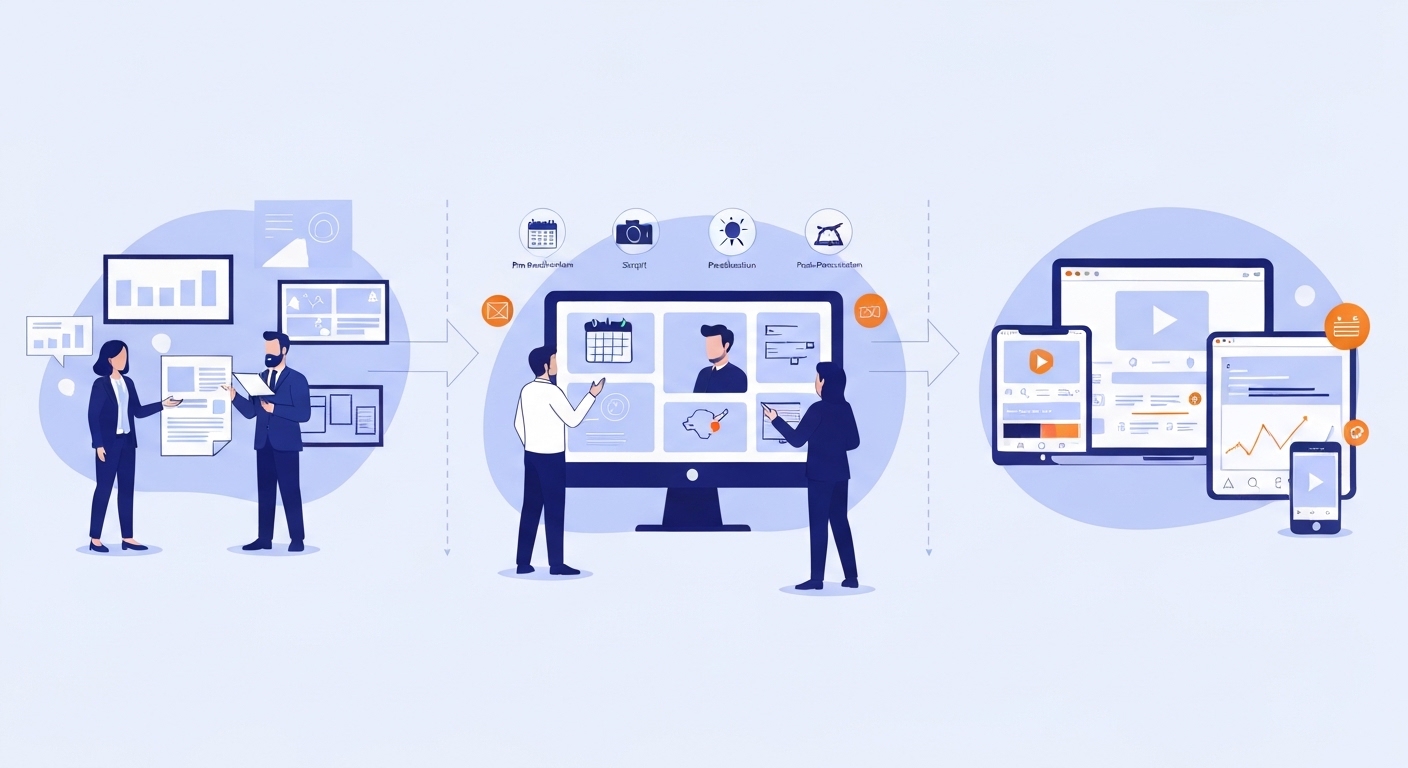
Professional video production is a strategic discipline, not just a technical task. The camera work is merely the visible tip of a structured iceberg. A full-service agency operates on a proven 3-stage process that ensures strategic alignment and quality from concept to delivery. This methodology, validated by over 150 B2B client engagements, transforms raw ideas into measurable outcomes.
The core stages are:
- Pre-production: This foundational phase includes strategic planning, scriptwriting, storyboarding, and logistics. It’s where 70% of a project's creative direction is locked in.
- Production: The execution phase involving filming, direction, and audio capture. It’s governed by the detailed plans established beforehand.
- Post-production: Where the narrative is built through editing, color grading, motion graphics, and sound design, turning footage into a polished final asset.
This end-to-end control is what separates a service partner from a simple vendor, guaranteeing your vision is realized without costly missteps.
From brief to screen: how the right partnership transforms your vision
Initiating contact is the first step in a collaborative journey, not a transactional quote request. The right partnership acts as a force multiplier, translating your initial brief into a video that achieves strategic goals—be it boosting brand awareness by 40% or generating qualified leads.
Consider a Product Launch Campaign. An amateur might just film the product. A professional partner will deconstruct the launch strategy, identifying key messages for different audience segments and planning a content series that includes a hero film, social snippets, and sales enablement tools. This holistic approach, drawn from a portfolio of successful Brand Storytelling and Testimonial Video projects, ensures your video is an investment, not an expense. The transformation happens when your internal vision is augmented by proven external expertise.
Your first point of contact: choosing the right channel for your project
Your project's complexity and urgency should dictate your first point of contact. Selecting the optimal channel streamlines communication and sets the right tone for the collaboration. Industry standards for 2026 prioritize structured, trackable initial contact to ensure no detail is lost.
For comprehensive project inquiries, the dedicated contact form (detailed in the next section) is the gold standard. It forces a structured brief, allowing producers to immediately assess scope and fit. For a general exploratory conversation, a direct email to `contact@company.com` is appropriate. For time-sensitive or highly complex needs, a phone call to a main line (e.g., `+33 1 23 45 67 89`) can quickly establish a direct line to a project lead. Many studios also offer direct scheduling via tools like Calendly for efficiency.
The strategic takeaway: match the channel to your need. A detailed form fast-tracks a quote, while a call resolves high-level strategic questions. Choosing correctly demonstrates professionalism and accelerates the path to a defined project plan.
3 trust signals that separate professional studios from amateurs
Evaluating a potential partner requires looking beyond a showreel. Three concrete trust signals validate a studio's professionalism and reliability in the B2B space.
- Quantifiable B2B Experience: Look for evidence of work with organizations of your scale. A claim of serving over 150 enterprises is a stronger signal than vague "corporate experience." It implies understanding of procurement cycles, stakeholder management, and B2B messaging.
- Structured Process Transparency: Amateurs operate reactively. Professionals document their workflow. A clearly articulated 3-stage process (Pre-Prod, Prod, Post-Prod) with defined deliverables at each phase is a hallmark of managed, predictable project execution.
- External Validation & Affiliations: While specific awards are company-dependent, look for industry-standard badges like Clutch verification or membership in professional bodies. Affiliation with recognized networks (as referenced by agencies like Authentic or Yalp) indicates peer recognition and adherence to industry standards.
The project brief blueprint: 6 fields that fast-track your quote
A precise project brief is the single most effective tool for receiving a relevant, comparable, and timely quote. Omitting key details leads to generic proposals and follow-up emails that delay the process by days. This blueprint outlines the six essential fields that enable a production studio to immediately qualify your project and provide a focused response.
- Project Type & Goal: Specify the format (e.g., Corporate Explainer, Event Aftermovie) and the primary business objective (e.g., "Increase demo requests by 25%").
- Budget Range: Providing a realistic bracket (e.g., €15k-€25k) is not limiting—it's efficient. It ensures the proposed creative approach and resources are aligned with your financial reality from the outset.
- Timeline: Include key dates: ideal kick-off, mandatory delivery date, and any internal review milestones. This dictates resource scheduling.
- Target Audience: Who are you speaking to? (e.g., "CTOs in SaaS companies with 500+ employees").
- Core Message: What is the one thing the viewer must remember?
- Distribution Channels: Where will this video live? (e.g., Website homepage, LinkedIn, trade show booth). This influences technical specs and aspect ratios.
Completing these fields transforms your inquiry from a question into a actionable brief, allowing for a 48-hour turnaround on a preliminary project plan.
After you click 'send': the 48-hour path to a defined project plan
Submitting your brief initiates a standardized qualification process designed for speed and clarity. Here is what you can expect within two business days:
- Acknowledgment & Review (Within 24 Hours): You will receive a confirmation that your brief has been received and is being reviewed by a project lead.
- Discovery Call Scheduling: A producer will contact you to schedule a 30-minute call. This is not a sales pitch, but a collaborative session to clarify objectives, discuss creative angles, and address any questions from the brief.
- Preliminary Project Plan Delivery (By Hour 48): Following the call, you will receive a structured document outlining a proposed creative approach, a high-level timeline, and a transparent preliminary quote based on the aligned scope.
This process eliminates uncertainty, ensuring you move from initial contact to a clear, actionable proposal in a predictable timeframe.
Why industry benchmarks matter: decoding social proof for your video project
While specific client testimonials are powerful, understanding broader industry benchmarks provides a crucial baseline for evaluating any potential partner. For instance, the average client rating for top-tier B2B video agencies on platforms like Clutch often exceeds 4.8 out of 5 stars. A response time to new inquiries under 24 hours is considered a professional standard, as noted in 2025 industry analyses.
These metrics help you "decode" social proof. They separate market-validated performance from isolated opinions. When reviewing an agency, check for consistency across third-party platforms like Google Business Profile and specialized B2B directories. This external validation acts as a collective vote of confidence on reliability, quality, and client service, reducing your perceived risk in initiating that first, crucial contact.
Conclusion
You’ve just navigated the complete blueprint for a professional video production engagement—from understanding the proven 3-stage process to decoding the trust signals that separate strategic partners from simple vendors. Think of this guide as your project’s pre-production checklist; the planning is done, and the path to a seamless collaboration is mapped.
Now, picture the outcome: a video that not only meets specifications but exceeds strategic goals, backed by a process that has delivered for over 150 B2B companies. With the industry’s average client satisfaction benchmark at 4.8/5 and a standard 24-hour response time, your decision today aligns you with proven performance, not just promise.
Consider your own project timeline. The most common bottleneck isn’t production—it’s the delay in initiating the right conversation. Every week of indecision pushes your launch date, potentially missing a key market window or internal campaign milestone. The cost of inaction isn’t just time; it’s missed opportunity and diluted impact.
Before you move on, ask yourself three quick questions:
- Is my current project brief detailed enough to fast-track a meaningful quote?
- Have I validated potential partners against the three non-negotiable trust signals?
- What is the tangible business cost if this video launches one quarter later than planned?
The good news is that complexity is now manageable. You’re equipped with the exact framework—the channel selection, the brief blueprint, the evaluation criteria—to move forward with confidence. You’re not starting from scratch; you’re activating a defined process.
The next step is to transform this knowledge into a specific plan. Use the 6-field project brief blueprint detailed in this guide to draft your requirements, then initiate the conversation through the recommended channel. A clear brief is the fastest route to a defined proposal and a tangible start date.
Ready to move from planning to execution? Submit your project brief via our contact form to schedule your discovery call and receive a preliminary project plan within 48 hours. 🎬
Sources
- https://portemire.com/production-audiovisuelle
- https://authentic.paris/blog/le-role-dune-agence-de-production-video
- https://www.kabocharts.com/blog/quest-ce-quune-agence-video/
- https://www.video-experience.fr/production-audiovisuelle/quels-sont-les-services-de-production-audiovisuelle/
- https://yalp-video.fr/production-audiovisuelle