
Video production: beyond filmmaking, your complete guide to the modern process (3 core stages)
Introduction
Video production is not filmmaking. It’s a digital-first process where 4K UHD is now the baseline standard, not the exception.
As an industry insider, I’ll show you the hidden benefits of mastering the universal three-stage framework. This guide unpacks the six critical sections that separate amateurs from professionals.
Ignore this structured approach, and you risk budget overruns, technical failures, and content that fails to engage. The cost of a poorly planned video in 2026 is measured in lost revenue and credibility.
Do you know the three non-negotiable stages that govern every project? Can you spot the critical choice between ENG and EFP styles? How have cloud computing and AI tools fundamentally rewritten the workflow?
We’ve analyzed the latest SMPTE-aligned standards and 2025 workflow evolutions to provide a clear, actionable methodology. This is your definitive operational blueprint.
Your complete guide to the modern process is ready. Estimated read time: 7 minutes. Let’s roll camera.
Video production defined: why it's more than just 'filmmaking with a camera'
Video production is the end-to-end process of creating video content, from initial concept to final distribution. While it shares DNA with filmmaking, the distinction is critical. Video production is defined by its use of digital or analog video signals recorded to tape, hard drives, or memory cards, as opposed to celluloid film stock. This technical foundation enables a workflow optimized for modern digital platforms—from corporate explainers and social media clips to streaming series—prioritizing formats like MP4 and 4K UHD for web distribution over theatrical release. It’s a structured discipline built for speed, scalability, and the demands of the digital age.
---
The 3 universal stages of production: your framework for any project
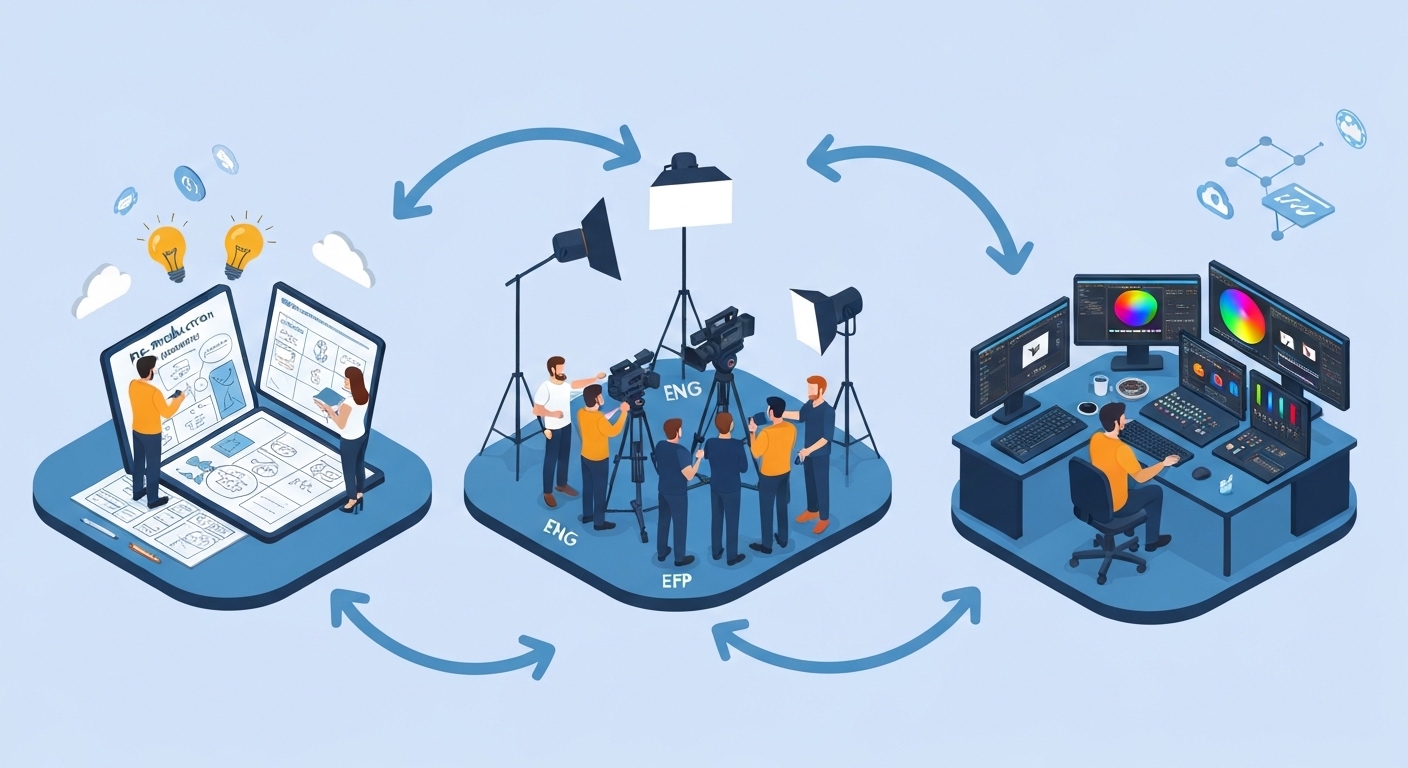
Every successful video, from a 30-second TikTok ad to a feature-length documentary, is built on the same three-stage framework. This universal structure is your blueprint for managing complexity, budget, and creative vision.
- Pre-production: This is the planning phase where the project is designed on paper. It encompasses concept development, scripting, storyboarding, casting, location scouting, budgeting, and scheduling. A 2025 industry analysis confirms that robust pre-production is the single greatest predictor of staying on schedule and budget.
- Production: This is the execution phase—the actual filming or animation capture. It involves setting up equipment, directing talent, managing lighting, and capturing high-quality picture and sound. Whether it’s a single-camera interview or a multi-camera live event, this stage transforms the plan into raw assets.
- Post-production: Here, the raw footage is assembled, refined, and polished into the final product. This includes editing, color grading, sound design, visual effects (VFX), and exporting the video in its required formats. Modern workflows leverage tools like DaVinci Resolve and Adobe Premiere, with AI-driven auto-editing features accelerating this phase.
For example, a corporate training video begins with a script and shot list (pre-production), is filmed with a presenter and B-roll (production), and is finally edited with graphics and a branded soundtrack (post-production). This framework applies universally, providing a controlled process for any project type.
For a deeper dive into how these stages apply to different project types, explore our guide on the 3 Universal Stages of Production.
---
How the internet transformed production: 3 tech drivers you can't ignore
The internet didn't just create new places to publish video; it fundamentally rewired the production process itself. Three technological drivers have dismantled traditional barriers, democratizing high-quality production and enabling global collaboration.
- Cloud Computing & SaaS Platforms: The shift from local servers to the cloud has revolutionized workflows. Teams can now collaborate on edits in real-time from different continents using platforms like Frame.io or Riverside.fm. Cloud-based asset management and review/approval cycles have compressed timelines that once took weeks into days, a change solidified in mainstream practice by 2025.
- High-Speed Connectivity & 5G: Widespread 5G deployment and fiber-optic internet have made remote and live production feasible at a professional level. Directors can monitor shoots in 4K quality from another location, and live-streamed events can be produced with multi-camera setups without a broadcast truck on-site. This has given rise to the "hybrid crew," blending local technicians with remote creative directors.
- AI-Integrated Software Tools: Artificial intelligence has moved from a novelty to a core production assistant. In 2026 workflows, AI tools handle labor-intensive tasks such as generating transcriptions for subtitles, performing initial color correction, and even suggesting edit points based on pacing. This allows human creators to focus on high-level creative decisions, significantly lowering the skill floor for technical polish.
To understand how these drivers continue to reshape the industry, read about how the Internet Transformed Production.
Educational video production: the 2 principles for maximum learning impact
Educational video production is a specialized application where pedagogical goals dictate the creative process. Its core purpose is to facilitate comprehension and retention, governed by two key principles.
- Cognitive Load Management: Effective educational videos are designed to avoid overwhelming the learner. This principle, backed by multimedia learning research, dictates concise runtimes (often 6-10 minutes), the use of clear visuals to support audio narration, and the strategic onboarding of text and graphics. The goal is to present information in digestible segments, not a continuous data stream.
- Universal Accessibility & Engagement: Learning must be accessible to all. This mandates the inclusion of accurate closed captions not just for the hearing impaired, but for viewers in sound-sensitive environments. Furthermore, engagement is engineered through a conversational tone, interactive elements like embedded quizzes, and a narrative structure that poses and answers questions, transforming passive watching into active learning.
A prime example is a MOOC (Massive Open Online Course) module that uses animated diagrams to explain a complex scientific concept (managing load) while offering downloadable transcripts and paced, chaptered video playback (ensuring accessibility).
Applying these principles effectively is key; learn more in our dedicated resource on Educational Video Production.
---
Inside the production machine: a step-by-step breakdown of each critical phase
Understanding the three-stage framework is one thing; knowing what happens inside each phase is what separates planning from execution. Let's open the hood on the production machine.
Pre-production: The Blueprint
This phase is about eliminating uncertainty. It starts with a creative brief aligning all stakeholders on goals. Writers then develop the script, which is translated into a visual plan via storyboarding. Simultaneously, producers handle logistics: creating detailed budgets, scheduling shoot days, securing locations and permits, and casting talent. Every hour invested here saves multiple hours during production and post.
Production: The Capture
The plan meets reality. The crew sets up, performing technical checks for lighting, camera settings, and sound. The director blocks scenes with talent before principal photography begins. The focus is on acquiring all necessary footage: primary scenes (A-roll), supplemental shots (B-roll), and clean audio. A single day of shooting for a commercial, for instance, may yield 4-6 hours of raw footage to be distilled into a 60-second final cut.
Post-production: The Assembly
The editor sifts through raw footage to find the best takes, assembling the rough cut. Once the sequence is locked, the refinement begins: color grading establishes visual tone and consistency, while sound design adds music, effects, and cleans up dialogue. Finally, the video is exported into deliverables—different file formats and resolutions for social media, websites, and broadcast.
This overview covers the critical phases; for an even more detailed, phase-by-phase walkthrough, see our complete Step-by-Step Breakdown.
Eng vs. efp: the critical choice between speed and polish
Within professional video production, two dominant styles dictate approach, equipment, and crew: Electronic News Gathering (ENG) and Electronic Field Production (EFP). The choice hinges on the core trade-off between speed and polished quality.
- ENG (Electronic News Gathering) is built for speed and agility. Characterized by small, mobile crews (often 1-3 people), it uses lightweight, run-and-gun equipment to capture events as they happen. Planning is minimal, turnaround is measured in hours, and the primary goal is to disseminate information quickly. It’s the standard for live news, sports events, and breaking coverage.
- EFP (Electronic Field Production) is engineered for controlled quality. Used for documentaries, corporate films, and television commercials, it involves larger crews, planned lighting setups, and higher-end cinema cameras. Shoots are meticulously scheduled, with a focus on achieving a specific, polished look and sound. The timeline is longer, and the output is designed for longevity and impact.
Choosing the right style is crucial for project success. Delve deeper into the technical and practical nuances of ENG vs. EFP.
---
From marketing to healthcare: where your video production knowledge applies next
The universal framework of video production is the key that unlocks content creation across the modern economy. Your understanding of the process is directly applicable to diverse and growing fields:
- Marketing & Advertising: Crafting brand stories and product campaigns through polished commercial spots and social media content.
- Corporate Communications: Producing internal training modules, executive messages, and shareholder reports.
- Healthcare & Sciences: Developing patient education explainers, surgical procedure videos, and complex medical animation for research.
- Entertainment & Media: Creating streaming series, independent films, and music videos for digital platforms.
Mastering the core process is your first step. For projects where industry-specific expertise, complex logistics, or bespoke creative vision are critical, a consultation can tailor this framework to your precise goals.
Conclusion
You now possess the universal framework. You’ve moved from a simple definition to understanding the three core stages that structure any project, from a corporate training module to a live-streamed event. You’ve seen how the internet and AI tools like those in DaVinci Resolve have compressed timelines, and you know the critical choice between ENG speed and EFP polish. This isn't just theory; it's the operational blueprint for creating video that achieves its goal.
With this framework, your next project transforms from a daunting challenge into a manageable sequence. You can anticipate bottlenecks in pre-production, allocate resources correctly during the shoot, and plan for efficient post-production. The result? Professional-quality video delivered on time and on budget, whether it's for marketing, education, or internal communications.
Consider this: the demand for video content isn't slowing down; it's accelerating. By 2027, video is projected to dominate over 85% of all internet traffic. The organizations that thrive will be those with a clear, internalized production process, not those scrambling to figure it out with each new request.
Before you move on, ask yourself:
- Does my current project plan account for all three stages—Pre-Production, Production, and Post-Production—with clear deliverables for each?
- Am I using the right production style (ENG vs. EFP) for my deadline and quality requirements, or am I risking polish for speed (or vice versa)?
- Have I budgeted for the critical post-production phase—editing, color grading, sound design—where the raw footage truly becomes a compelling story?
The complexity you might have felt at the start is now a structured process. You’re no longer just looking for a definition; you’re equipped with the actionable methodology to execute.
Ready to apply this framework to your specific goals? Whether it's a brand campaign needing cinematic polish or an educational series requiring clear, accessible edits, the next step is to tailor this universal process to your unique vision, audience, and constraints. Let's discuss how to make it work for you.
Sources
- https://en.wikipedia.org/wiki/Video_production
- https://quickframe.mountain.com/blog/video-production-process/
- https://photography.tutsplus.com/articles/what-is-video-production-meaning-phases-types--cms-108106
- https://www.ziflow.com/blog/video-production-workflow
- https://riverside.com/blog/video-production-process
- https://www.lanemp.com/trending-topics/three-stages-of-video-production-process
- https://www.lemonlight.com/video-production/