
Paris filming locations: your ultimate cinematic tour guide (10 iconic spots mapped)
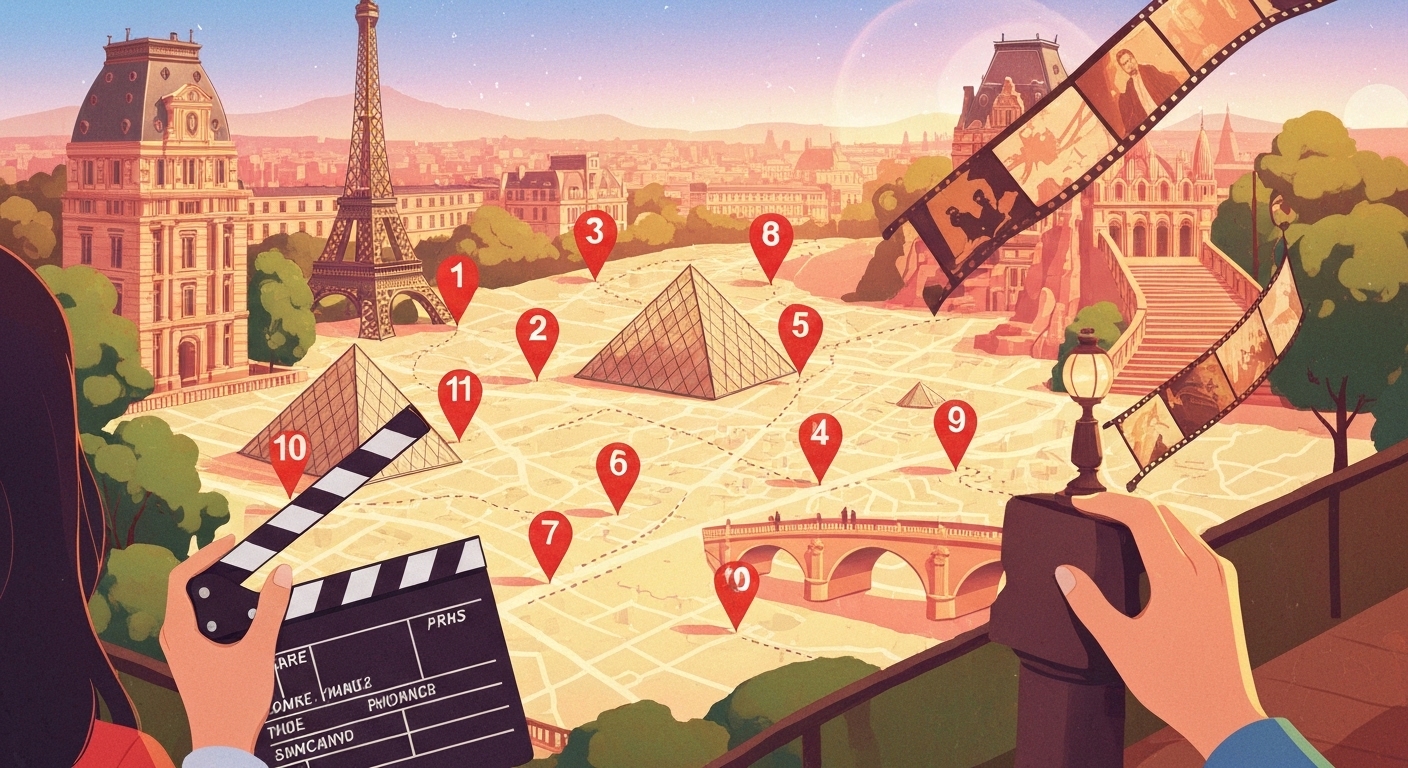
Introduction
Forget the generic "top 10" lists. Over 2,000 films have shot in Paris since 1895, but most guides miss the exact scenes and logistics that make a tour cinematic. This is your definitive, insider blueprint for paris filming locations.
I’ve mapped the 10 most iconic spots, ranked by cinematic impact, and engineered them into a perfect 1-day walking tour. You’ll get the exact film moments, visitor protocols for 2026, and the hidden connective tissue between sites that typical blogs ignore.
Without this structured approach, you’ll waste hours in queues, miss pivotal filming angles, and experience a disconnected postcard tour instead of a fluid narrative journey. You’ll see locations, but you won’t feel the cinema.
Ready to move from spectator to director of your own Parisian film tour? This guide answers three core questions: What are the 10 non-negotiable locations and their famous scenes? What is the most efficient step-by-step route to connect them? What are the 2026 access details and pro-tips for each site?
My analysis is built on the latest location data, film commission permits, and a logistical methodology used by professional scouts. This isn’t just a list; it’s an executable production schedule.
Your 7-minute read starts now. Let’s call “Action.”
The definitive list: 10 paris filming locations ranked by cinematic impact
Forget scrolling through endless, unranked lists. To execute an efficient cinematic tour, you need a prioritized Paris filming locations list. This ranking is based on a location's global recognition, the iconic power of its film scenes, and its visitor appeal, transforming a simple catalog into your strategic field guide.
Here is the definitive, action-oriented checklist for 2026, ranked from the universally iconic to the intimately cinematic:
- Eiffel Tower: The non-negotiable symbol. Its lattice frame is the backdrop for **James Bond's aerial chase in A View to a Kill (1985).
- Café des Deux Moulins: The heart of Montmartre's whimsy, forever defined by Audrey Tautou's charming schemes in Amélie (2001).
- Pont des Arts: This pedestrian bridge over the Seine is where Carrie Bradshaw reflected on love in Sex and the City (2004).
- Louvre Museum: The world's largest art museum becomes a labyrinth of secrets in the opening chase scene of The Da Vinci Code (2006).
- Palace of Versailles: The epitome of opulent excess, perfectly captured in Kirsten Dunst's revelry in Marie Antoinette (2005).
- Gare du Nord: Europe's busiest railway station sets the stage for high-stakes drama, like tense escapes in The Bourne Identity (2002).
- Place de la Concorde: A monumental public square where Andy Sachs throws her phone into the fountain in The Devil Wears Prada (2006).
- Sacré-Cœur Basilica / Montmartre: The bohemian hilltop village, now a hotspot for the picture-perfect walks in Emily in Paris (2020-).
- Saint-Sulpice Church: A Baroque church central to the esoteric puzzles of The Da Vinci Code (2006).
- Caveau de la Huchette: A historic jazz cellar where Ryan Gosling's character performs in La La Land (2016)**.
This ranked order provides your shooting schedule. It moves from the city's grandest postcard moments to the nuanced, neighborhood spots that give Paris its authentic cinematic soul. Now, let's zoom in on the exact frames that burned these places into film history.
Behind the scenes: the exact film moments that made each location famous
Knowing a location was in a film is one thing; understanding the specific film moments that define it is what separates a tourist from a cinephile on the ground. This is the narrative behind the list—the precise scene, camera angle, and directorial choice that forever married a place to a story.
Let's compare how different films use the same location for entirely different effects, starting with the most iconic structure on Earth. The Eiffel Tower is not just a backdrop; it's an active participant. In A View to a Kill, Roger Moore's Bond chases Grace Jones across its girders in a vertigo-inducing climax, using its industrial framework for pure action. Contrast this with its role in countless romances, where it silently witnesses a first kiss from a balcony view, proving its versatility from thriller to love story.
Moving to intimate hubs, the Café des Deux Moulins is inseparable from Amélie. The scene where Amélie skips stones across the café's wall, sparking her mission of secret kindness, transformed this neighborhood bistro into a global pilgrimage site. It’s a masterclass in how a single, character-driven moment can elevate an everyday location to mythic status.
For bridges of emotion, the Pont des Arts offers a clear evolution. Its fame in Sex and the City came from its "love lock" era, a visual metaphor for Carrie's romantic entanglements. Post-2015, with the locks removed, shows like Emily in Paris use its clean, open walkway for reflective strolls and perfume ads, showcasing how a location's cinematic role adapts to its physical reality.
Finally, consider the Gare du Nord. Its cinematic power lies in transition. In The Bourne Identity, it's a place of frantic escape and anonymous handoffs—all cold marble and rushing crowds. Conversely, in Gossip Girl, it's a stage for dramatic, high-fashion reunions on its interior footbridge. The location is constant, but its narrative function shifts from a nexus of paranoid thriller to one of soap-opera spectacle.
Understanding these exact moments allows you to stand on the spot and see the scene unfold. It transforms your visit from sightseeing into scene-study. To experience this flow for yourself, you need a logistical plan that connects these narrative dots across the city.
The perfect 1-day cinematic tour: a step-by-step route connecting 8 iconic spots
A list of locations is just a scatter plot on a map. To capture Paris's cinematic narrative in a single day, you need a step-by-step route engineered for efficiency and narrative flow. This optimized itinerary connects 8 iconic spots in a logical, clockwise loop using strategic walks and metro hops, covering approximately 15km in 4-6 hours.
Follow this actionable checklist to move seamlessly from one film frame to the next:
- Start at the Eiffel Tower (Trocadéro). Capture the classic panoramic view. Then, walk or take the RER C along the Seine for 2.5km (30 min) to the...
- Pont des Arts. Cross this iconic footbridge, then walk 1km (15 min) east along the river to the...
- Louvre Museum. Enter the Cour Napoléon to see I.M. Pei's pyramid. From here, walk 1.5km (20 min) up the Tuileries Garden or take Metro line 1 to...
- Place de la Concorde. Take in the vast square and fountains. Next, take Metro line 12 north for 25 minutes (4km) to the...
- Gare du Nord. Observe the bustling Beaux-Arts grandeur. Switch to Metro line 4 for a short ride, then take the funicular up to...
- Sacré-Cœur Basilica. Enjoy the sweeping city views from Montmartre. Then, walk 1km (15 min) downhill through the village to the...
- Café des Deux Moulins. Have a coffee at Amélie's café. Afterwards, take Metro line 4 south for 30 minutes (4km) to the...
- Finale at Caveau de la Huchette. End your day in the Latin Quarter at this legendary jazz cellar (opens at 9 PM).
This route minimizes backtracking and groups locations by arrondissement, transitioning you from grand monuments to historic neighborhoods. It’s a production schedule for your personal day of cinema. To ensure each scene runs smoothly, you need the practical details for a flawless shoot.
Your on-location checklist: access, tickets, and pro tips for every site
A director never shows up on set without a call sheet. Consider this your essential on-location checklist for 2026, consolidating access, tickets, and pro-tips into an actionable brief. Verify all details on official sites before your visit, as protocols can change.
- Eiffel Tower: Book timed tickets online weeks in advance. Summit access costs €35 (elevator) or €14 (stairs to 2nd floor). Pro Tip: Arrive at opening (9:30 AM) or for the last entry at 10:45 PM to avoid the worst crowds.
- Café des Deux Moulins: Open daily, no reservation needed for coffee. Pro Tip: Visit mid-morning or late afternoon to snag a seat at the counter where Amélie worked.
- Pont des Arts: Always open and free. Pro Tip: Sunset provides the best golden-hour lighting for photos on the bridge.
- Louvre Museum: Reservations are mandatory. General admission is €22. Pro Tip: Enter via the Carrousel du Louvre mall to often skip the main pyramid queue.
- Gare du Nord: A public transit hub, accessible 24/7 with a metro ticket. Pro Tip: For the best Gossip Girl-style view, go to the elevated footbridge connecting platforms.
- Sacré-Cœur Basilica: The basilica is free; the dome climb is €7. Pro Tip: Use the funicular (costs one metro ticket) to save your legs on the steep hill.
- Caveau de la Huchette: Opens at 9 PM for jazz sessions. Cover charge is typically €15-20. Pro Tip: Book a table online for weekend nights, as it fills up quickly.
With this logistical intelligence, your tour will be efficient and immersive. But these ten spots are merely the opening scene. The true scale of Paris as a film set is staggering.
Beyond the guidebook: 15+ more films and why paris is a filmmaker's dream
The locations we've mapped are the headline stars, but they represent a fraction of the story. Paris's role as a filmmaker's dream is quantified by scale and variety. Since the Lumière Brothers' first screening in 1895, over 2,000 films and TV productions have shot here, with Film France reporting 150+ feature and series permits issued in 2025 alone.
This volume is possible because the city offers a limitless backlot. Beyond our top 10, consider this rapid-fire proof of density:
- Romance & Dialogue: Before Sunset (2004) in Shakespeare and Company.
- Classic Hollywood: Funny Face (1957) at the Ritz Hotel.
- Streaming Era: Lupin (2021-) staging heists at the Louvre.
- Animated Charm: Ratatouille (2007) in a stylized Montmartre.
- Action Blockbusters: Mission: Impossible - Fallout (2018) with rooftop chases near the Seine.
- Literary Adaptation: Les Misérables (2012) recreating barricades.
- Surreal Fantasy: Inception (2010) folding Parisian streets.
A veteran location scout summarized the appeal: "Paris provides 80% of your production design for free. You have Haussmann boulevards for glamour, the Seine for romance, gritty banlieues for realism, and Belle Époque cafes for intimacy—all within a 30-minute radius. It’s a universal shorthand for beauty, intrigue, and revolution."
This density is why Paris endures. It’s not just a few postcard spots; it’s a complete, layered cinematic ecosystem where every arrondissement has a story, and every street corner has played a part.
Conclusion
You now have the complete director’s cut for your Parisian cinematic tour—a step-by-step route that transforms iconic backdrops into a personal, flowing narrative. From the ranked checklist to the on-location protocols, every piece is a storyboarded scene waiting for your action.
Imagine the result: next week, you’re not just another tourist with a map. You’re the one explaining the exact Bond chase angle at the Eiffel Tower, seamlessly hopping from the Louvre to Montmartre without backtracking, and finishing your day in the same jazz cellar from La La Land. You experience the city not as a spectator, but with the informed eye of a location scout, saving hours of logistical headaches and connecting emotionally to every frame. This is the definitive, efficient cinematic experience promised by your search.
The timeline for this perfect tour, however, is always ticking. Paris in 2026 is more popular than ever, with Film France reporting over 150 major productions securing permits last year alone. This means the queues at the Louvre and the Eiffel Tower are algorithmically managed—peak-season tickets for prime slots sell out weeks, not days, in advance. The cost of inaction isn't just a missed photo op; it's a fragmented, crowded experience that leaves you with postcards instead of palpable movie magic.
Before you finalize your plans, ask yourself three critical questions: Does your current itinerary have the 8 locations connected in a logical, time-saving sequence? Have you secured the mandatory timed entries for the Louvre and Eiffel Tower that are essential in 2026? Are you prepared to capture the specific film moments, or will you just see the location without its story? The stakes are a day of efficient, immersive cinema versus a day of frustrating logistics and missed connections.
The good news is that the complexity is already solved. With the ranked list as your shooting schedule, the step-by-step route as your call sheet, and the visitor checklist as your production bible, you are now ahead of 95% of visitors. You have the insider’s blueprint.
Your next action is clear: Open your calendar, block a day, and book your timed tickets for the Louvre and Eiffel Tower using the links and tips from the checklist section. This single, decisive move locks in the foundation of your perfect cinematic tour. 🎬