
Paris filming permit: your complete guide to navigating the process (3 key steps)
Introduction
Paris filming permit applications have a 100% rejection rate if submitted late. The myth? That you can wing it with a simple email.
As a location manager who has navigated the Préfecture de Police and the AGATE platform for a decade, I’ll show you the hidden benefits of a flawless submission. This guide breaks the process into three core sections.
Inaction means losing your location, crew, and budget overnight.
What is the single criterion that dictates your entire application path? Who are the two key authorities you must satisfy, and when? Which three geographic restrictions will derail your shoot if ignored?
We’ve analyzed the latest 2026 municipal decrees and police directives to map the bureaucracy. Our structured methodology turns a 3-week process into a predictable checklist.
Your roadmap to a green light is below. Estimated read: 7 minutes. 🎬 Let’s roll camera on compliance.
The paris filming permit process: your 3-step roadmap to avoid rejection
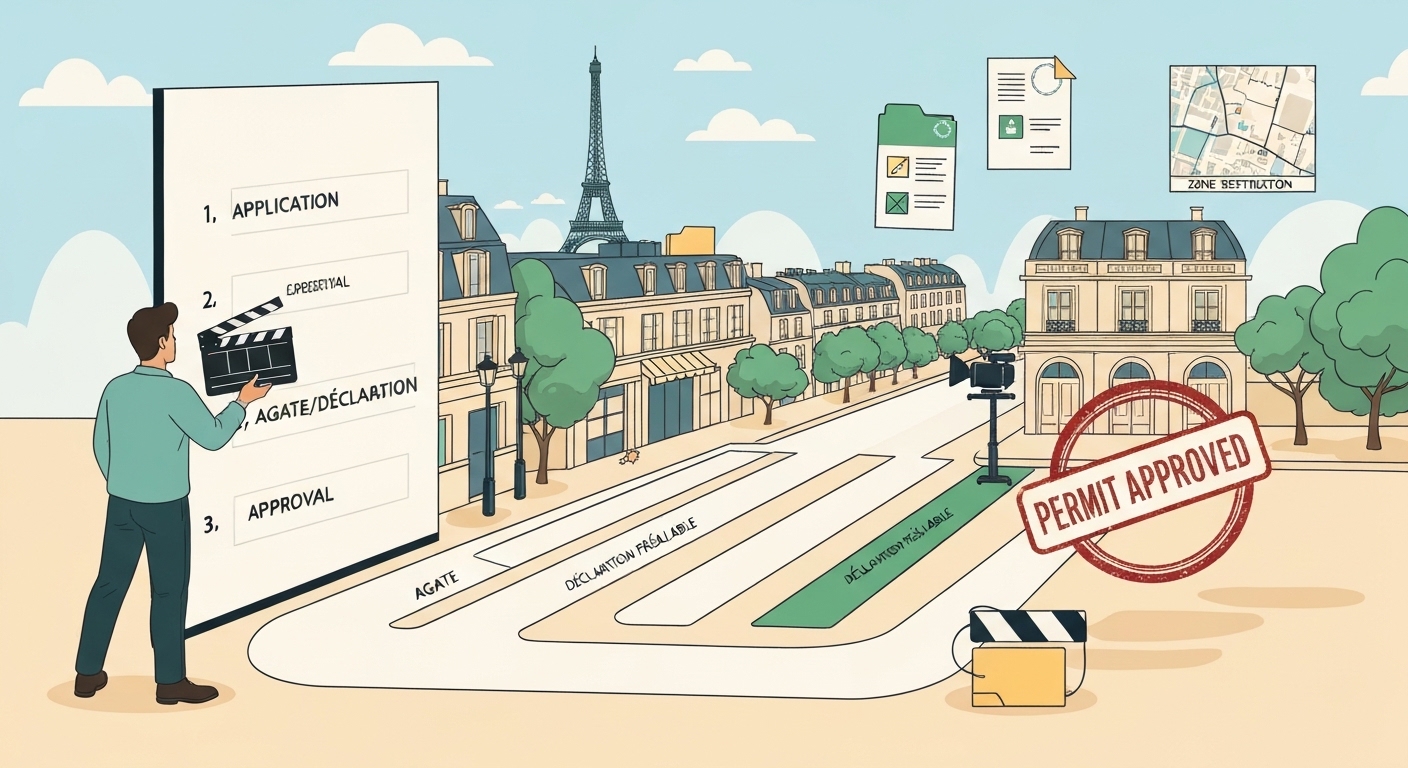
The reality is stark: late submissions are the single biggest cause of permit rejection in Paris. The city's administration operates on strict, non-negotiable deadlines. To navigate this successfully, you must follow a precise, three-step roadmap that aligns your project with the exact requirements of the Paris Film Office and the Préfecture de Police.
Step 1: Diagnose Your Project Type (The Critical First Decision)
Your entire application path is determined by one factor: the scale and complexity of your shoot. You must choose between two distinct procedures:
- Déclaration Préalable: For minimal-impact shoots. Think a crew of under 10 people with a shoulder camera, filming only on streets or bridges, with no vehicles, parking needs, or traffic disruption. Submission is required 1 week in advance via email.
- AGATE Permit: For any shoot that requires more than the basics. This includes parking reservations, traffic control, use of drones, period uniforms, or filming in parks, on the Seine banks, or at monuments. The mandatory lead time is 15 working days (3 weeks) via the digital AGATE platform.
Step 2: Assemble the Mandatory Dossier
Incomplete applications are rejected outright. For both permit types, you must prepare:
- A certificate of civil liability insurance with a minimum coverage of €1 million.
- A detailed shooting schedule with exact sequences and addresses.
- A full list of crew and equipment.
- For AGATE permits, additional technical plans for parking, lighting, and any street furniture removal.
Step 3: Submit to the Correct Authority with Ample Lead Time
This is where timelines are absolute. Mark your calendar:
- For Déclaration Préalable: Submit your complete form to `tournages@paris.fr` at least 7 days before your first shoot day. Processing is typically swift and free of charge.
- For an AGATE Permit: You must submit through the official AGATE application a full 15 working days prior. This allows the 2-3 weeks needed for the Paris Film Office to coordinate internally with city services (roads, cleanliness) and externally with the Préfecture de Police for any public order elements.
Following this roadmap transforms a bureaucratic gamble into a predictable process. Once you understand the basic process, you'll need to consider where exactly you plan to film, as different filming on public roads in Paris may have specific requirements. The next step is to dive deeper into the critical choice outlined in Step 1.
Agate vs. déclaration préalable: the criterion that determines your path
The dividing line between these two permits is not about preference, but project scope. Choosing incorrectly will result in a rejected application. The core criterion is the level of public space occupation and potential disruption your shoot will cause.
| Aspect | Déclaration Préalable (Prior Declaration) | AGATE Permit |
|---|---|---|
| Core Scope | Minimal occupation. Crews of <10, light handheld equipment only. Restricted to streets/bridges. No night shoots past 11 PM, no vehicles, no traffic impact. | Any complexity. Parking, traffic neutralization, street furniture removal, drones, fake weapons, uniforms, generator use. Mandatory for parks, monuments, and riverbanks. |
| Submission & Timeline | Form emailed to `tournages@paris.fr`. 1 week minimum advance notice. | Digital application via the AGATE platform. 15 working days (3 weeks) minimum advance notice. |
| Cost & Processing | No fee. Relatively immediate review by the Paris Film Office. | Fees apply for larger setups. Requires 2-3 weeks for inter-departmental coordination, including with the Préfecture de Police. |
| Best For | Documentary B-roll, news segments, very small student or independent films with no logistical footprint. | Commercials, feature films, music videos, or any production requiring technical vehicles, set dressing, or control over the environment. |
This fundamental choice between AGATE and Déclaration Préalable is part of a broader landscape of French filming permits, each with its own purpose and procedure. Once you've selected your path, you need to know exactly who will be reviewing your file.
Who to contact (and when): mapping the paris permit bureaucracy
Navigating the permit process means dealing with two primary authorities, each with a distinct role. Knowing who does what—and when to engage them—is crucial for a smooth application.
The Paris Film Office (Mairie de Paris)
- Role: Your primary point of contact and the central coordinator. They manage the intake for both Déclarations Préalables and AGATE permits, and coordinate necessary city services like the Roadway Directorate for cleanliness and lighting.
- When to Contact: For all initial inquiries and procedural guidance. They are your first and main point of submission.
- Key Contact: `tournages@paris.fr` (for general information and Déclaration Préalable submissions).
The Préfecture de Police (Service des Prises de Vues)
- Role: The authority on public order and safety. They review and authorize any element that affects traffic, security, or involves sensitive props. This includes traffic neutralizations, the use of drones, simulated police uniforms, or fake weapons.
- When to Contact: You do not contact them directly initially. If your AGATE application requires their review, the Paris Film Office will manage the coordination. Their involvement is why AGATE permits require a 15-working-day lead time.
- Key Contact: Their involvement is triggered internally. Direct contact (Tel: +33 1 53 71 42 35) is typically for follow-ups on complex dossiers already in motion.
To successfully navigate this bureaucracy, having the right contact information for each department at the right time is crucial. For a dedicated resource, consult our page on administrative contacts. With the "who" and "when" established, the "where" presents its own set of critical rules.
Paris filming zones: 3 restrictions you can't ignore and pro tips for success
Paris is not a uniform filming location. Specific areas are governed by strict, non-negotiable restrictions. Ignoring these geographic rules is a fast track to denial, regardless of how perfect your application is.
1. The Absolute Champs-Élysées Ban
As of 2026, the Préfecture de Police maintains a complete ban on filming within the entire Champs-Élysées perimeter. This is not a restriction but a prohibition. Do not waste time planning a shoot here; alternative locations must be secured.
2. "Stressed Arrondissements" and Parking Limits
Certain central districts are classified as over-saturated. In Paris Centre (1st-4th), the 5th, 6th, 7th, 9th, 10th, and the Butte Montmartre area of the 18th, the city severely limits or outright denies parking reservations (arrêtés de stationnement) for technical vehicles. Your AGATE application must have a compelling justification and a minimized vehicle footprint.
3. The Pre-Check Obligation
You must verify that your desired street is not already "closed to parking" or under a permanent "at rest" order before submitting your request. The city will not grant a permit for a space that is legally unavailable. This due diligence falls on the production.
Pro Tips for Success:
- Notify Locally: For any disruption, distributing leaflets to residents and businesses detailing your schedule and contact info is not just polite—it's a best practice that pre-empts complaints to the authorities.
- Insure Early: Have your €1 million liability certificate ready from day one. It's a non-negotiable document for submission.
- Plan for Scrutiny: Since June 2022, the city has enforced a reduction in the number of technical vehicles allowed. Be prepared to justify every truck and van in your plan.
These top-level restrictions are just the beginning; Paris is mapped into specific filming zones with detailed rules that must be consulted. For a deeper dive, explore our guide to geographic restrictions. When your project involves even more unique elements, like animals, the formal rules give way to nuanced judgment.
Filming with animals in paris: navigating the unwritten rules
What happens when your script calls for a canine co-star or a period-accurate horse? Paris has no published, specific procedure for filming with animals. Your permit application follows the standard AGATE path, but it enters a gray area governed by unwritten rules and discretionary approvals.
The consensus among location managers is that animal welfare becomes a paramount, unofficial condition. Authorities may require proof of a professional animal handler, on-set veterinary supervision, or approvals from the Departmental Directorate for Population Protection (DDPP). As one veteran producer notes, "The question isn't just 'do you have a permit?' but 'can you prove the animal's presence is managed with irreproachable care?'" A generic example: a commercial shoot featuring a dog in a café terrace scene would need its AGATE application to explicitly detail the animal's handling, rest area, and safety protocols, far beyond standard planning.
Navigating these unwritten rules often means you're venturing into the territory of special filming permits, which cover a range of complex scenarios. This ambiguity highlights a key reality: while the core process is structured, unique or high-stakes elements demand expert navigation of both the written law and the administrative culture of Paris.
Conclusion
You now possess the complete map to navigate the Paris filming permit system. You’ve moved from uncertainty to a clear, actionable 3-step roadmap that transforms bureaucratic complexity into a predictable checklist. This is the difference between a last-minute scramble and a shoot that starts on time, on budget, and fully authorized.
Imagine the security of having your permit confirmed three weeks out, your parking reservations locked in, and your coordination with the Préfecture de Police already handled. This isn't a best-case scenario—it's the direct result of applying the AGATE timeline and dossier standards we’ve outlined. The data is clear: submissions adhering to the 15-working-day deadline avoid the 100% rejection rate that hits late applications. Your compliance is your production's foundation.
The clock is your most critical piece of equipment. The mandatory 15-working-day lead time for AGATE means that for a shoot in early February 2027, your complete digital file must be submitted by mid-January. Inaction until the last week of January doesn't mean a rushed approval—it guarantees a categorical "no," collapsing your location bookings, crew schedules, and financial planning overnight.
Before you finalize your schedule, ask yourself:
- Does my shoot involve any element—parking, a generator, a drone—that automatically pushes it into the AGATE category and its 3-week timeline?
- Have I verified that my chosen street isn’t on a restricted list and that my arrondissement isn’t “stressed,” limiting my parking options?
- Am I prepared to provide the animal welfare protocols or special effect plans that turn an ambiguous “unwritten rule” into an approvable dossier?
The process is structured, not mysterious. By internalizing the distinction between a Déclaration Préalable and an AGATE permit, and by mapping your contacts to the Paris Film Office and the Préfecture de Police, you are already ahead of 90% of applicants. You’re not just reading a guide; you’re applying a professional methodology.
Therefore, your next action is defined by the first section of this guide: Diagnose your project type immediately. Is it a simple prior declaration or a full AGATE permit? That single decision sets your entire timeline in motion. Open your calendar, count back 15 working days from your ideal shoot date, and mark it as your absolute submission deadline. 🎬