
Video production stages: the complete guide to avoid costly pitfalls (5 proven steps)
Introduction
Forget the myth that video production stages are just "shoot and edit." 80% of your project's success is locked in before you ever press record.
As a producer who has managed over 200 shoots, I’ll show you the hidden levers that control budget, quality, and timeline. This isn’t theory—it’s a field-tested, five-section blueprint to navigate the 2026 landscape where AI-assisted logging and AV1 codecs are now standard.
Ignoring this structured process isn't an option. A single on-set audio mistake or a botched export at -6 LUFS can waste thousands and destroy viewer trust.
So, how do you build an insurance policy against budget overruns in pre-production? What are the five on-set mistakes that ruin raw footage? And which final QC checks guarantee platform acceptance?
We’ve analyzed the latest platform specs and 2026 workflow decrees. Our methodology breaks each phase into actionable, technical steps—from storyboarding to cloud delivery.
Ready to master the sequence? Your 8-minute read starts now. Let’s roll camera. 🎬
Why 80% of video success happens before you press 'record'
The most common misconception in video creation is that the magic happens on set. In reality, the foundation for success is poured long before the cameras roll. Industry analysis from 2025-2026 guides confirms that pre-production determines 80% of project success, from budget adherence to final quality. This isn't just planning; it's a sequential multi-stage workflow that transforms an idea into a deliverable asset.
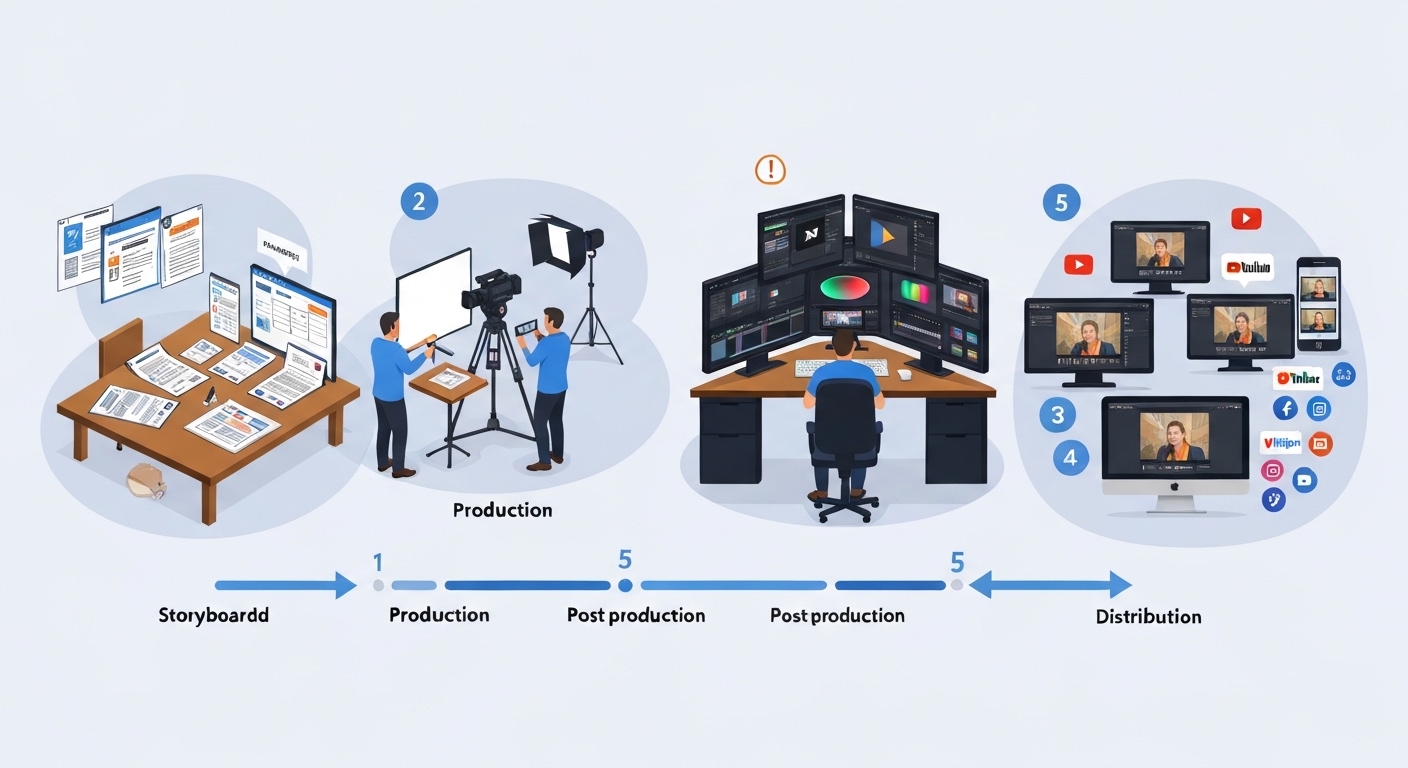
This process is a defined pipeline: initial concept and planning (pre-production), filming (production), editing and refinement (post-production), and final delivery. For example, a corporate explainer video begins with scripting and storyboarding, is captured in a studio, polished with graphics and sound, and published to a learning management system. Skipping a stage is like building a house without a blueprint—possible, but fraught with costly, visible errors. Understanding these stages is fundamental to mastering the complete video production process.
The strategic pivot is clear: mastering this structured sequence is your primary leverage point. It turns reactive problem-solving into proactive control. Now, let's examine the first and most critical phase: the detailed insurance policy known as pre-production.
Pre-production: your 6-step insurance policy against budget overruns
If production is the journey, pre-production is the meticulous map and packed suitcase. This phase is your definitive safeguard against the chaos of blown budgets and missed deadlines. According to 2025 industry best practices, a detailed shot list alone can save 30-50% of on-set time, directly protecting your financial bottom line. Your policy consists of six non-negotiable steps:
- Concept & Objectives: Define the core message, target audience, and key performance indicators (KPIs). What action should the viewer take?
- Scripting & Scenario: Write the narrative blueprint, including all dialogue, presenter lines, and visual cues.
- Storyboarding & Technical Breakdown: Translate the script into visual frames. This is where you plan shots, angles, and create a detailed equipment list.
- Budgeting & Scheduling: Build a line-item budget with a 10-20% contingency buffer and a realistic timeline that accounts for client reviews.
- Logistics & Casting: Secure locations, permits, props, and cast your on-screen talent. Every detail must be locked.
- Crew & Equipment Finalization: Assemble your team (director, DP, sound engineer) and confirm all gear, from cameras to lighting kits.
For instance, a sample script snippet for a product launch might read: "Scene 1: Hero shot of product on rotating stand (close-up, 3s) - Voiceover: 'Introducing durability, redefined.'" This clarity prevents ambiguity on set. To ensure you don't miss any critical steps, follow this comprehensive pre-production checklist.
By investing time here, you purchase certainty. This disciplined foundation is what allows the production phase to focus on execution, not improvisation. However, even the best plan can be derailed by common on-set pitfalls.
Production: the 5 on-set mistakes that ruin your footage (and how to avoid them)
The production stage is where the plan meets reality. It involves setup, directing, and capturing all visual and audio assets. However, pressure and complexity breed errors that can render hours of footage unusable. Here are the five critical mistakes to avoid, informed by 2025-2026 on-set protocols:
- Poor Audio Capture: Relying on camera microphones results in hollow, noisy audio. Solution: Always use external lavalier or boom microphones, and monitor levels with headphones.
- Inconsistent Lighting: Harsh shadows or changing light conditions between shots break continuity. Solution: Control your environment. Use diffusers and record lighting settings for each setup to ensure perfect matches.
- Failing to "Shoot for the Edit": Capturing random footage without planned cut-aways or sequences. Solution: Follow your shot list meticulously and capture B-roll, cutaways, and reaction shots to give your editor options.
- Neglecting Slate or Logs: Unlabeled footage creates a nightmare in post-production. Solution: Use a clapperboard for each take. Leverage AI-assisted logging tools, which reduce manual logging time by 40% according to 2026 workflow trends.
- Ignoring Client/Stakeholder Presence: Making creative decisions without validation leads to costly reshoots. Solution: Have a key decision-maker on set or establish a clear remote review protocol for daily rushes.
A sample call sheet entry exemplifies good practice: "Shot 5B: CEO testimonial, Camera: Sony FX6, Lens: 50mm, Audio: Sennheiser Lav, Time: 14:00-14:30." Avoiding these common production errors requires specific strategies that we detail in our dedicated guide.
Successfully navigating this minefield means you deliver a robust "canvas" of raw materials. But this canvas is just the beginning. Its true potential is unlocked in the next, multi-layered phase: post-production.
Post-production: beyond the edit, the 5 layers that transform raw footage
Post-production is often mistakenly reduced to "editing." In reality, it's a sophisticated, layered construction process where raw footage is transformed into a polished story. Modern 2026 workflows in tools like Adobe Premiere Pro and DaVinci Resolve treat this as a non-destructive, multi-track endeavor. The transformation happens through five distinct layers:
- Assembly & Organization: Ingesting, backing up, and logging all footage (derushage). Strict naming conventions are critical for team collaboration.
- The Narrative Cut: Building the rough and fine cut using a Non-Linear Editor (NLE) to establish timing, pace, and story flow.
- Visual Polish – Color Grading: Correcting exposure and color balance, then applying a creative "look." This turns flat, log footage into vibrant, cinematic imagery.
- Sound Design & Mixing: Adding music, sound effects, and cleaning dialogue. The final mix must meet technical standards, typically -23 LUFS for broadcast, as per updated 2025 audio specifications.
- Graphics & Visual Effects (VFX): Incorporating titles, lower-thirds, motion graphics, and any compositing or CGI elements.
For example, a simple interview is elevated by grading the skin tones, removing background hum, adding subtle music, and overlaying animated lower-thirds with the speaker's name and title. Each of these five layers transforms your footage in specific ways, as explored in our deep dive on post-production.
Once this layered masterpiece is complete, the final hurdle remains: delivering it flawlessly to the viewer. A single technical misstep here can undo all your previous work.
Distribution & finalization: why your last 4 checks determine 100% of viewer experience
Your video is only as good as how it's received. The finalization stage is a critical quality gate where technical oversights can lead to platform rejection, poor playback, or a compromised viewer experience. Industry reports indicate 90% of projects now use cloud delivery platforms like Frame.io, emphasizing the need for flawless digital handoffs. Four final checks are non-negotiable:
- Technical QC (Quality Control): Scrutinize the master file for visual glitches, audio peaks above 0dB, and correct aspect ratio. This is the last line of defense.
- Render & Export Specifications: Encode for the target platform. For web: H.264 at 8-12 Mbps is standard, optimized for 5G streaming. For future-proofing, the AV1 codec is gaining traction in 2026.
- Platform-Specific Upload: Adhere to the specs of YouTube, Vimeo, LinkedIn, or broadcast servers. This includes correct resolution (4K/1080p), file format (MP4, MOV), and metadata.
- Client & Archive Delivery: Provide the final files via secure link and archive the project assets (project files, raw footage, graphics) for potential future use.
To ensure you cover all essential final steps, refer to our comprehensive distribution checklist. Proper finalization not only improves viewer experience but also protects against unexpected budget overruns from correction requests or re-uploads.
This meticulous closure ensures your creative and technical investment delivers its intended return, completing the professional video production lifecycle.
Conclusion
You now hold the complete architectural blueprint for a successful video project. From the foundational strategy in pre-production to the pixel-perfect finalization, you’ve seen how each stage is a deliberate, interlocking system designed for one outcome: a high-impact video delivered on time and on budget.
Imagine your next project: the script is airtight, the shoot day flows without costly resets, and the final file meets every platform spec on the first upload. This isn't a fantasy—it's the direct result of applying the structured process you now understand. The data proves it: a detailed shot list saves 30-50% of on-set time, and 90% of 2026 projects leverage cloud delivery for seamless collaboration. This is your new standard.
However, this precision has a timeline. Viewer expectations and platform technical specifications evolve quarterly. The AV1 codec and -23 LUFS audio standard highlighted for 2026 will become baseline requirements; delaying your adaptation means your content will immediately look and sound outdated. The cost of inaction isn't just a missed trend—it's diminished ROI, compromised professionalism, and lost audience trust.
Before you move on, ask yourself three critical questions about your upcoming project:
- Does my script and storyboard provide an unambiguous guide for every single shot?
- Have I budgeted for the essential post-production layers—color grading, sound design, and graphics—that transform raw footage?
- Am I 100% confident my final exports will meet the specific codec, resolution, and loudness specs of my target platforms?
If any answer is uncertain, don't worry. You're already ahead of the curve. By internalizing this five-stage framework, you've moved from hoping for a good result to engineering one. The complexity lies not in the steps themselves, but in their flawless execution under the unique constraints of your specific goals, timeline, and resources.
This is where a conversation becomes invaluable. Let's pressure-test your plan against 2026's technical realities. Book a free, 30-minute video project consultation with our production team. We'll review your outline, identify potential pitfalls in your stage sequence, and provide a clear roadmap to execution. Click the link below to select your slot.
Sources
- https://junto.fr/blog/etapes-production-video
- https://www.digitalvideo.fr/les-etapes-cles-de-la-production-video-du-concept-a-la-realisation/
- https://advertising.amazon.com/fr-fr/library/guides/video-production
- https://www.agence-smardia.com/production-audiovisuelle-definition/
- https://libelluleproductions.fr/les-etapes-de-productions-dune-video/
- https://maitrechat.com/etapes-production/
- https://pause-b-films.com/comprendre-differents-process-de-production-video
- https://www.adobe.com/fr/creativecloud/video/production.html