
Film vs video production: the critical choice that defines your project's success
Introduction
Choosing between film vs video production isn't about cameras. It's a $50,000+ strategic decision. Over 60% of video teams now use AI, but film's artistry demands a 50-person crew.
As a director who has navigated both worlds, I'll reveal the hidden benefits and critical trade-offs in 6 structured sections. Misapplying these formats wastes budget and alienates your audience.
Will you sacrifice narrative depth for agile delivery? Can a small team achieve a cinematic look? Does your audience's mindset demand film's prestige or video's immediacy?
This analysis decodes the latest production standards and provides a clear methodology. Your project's success depends on this first choice.
Read for 7 minutes. Let's roll camera on the right format.
Film vs video formats: why your choice dictates the entire creative process
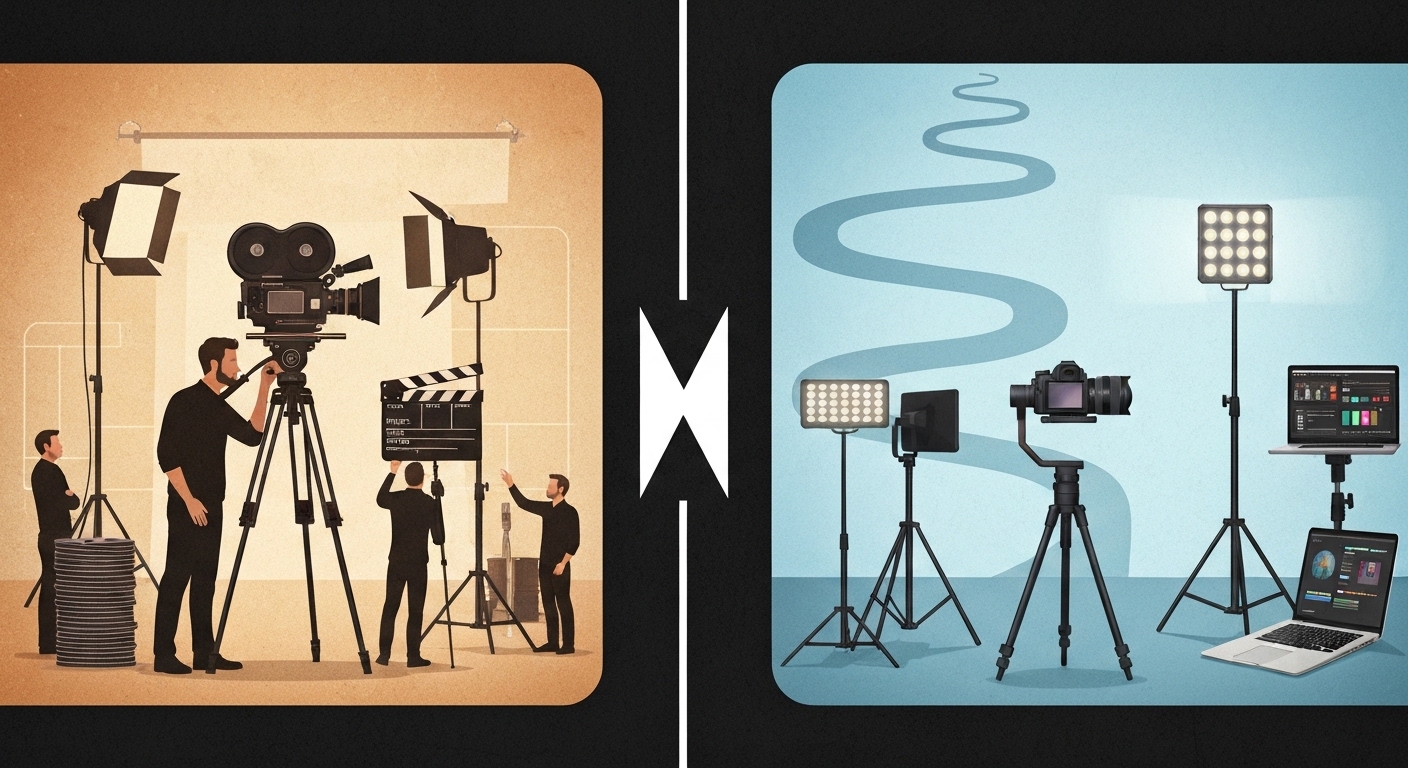
The initial choice between a film and a video format is not a simple technicality; it is the foundational decision that locks in your project's entire creative and logistical trajectory. This choice dictates whether your process will be one of meticulous, layered artistry or agile, targeted execution. The core distinction lies in their inherent goals: film production (encompassing features and narrative shorts) is engineered for narrative depth and cinematic immersion, while video production (including ads, music videos, and corporate content) prioritizes concise messaging and platform-specific flexibility.
This fundamental divergence manifests in every subsequent phase. A film workflow is deliberate and sequential, demanding extensive pre-production planning, shooting with specialized cinema cameras that capture nuanced texture, and a heavy, collaborative post-production process for color grading and sound design. For instance, directors like Christopher Nolan champion film for its organic grain and dynamic range, a choice that necessitates an entire pipeline built to support that aesthetic. Conversely, a video workflow is built for speed and adaptability, utilizing digital capture for instant review, faster edits, and formats optimized for digital platforms where viewer attention is measured in seconds.
Understanding this workflow is essential; for instance, choosing film necessitates a specific creative process that affects everything from on-set monitoring to final color grading. The format decision, therefore, isn't just about the "look"—it's about committing to an entire ecosystem of creation, from the size of your crew to the expectations of your audience.
The student's dilemma: how to master both formats in a single project
For film students, the theoretical difference between film and video becomes a practical challenge: how to develop competency in both seemingly opposed disciplines within the constraints of an academic timeline. The educational dilemma is real—mastering the deliberate, team-based artistry of a short film scene while also executing the quick, clear messaging of a public service announcement. A common curriculum strategy involves direct comparison: students may produce a 10-minute narrative scene requiring character arcs and composed lighting (film format) alongside a 2-minute PSA utilizing fast cuts and direct address (video format).
This hands-on approach reveals critical lessons. The film project teaches the non-negotiable value of pre-production planning and specialized roles, while the video project emphasizes agility, quick decision-making, and the polish achievable with a smaller crew. As one industry educator synthesizes, "The educational goal isn't to choose a side, but to understand the language of both. A director who knows the cost—in time, people, and money—of a cinematic shot can make smarter, more creative choices even when working on a 60-second social video."
As our expert suggests, the key is structured learning; a comprehensive student film production guide can provide the step-by-step framework to master both formats effectively. This dual-format mastery is what makes graduates adaptable, allowing them to navigate the hybrid demands of the modern media landscape.
Team size & scale: the hidden cost of choosing artistry over agility
The trade-off between "artistry" and "agility" is most visibly quantified in the size and structure of your production team. This is where the hidden operational costs of your format choice become explicit. Film production is synonymous with scale, requiring large, specialized crews—often dozens to hundreds—with clear hierarchies (director, cinematographer, gaffer, sound mixer). This structure is not bureaucratic overhead but a necessity to achieve the high-fidelity visuals and complex sound required for cinematic immersion.
In stark contrast, video production thrives on lean, agile teams. A typical corporate or commercial video crew may consist of 1 to 10 people wearing multiple hats—the director might also operate the camera, and the producer may handle basic audio. This model is accelerated by technology; over 60% of video teams in 2026 utilize AI-assisted tools for editing, color correction, and even sound mixing, effectively reducing the need for specialized crew members in post-production and allowing for faster turnaround.
This agility often comes from a streamlined team structure; understanding the core independent film crew roles shows how a small, agile crew can maintain high creative standards. The "cost" of choosing film's artistry is this mandatory investment in human capital and coordination time. The benefit of video's agility is speed and resource efficiency, but it requires team members to be versatile generalists.
Audience & purpose: how to match your format to your viewer's mindset
Your format must be engineered for your audience's psychology and the core purpose of your project. This is a strategic alignment, not an artistic whim. Film production targets an audience in a mindset of immersion. Whether in a theater or on a streaming platform, the viewer seeks entertainment, narrative escape, and emotional journey. The purpose is long-form storytelling and character depth, catering to psychographics of "narrative seekers" who value prestige and experiential depth.
Conversely, video production serves audiences in a mindset of utility or quick engagement. Viewers on social media or a company website are often seeking information, a quick emotional hit, or a solution. The purpose is branding, promotion, or direct instruction. In 2026, this is increasingly data-driven and hyper-personalized; video content is tailored to niche demographic segments (e.g., B2B decision-makers) and adapted using AI insights to maximize impact within the first few seconds.
For example, a cinematic brand film for a luxury product aligns with the film format to build emotional prestige, while a step-by-step software tutorial demands the clear, concise language of video. For example, a corporate training video requires a different approach than a cinematic short; a deeper analysis of your target audience for video content is crucial to truly match the viewer's mindset. Misalignment here—using a slow-burn filmic approach for an Instagram ad—guarantees your message will be skipped.
Your at-a-glance decision matrix: 3 core differences compared
When time is short, base your critical format decision on these three inviolable pillars:
| Category | Film Production (Long-Form Narrative) | Video Production (Short-Form/Promotional) |
|---|---|---|
| Core Workflow | Elaborate, sequential process with heavy pre- & post-production. Meticulous shooting for cinematic standards. | Flexible, agile digital-first process. Fast capture and rapid editing for platform delivery. |
| Team Structure | Large, specialized crew (dozens-hundreds) with defined hierarchical roles. | Small, agile team (1-10) with multi-role collaborators, aided by AI tools. |
| Audience & Purpose | Immersive entertainment for narrative-seeking viewers. Purpose: storytelling and prestige. | Targeted messaging for audiences seeking info/engagement. Purpose: promotion, instruction, or branding. |
From theory to practice: your action plan based on project goals
Translating this framework into action requires a clear-eyed assessment of your primary project goals. Begin by asking: Is the core objective long-form emotional immersion or short-form impact and conversion? Your answer dictates the path.
If your goal is artistic expression, narrative depth, and cinematic prestige, you are choosing the film path. Your action plan must then accommodate a larger budget, a longer timeline, and a workflow built for collaboration and high-fidelity results. If your goal is efficient messaging, rapid production, and direct audience action, the video pathway is your strategic choice. Your plan will leverage agile teams, digital tools, and a post-production pipeline optimized for speed, potentially utilizing the AI tools now adopted by over 60% of professional video teams.
As the industry insight clarifies, "Film is rooted in tradition, artistry, and prestige, while video is fast, flexible, and accessible." This isn't a value judgment but a map. Use the decision matrix to diagnose your project's needs. For straightforward goals, the path is clear. However, for complex, hybrid, or high-stakes projects—like a campaign requiring both a cinematic brand film and a suite of agile social videos—navigating these principles successfully often benefits from expert consultation to tailor the framework to your specific vision and constraints.
Conclusion
You've just navigated the strategic blueprint that separates a project with impact from one that misses its mark. We've moved beyond simple definitions to map the critical operational DNA that defines your project's success, from the foundational workflow to the final viewer's mindset.
Now, picture the result: a project where every dollar and hour is optimized because the format—film's immersive artistry or video's agile precision—is perfectly engineered for your goals. The proof is in the data: aligning with the video production path lets you leverage the AI tools adopted by over 60% of teams in 2026 for rapid, cost-effective execution. Conversely, committing to the film production route secures the prestige and narrative depth that commands audience attention in a crowded streaming landscape. This clarity is your new benchmark for success.
The timeline for this decision is now. The media landscape of 2027 is being shaped by the projects greenlit today. Hesitation has a tangible cost: allocating a large film crew and budget to a project that needed the speed of video, or producing a generic video when your brand story demanded cinematic gravitas. This misalignment wastes resources and dilutes your message when you can least afford it.
Before you move forward, assess your plan against the three pillars:
- Is my core workflow built for meticulous layering or agile iteration?
- Does my team structure reflect a need for deep specialization or versatile collaboration?
- Am I targeting an audience seeking immersion or one demanding immediate utility?
If the answers aren't crystal clear, the financial and creative stakes are too high to guess.
The good news? You're no longer choosing in the dark. The matrix and principles you now possess demystify the process, putting you ahead of the curve. For straightforward projects, your path is clear. For ambitious, hybrid, or high-stakes campaigns that demand both cinematic scale and digital agility, the final step is to pressure-test your strategy with a specialist.
Discuss your specific project goals with our production strategists to validate your format choice and build a bulletproof plan. 🎬