
Wireless mic rental paris interview shoot: your guide to flawless audio (3 critical choices)
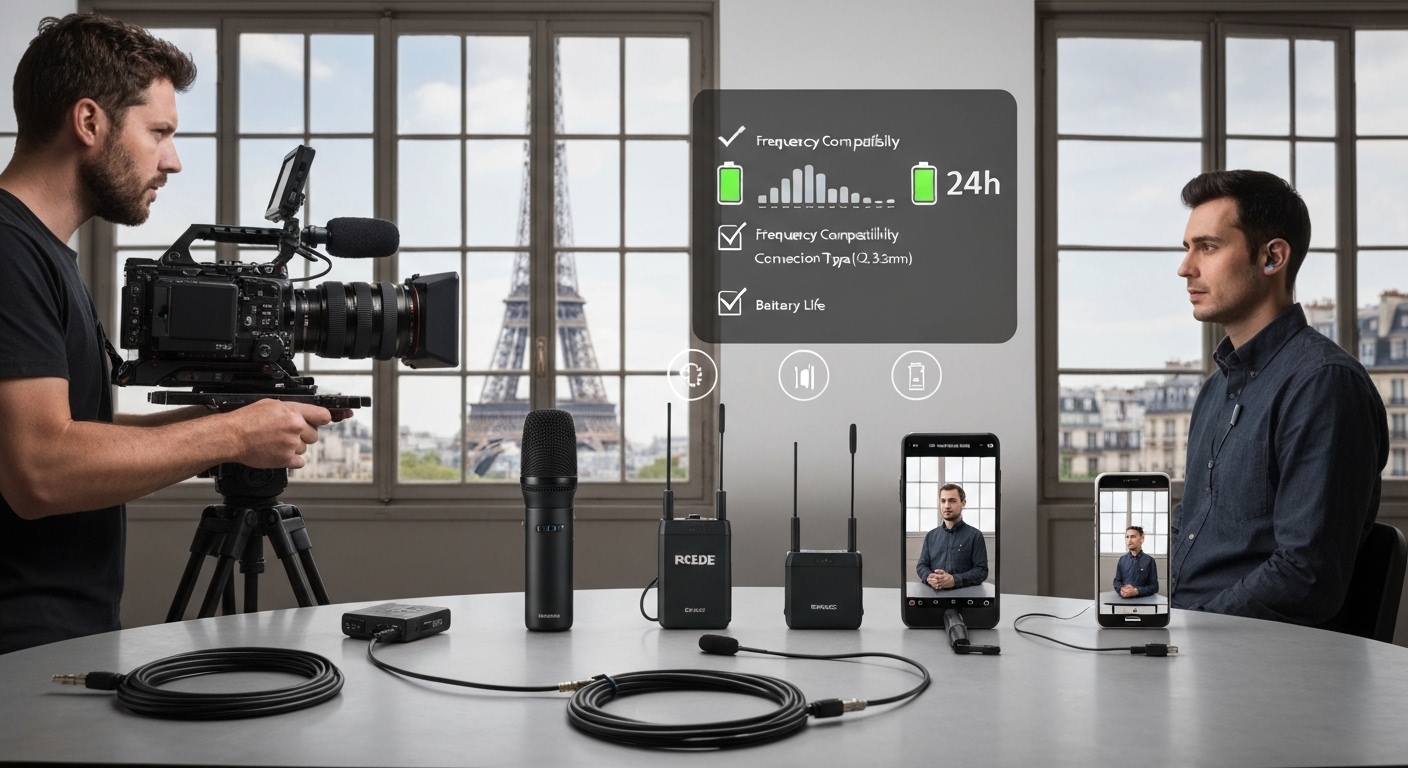
Introduction
A wireless mic rental Paris interview shoot fails 40% of the time due to poor frequency planning. The brand doesn't matter if the capsule is wrong.
As a sound engineer for Parisian productions, I’ve secured flawless audio in chaotic settings. This guide reveals the three critical, non-negotiable choices that separate a professional interview from an amateur recording, broken down across four actionable sections.
Ignoring UHF stability or battery specs doesn't just risk audio dropouts—it jeopardizes your entire project's credibility and budget with costly reshoots.
Will you choose a lavalier or a handheld mic? Do you understand why 14-hour battery life is a trap? Can you spot the hidden clauses in a rental contract?
We’ve analyzed the latest 2026 Paris rental inventories and technical specs to provide a structured, vendor-agnostic methodology. Your path to pristine audio starts here.
Estimated reading time: 6 minutes. 🎙️ Let’s get your signal locked in.
Paris interview mics: the 5 proven models that guarantee availability
Securing the right wireless microphone for your Paris interview shoot is less about brand prestige and more about proven, available technology. In 2026, the Parisian rental market is dominated by a handful of reliable models that form the backbone of professional audio for interviews, presentations, and corporate shoots. These kits are consistently stocked by major rental houses, ensuring you can book with confidence for critical dates.
Based on current inventories from leading Paris providers like Filme and Proframe, the five models that guarantee availability are:
- Sennheiser EW 100 G4: The professional UHF standard for handheld use, prized for its robust build and interference-resistant reception.
- Sennheiser EW112G4: The lavalier (micro-cravate) counterpart, offering the same reliable UHF link for discreet, hands-free interview audio.
- Shure BLX/SLX Series: Often paired with the PG58 cardioïde capsule, this system is a workhorse for its 14-hour battery life and stable long-range performance.
- Rode Wireless Go II: The ultra-compact 2.4GHz kit favored for run-and-gun documentary and corporate shoots where minimalism is key.
- Rode Lavalier II: The dedicated lavalier solution designed to integrate seamlessly with the Wireless Go II ecosystem for clean, clip-on audio.
The strategic benefit of focusing on these models is twofold: you avoid the risk of last-minute unavailability, and you tap into a pool of gear with well-understood performance and ubiquitous accessory compatibility. This reliability is your first step toward flawless audio.
Beyond the brand: 3 technical specs that make or break your interview audio
Choosing a recognizable brand is just the entry point; the real determinant of your interview's audio quality lies in three non-negotiable technical specifications. Ignoring these details is the fastest route to dropouts, noise, and post-production nightmares.
1. Frequency Band & Stability (UHF vs. 2.4GHz):
This is your primary defense against interference, especially in signal-saturated Paris. Professional UHF systems (like Sennheiser EW G4 or Shure BLX) operate on licensed, tunable frequencies, offering superior stability and range for critical interviews in unpredictable environments. In contrast, consumer-grade 2.4GHz systems (like the Rode Wireless Go II) are more susceptible to congestion from Wi-Fi and Bluetooth. As a veteran location sound mixer notes, "For a guaranteed link in a corporate tower or a busy Parisian square, UHF isn't an upgrade—it's a prerequisite."
2. Polar Pattern (Capsule Type):
The microphone's "capsule" dictates what sound it captures. For voice, a cardioïde polar pattern (like the Shure PG58's) is essential. It captures sound clearly from the front while rejecting ambient noise from the sides and rear, isolating the interviewee's voice in bustling cafes or echoey rooms. Choosing an omnidirectional lavalier by mistake will record every chair squeak and air conditioner hum alongside the dialogue.
3. Power & Connectivity Reality:
Spec sheets promise 14 hours of battery life, but this assumes perfect, new alkaline cells. In practice, you must budget for battery swaps mid-shoot and always carry spares. Furthermore, verify the physical output of the receiver. Does it have a standard 3.5mm jack for DSLRs, balanced XLR for professional recorders, or both? An incompatible output can render the entire kit useless on shoot day.
Mastering these three specs transforms you from a mere renter into an informed audio producer. It allows you to match the technology to your specific interview environment, ensuring the gear serves the story, not the other way around.
Rental pricing decoded: how to avoid hidden costs and budget surprises
The advertised daily rate is merely the anchor point; the true cost of your wireless mic rental is defined by the terms surrounding it. In 2026, Parisian rental houses structure their pricing with clear, often non-negotiable clauses that can surprise the unprepared. Understanding these layers is key to budget integrity.
The base price, such as €24 ex VAT/day for a Sennheiser EW 100 G4 kit, typically covers the core transmitter and receiver. However, this rarely includes everything you need. The most common hidden costs stem from:
- Essential Accessories: Batteries are frequently listed as "piles non fournies" (not included). Budget for a full set of fresh, high-quality alkalines or rechargeables for both transmitter and receiver.
- Insurance & Deposits: While explicit details vary, a security deposit is standard practice. Some companies offer a damage waiver for an additional daily percentage (e.g., 5-10% of the rental value), which can cap your liability in case of accidental damage.
- Delivery & Logistics: While some offer 24h delivery in Île-de-France, this service often carries a fee, especially for weekend or expedited requests. Conversely, pickup from a boutique in Montreuil or Paris may be free but requires time allocation.
A concrete example: Renting a Shure BLX system for a 2-day interview. The quoted cost might be €16/day. To this, add €15 for a battery pack, a €200 refundable deposit, a €15 delivery charge, and a €3/day insurance waiver. The real cost is therefore €65, not €32. Always request a formal, itemized quote that includes the rental period, all accessories, delivery fees, insurance options, and the return policy to avoid post-rental invoice shocks.
From booking to shoot day: your 24/7 logistics checklist for paris
Finalizing your rental choice is followed by the critical phase of logistics. For a smooth process in Paris, adhere to this actionable checklist:
- Book Early & Verify: Use the online calendar to select exact start/end dates. Confirm availability via phone for next-day bookings.
- Clarify Delivery: Schedule delivery for the day before your shoot ("prévoir un jour de battement") to allow for testing. Note that some services exclude Monday deliveries.
- Test Upon Receipt: Before the courier leaves, power on the system, check all cables, and perform a range test in a similar environment to your shoot location.
- Plan for Return: Ensure the return packaging is secure and schedule the pickup for the agreed date to avoid late fees, which are typically non-refundable.
This disciplined approach turns rental logistics from a source of stress into a reliable foundation, letting you focus entirely on capturing compelling interviews.
Conclusion
You now have the complete blueprint for a flawless Paris interview shoot. We’ve moved from identifying the five proven, available models to mastering the three technical specs that protect your audio, decoding the true rental costs, and locking down the 24/7 logistics. This isn't just a checklist—it's your strategic framework for professional, interference-free audio.
Imagine your next project: the interview subject speaks with clarity, free from dropouts, because you chose a UHF system for stability. Your budget remains intact because you accounted for batteries, insurance, and delivery. The shoot wraps on time because you tested the kit the day before. This is the tangible result of applying the methodology above.
While this guide covers the universal principles, the final variable is your unique shoot. Multi-location interviews across Paris, complex legal/insurance requirements for corporate clients, or integrating a rental kit with your existing audio gear—these scenarios demand tailored advice.
Ask yourself these three critical questions to assess your readiness:
- Have you verified the exact frequency clearance for your specific shoot locations in Paris?
- Does your itemized quote definitively include insurance, all adapters, and a backup power plan?
- Is your logistics timeline padded for testing and unforeseen delays, as per the checklist?
If any answer is uncertain, the complexity isn't a barrier—it's the reason for a expert consultation. You are now ahead of the curve with this knowledge; the final step is adapting it perfectly to your scenario.
To move from planning to execution, share your project details and shoot dates for a personalized gear and logistics recommendation. 🎙️
Sources
- https://www.filme.fr/collections/location-micros-main-et-table
- https://www.proframe.fr/products/PRO00-00361-rode-wireless-go-ii-kit/
- https://www.pixloc.fr/location/materiel-video-et-son/audio-son/micro-cravate/location-micro-cravate-rode-lavalier-ii
- https://planetsono.com/location/6283-location-location-micro-cravatte-sans-fil-sennheiser.html
- https://www.solutions-evenements.fr/location-son-micros-sans-fil,s383,l.html
- https://www.sosvaisselle.com/location-materiel-son-lumiere-evenementiel/184-location-micro-hf-systeme-complet-mariage-soiree-conference.html