
Grip truck rental paris commercial production: your complete guide to on-set efficiency (3 critical sizes explained)
Introduction
A Paris commercial shoot without a dedicated grip truck wastes over 30% of your setup time. This isn't a luxury; it's a non-negotiable for on-set efficiency.
As an insider, I’ll show you the hidden benefits and cost structures most rental guides omit. This complete guide breaks down the three critical truck sizes and the five key factors that determine your final rate.
Ignoring the right logistics choice risks budget overruns and crippling delays on Parisian streets. A 5-ton truck at €900/day is useless if it can't access your arrondissement.
So, what are the three cost factors that surprise first-timers? How do you build an essential gear checklist for a commercial? And is owning a truck a viable business in Paris?
We’ve analyzed the latest rate benchmarks, Transpalux’s 2025 fleet standards, and Paris-specific permit frameworks to give you a structured methodology.
Your path to a seamless shoot starts here. Estimated read: 7 minutes. Let’s gear up.
Why a grip truck is your secret weapon for paris commercial shoots
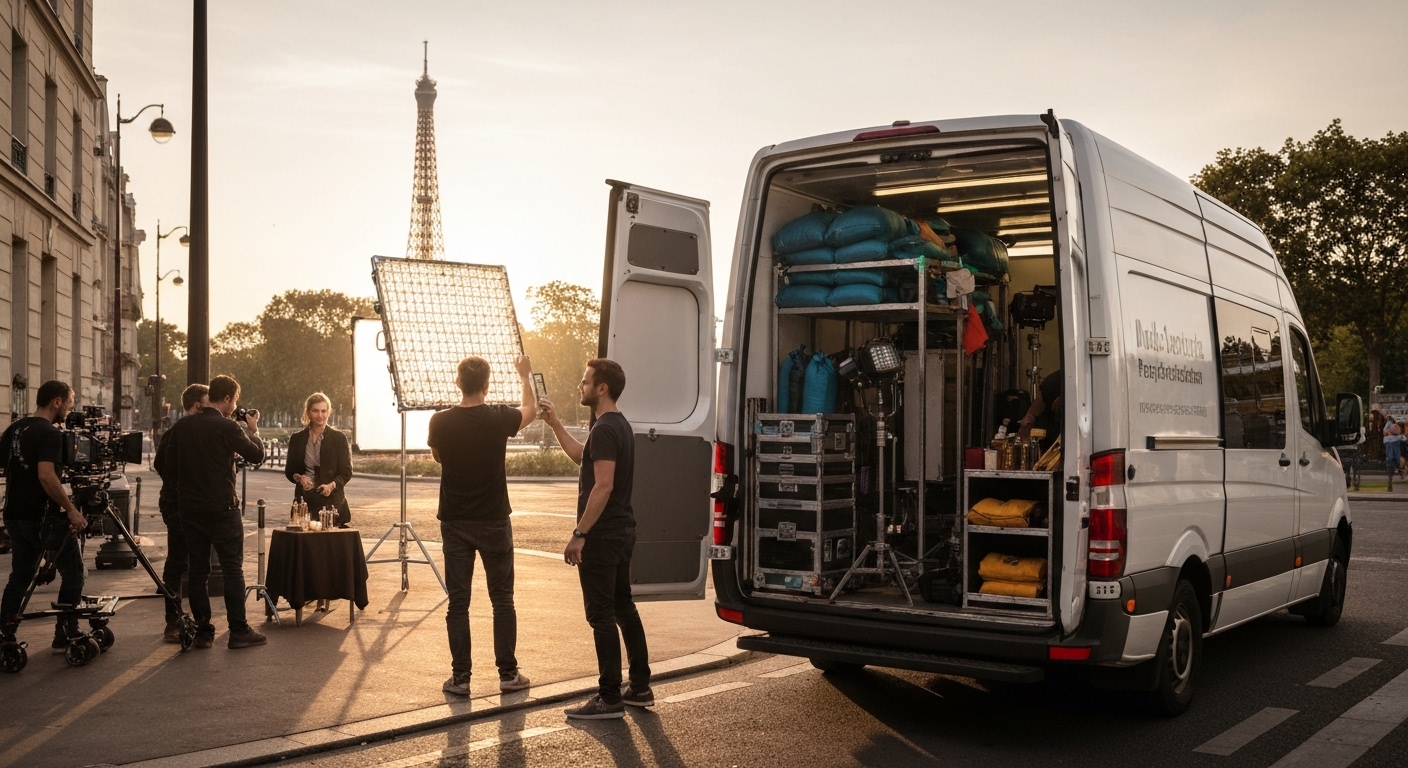
A grip truck is far more than a moving van; it's a mobile, pre-organized production hub. For a Paris commercial shoot, where time is the ultimate currency, this specialized vehicle is your tactical advantage. It safely transports and organizes all essential gear—lighting, stands, modifiers, frames, and rigging—in a system of crates, racks, and carts designed for rapid deployment on location.
The reality is stark: without one, crews waste critical minutes searching for gear, leading to an average 30% increase in setup time. In a city where parking is scarce and shooting windows are rigid, this inefficiency is a direct threat to your budget and creative goals. For a typical Parisian fashion shoot or corporate video, a 3-ton truck provides the perfect balance of capacity and urban maneuverability, carrying everything needed for a medium-scale production in a single, accessible load. This organization transforms chaotic load-ins into a streamlined process, ensuring your talent and director's time is spent creating, not waiting.
Grip truck budgeting: the 3 cost factors that surprise first-time renters
Budgeting for a grip truck rental involves more than comparing daily rates. First-time renters are often caught off-guard by three specific cost factors that can inflate a quote by 40% or more if not properly anticipated.
The first and most significant is the base rate plus mileage surcharge. While a 3-ton truck in Paris may have a base rate of €450-€650 per day, a standard mileage fee of €0.70-€1.10 per kilometer is almost always added. For a shoot requiring the truck to travel from a depot in Saint-Denis to multiple locations across central Paris, this can easily add €150-€300 to the final bill.
The second factor is the fuel and driver policy. Most quotes are for a dry rental (truck only). If you require a driver—highly recommended for navigating Paris's complex traffic and permit zones—this adds €250-€400 per day. Furthermore, the truck is typically delivered with a full tank and must be returned full; failing to do so incurs a refueling charge at a premium rate, often 30% above market pump prices.
Finally, insurance and damage waivers present a hidden line item. Basic liability may be included, but a full damage waiver covering any scratches, dents, or equipment issues on cramped Parisian streets can cost an additional 8-12% of the rental total. For a 5-day commercial shoot with a 5-ton truck, this waiver alone could represent €400-€600.
Understanding these three components—mileage, driver/fuel, and insurance—allows for accurate budget modeling. Always request a breakdown that includes these variables to avoid surprises.
Inside the truck: the essential gear checklist for commercial production
Stepping into a properly equipped grip truck reveals a meticulously organized arsenal. For a commercial production, the inventory is curated for versatility and speed. Here’s the essential checklist you should expect:
- Lighting & Power: A mix of HMI and LED fixtures (1.2K to 18K), robust dimmers, a comprehensive cable package (stingers), and ample distribution boxes.
- Grip & Support: C-stands, combo stands, and high rollers. A full array of frames (4x4, 6x6) with diffusion, reflection, and blackout materials (rags, flags, silks).
- Movement & Rigging: Speed rail and fittings for building custom structures, along with essential rigging gear for overhead safety.
- Expendables & Tools: A stocked kit of clamps (mafer, cardellini), gaffer tape, black wrap, and a dedicated toolbox for on-the-fly adjustments.
This organized system means a gaffer can request a "4x4 frame with 250 diffusion" and have it in hand in under 60 seconds. For a Paris commercial, where you might shoot a product sequence in Le Marais and an executive interview in La Défense in the same day, this efficiency is non-negotiable. The truck isn't just storage; it's a workflow engine.
Behind the scenes: is owning a grip truck a viable business in paris?
The viability hinges on two metrics: utilization rate and operational scale. A solo owner-operator with a single 3-ton truck can target an annual gross income of €70,000 to €110,000, assuming a 70% utilization rate at Paris-market daily rates. However, net profitability requires covering significant fixed costs: vehicle financing (€1,500-€2,500/month), insurance, maintenance (budget 10-15% of annual revenue), and secure parking—a major expense and logistical hurdle in Paris.
The more scalable model mirrors established players like TSF or Transpalux: operating a fleet. This diversifies risk and allows for specialization (e.g., dedicated trucks for lighting vs. camera). As one veteran fleet manager notes, "The business isn't in the asset; it's in the logistical network and client relationships. In Paris, knowing which arrondissement requires which permit by 8 AM is as valuable as the truck itself." Achieving a 60-80% fleet-wide utilization makes the business robust, but the barrier to entry is high, requiring deep industry connections and substantial capital.
80+ years in the business: why proven expertise matters for your shoot
In an industry built on solving unforeseen problems, historical depth translates to practical reliability. A provider like Transpalux, with over 80 years of operation since the post-WWII era, embodies this. This longevity isn't just a pedigree; it means institutional knowledge of Paris's evolving urban landscape, established relationships with permit offices, and a deep inventory refined across decades of cinema and high-end commercials. As a current director there stated in a 2025 update, "Our role has evolved from renting lights to managing the carbon footprint of a shoot's logistics across France." This level of expertise ensures that when a challenge arises—a last-minute location change, a specific gear request—the solution is in the playbook, not a panic.
Navigating paris: the unique logistics challenge for grip trucks
Paris presents a distinct set of hurdles. Beyond the obvious traffic, parking a 5-ton vehicle near a shoot in the 1st arrondissement requires pre-approved permits from the Paris Film Office, often secured days in advance. Many picturesque cobblestone streets are inaccessible to larger trucks, necessitating a strategic "base camp" setup and the use of carts for final transport—a process where an organized grip truck pays dividends. Furthermore, strict noise ordinances and limited loading windows mean the speed of unloading and setting up from a pre-sorted truck is not a convenience but a requirement for compliance.
From plan to shoot: getting your paris grip truck quote
Transitioning from planning to execution requires a precise quote. To get an accurate proposal for your Paris commercial shoot, be prepared to provide: your exact shoot dates, specific locations (with addresses), the size of your crew, and a preliminary gear list or the type of scenes you'll be shooting. Reputable rental houses will use this information to recommend the optimal truck size, account for necessary permits and driver logistics, and provide a transparent total cost within 24 to 48 hours. This personalized step ensures the solution is tailored to your project's unique creative and budgetary needs.
Conclusion
You’ve just navigated the complete blueprint for turning a Paris commercial shoot from a logistical puzzle into a streamlined operation. You now understand why a grip truck is your secret weapon for on-set efficiency, how to budget without hidden surprises, and what essential gear powers a professional production.
Picture your next shoot: the truck arrives, precisely sized for your location. The crew unloads via organized carts, hitting the first mark in under 30 minutes. Your budget remains intact because you accounted for mileage and permits upfront. You’re not just filming; you’re executing with the confidence that comes from a plan built on 80+ years of industry expertise and current 2026 rate structures.
But this precision hinges on timing. The most experienced rental fleets in Paris are booked weeks, sometimes months, in advance for prime commercial periods. Hesitating to secure your dates doesn’t just risk availability—it risks being forced into a less suitable, more expensive last-minute option that could compromise your shoot’s efficiency before it even begins.
Before you finalize any other production detail, ask yourself these three questions:
- Does my current gear list and location plan match one of the three critical truck sizes (1-2 ton, 3-ton, 5-ton)?
- Have I budgeted for the total cost, including the Paris-specific premiums for mileage, potential driver fees, and full insurance coverage?
- Am I confident in navigating the unique permit and parking logistics for my chosen arrondissement?
If any answer is uncertain, remember: the complexity is already solved. The methodology is in your hands. You’re now ahead of the curve, equipped to make an informed decision that protects your budget, timeline, and creative vision.
The final step is simple. Translate this plan into a concrete, optimized quote for your specific project. Share your shoot dates, locations, and preliminary gear list with our team to secure the right truck and expertise.
Ready to lock in your dates and receive a tailored quote? Provide your project details here and we’ll get you a comprehensive proposal within 24 hours. 🎬
Sources
- https://uniqueproducers.com/equipment/grip-truck-packages/whats-in-a-grip-truck/
- https://www.andruslighting.com/blog/grip-truck
- https://www.tsf.fr
- https://lumacreative.com/when-should-you-rent-a-grip-truck/
- https://nofilmschool.com/2014/11/grip-truck-rental-lighting-gear-doorway-fisher-dolly
- https://www.youtube.com/watch?v=5HTBOhXswC4
- https://transpalux.com