
Boom pole and mixer rental paris production: your guide to professional sound without the high cost (3 key scenarios)
Introduction
A professional sound kit in Paris costs over €2,000 to own. Boom pole and mixer rental Paris production is not a luxury—it's a strategic necessity for 2026 budgets.
As an insider, I’ll show you the hidden financial and logistical benefits of rental across three key scenarios.
Ignoring this calculus risks your project's audio integrity and budget. A single day of unusable sound in a historic district can cost thousands in reshoots.
Do you know the two non-negotiable features for a Paris boom pole? Can you navigate the insurance exclusions most rentals have? What’s the real cost difference between a Sennheiser MKE600 and a VDB pole for your shoot type?
This guide analyzes current 2026 rate structures from Parisian rental platforms and fixer services. We provide a structured methodology to match gear to your specific production challenge.
Your path to flawless audio starts in 7 minutes. Let’s cut through the noise.
Why parisian sound recording demands more than just a microphone
Capturing clean dialogue on a Parisian set is an acoustic battle. The city’s dense urban fabric, with its constant traffic hum, café chatter, and echoing cobblestone streets, creates a noise floor that consumer microphones simply cannot overcome. This isn't just about volume; it's about spectral pollution that bleeds into every frequency.
The logistical reality compounds the technical challenge. Shooting in historic districts often requires specific permits coordinated by local fixers, and the narrow streets of Le Marais or Montmartre present severe transport and parking constraints. Attempting to navigate the metro with a full kit, including a long boom pole, is impractical at best. Professional-grade equipment—specifically, highly directional shotgun microphones on boom poles and multi-track field recorders—is engineered to isolate the human voice from this chaos. For productions in 2026, where budgets are scrutinized but quality expectations remain high, accessing this gear without the €2,000-€10,000+ upfront purchase cost for a mixer alone is the first strategic decision. This context makes rental not an option, but a fundamental component of a viable production plan in Paris.
The boom operator's toolkit: 3 financial scenarios where rental beats ownership
The decision to rent professional audio gear in Paris is a calculated financial strategy, not a compromise. Ownership locks capital into depreciating assets and limits flexibility, while rental converts a large capital expenditure into a predictable operational cost. Let's examine three concrete scenarios where the numbers decisively favor rental.
- The Short-Term Project or Test Shoot: You have a corporate video scheduled over two days or a pilot scene to shoot. Purchasing a professional field mixer like a high-end Zaxcom or Sound Devices model can exceed €10,000. In contrast, renting a complete sound kit, including a boom pole and mixer from a Parisian service, runs approximately €450-€830 per day. For a two-day shoot, that's a maximum of €1,660—a fraction of the purchase price, with no long-term commitment or maintenance worry.
- Access to the Latest Technology: Audio technology evolves. The Sennheiser MKE600 shotgun microphone, favored for its high directionality against urban noise, represents a specific tool for a specific problem. Renting allows you to utilize this €500-€1,000 kit for the single project where its 132dB SPL handling and supercardioid pattern are critical, without investing in a mic that may not suit your next documentary in a quiet studio.
- Full-Service Production with Logistics: For complex shoots requiring permits, vehicle hire, and local coordination, bundling equipment rental with a fixer service is economically rational. These services manage transport, parking, and insurance logistics—hidden costs that can cripple a DIY production. The rental fee here includes not just gear, but risk mitigation and time savings, ensuring the sound team focuses on recording, not metro schedules.
In each scenario, rental provides financial agility and technical precision. It transforms equipment from a sunk cost into a scalable resource, perfectly aligned with the variable demands of Parisian production.
A day on set: how a rented boom pole solved a critical paris audio challenge
The call sheet for a fashion film shoot near Place de la République listed a 7:00 AM call time. The scene: an intimate dialogue between two models at a bustling sidewalk café. The sound recordist, Marie, had reserved a Sennheiser MKE600 boom pole set for its 3-meter telescopic reach and superior off-axis rejection. By 7:30 AM, the location's inherent challenge was clear—the low-frequency rumble of the nearby Rue du Faubourg du Temple traffic was overwhelming the lavalier mics.
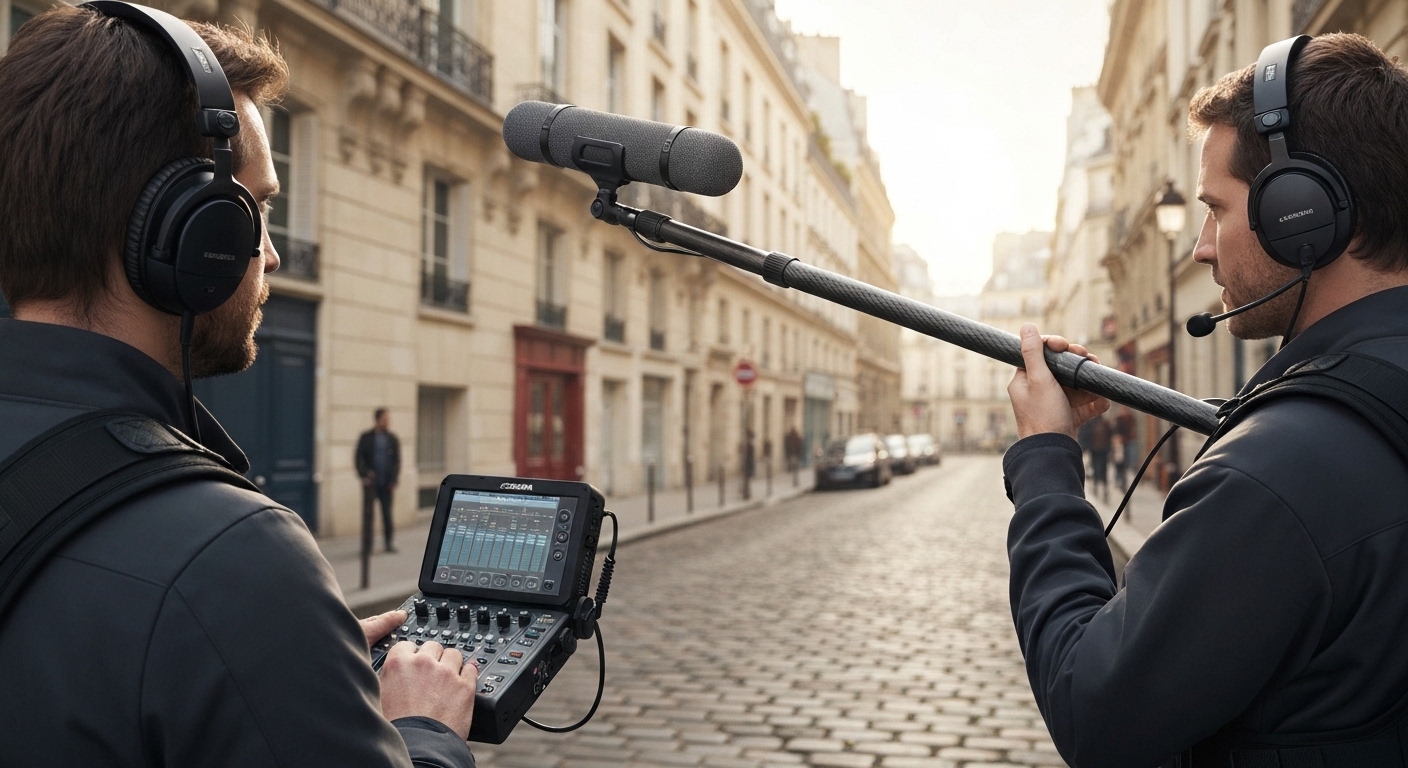
Marie’s solution relied entirely on the rented gear’s capabilities. She extended the lightweight carbon pole to its full length, allowing her to position the supercardioid shotgun microphone just inches above the actors, outside the camera frame. This proximity increased the volume of the desired dialogue relative to the ambient noise. Crucially, the microphone’s directional pattern was angled to reject sound from the busy street to the rear and sides. The rented Zoom F8 field mixer, with its 8 preamps, allowed her to record a safety track from the lavaliers while dedicating the primary track to the pristine, focused audio from the boom.
By the 8-hour day's wrap, the director had clean, usable dialogue tracks. The rental cost for the kit (implied in the standard €450-€830 day rate for a sound mixer with equipment) was justified in a single morning. Ownership of a less suitable pole or mic would have forced a compromise, potentially requiring costly ADR (Automated Dialogue Replacement) later. This day underscored that in Paris, the right rented tool isn't an expense; it's insurance for the entire project's audio integrity.
Expert insights: the 2 non-negotiable features for your paris boom pole rental
Selecting a boom pole for a Paris shoot requires more than checking a box for "audio." Based on consensus from rental house technicians and working sound mixers, two features are non-negotiable for navigating the city's unique demands.
1. Sufficient Length with Telescopic Flexibility: A pole that extends to at least 3 meters is standard for professional work, allowing the operator to maintain a safe distance from the frame while achieving critical microphone proximity. In Paris's cramped interiors or crowded exteriors, this reach is essential. However, it must collapse down to a portable size (~0.8m) for transport on the metro or in a small hire car. A lightweight carbon fiber telescopic model, like those commonly paired with the Sennheiser MKE600, provides this essential range of motion without operator fatigue during a long shooting day.
2. Integrated Shock Mount and Cable Management: "Handling noise is the boom op's silent enemy, especially when navigating uneven Parisian pavements or adjusting quickly in a dynamic shoot," notes a veteran rental manager. A professional boom kit must include a high-quality internal shock mount to isolate the microphone from vibrations transmitted through the pole. Furthermore, internal cable routing is critical. An external cable snagging on a doorway in a historic apartment or flapping in a breeze along the Seine can ruin a take and present a safety hazard. These features aren't luxuries; they are fundamental to capturing clean audio in unpredictable environments.
Ignoring either feature risks compromising your audio quality for marginal cost savings, a trade-off that rarely pays off in post-production.
Navigating paris rental logistics: the checklist most productions forget (until it's too late)
Securing the right gear is only half the battle; the logistical framework for its use is where productions often stumble. A streamlined rental process in Paris requires meticulous attention to details that extend beyond the equipment spec sheet.
- Insurance Verification: Most rental contracts exclude insurance by default. You must provide a certificate of insurance covering full replacement value for theft, damage, or loss. Confirm with your production insurer that rented equipment is explicitly covered under your policy's "rented equipment" or "miscellaneous rental" clause before signing the contract.
- Transport & Access Planning: A 3-meter boom pole case does not fit on a standard Parisian metro. Plan for vehicle hire or dedicated production transport. Services like those offered by French production fixers include logistics coordination, solving for parking permits and loading zone access in restricted districts—a critical and often overlooked time-saver.
- Rate Structure Alignment: Understand the minimum rental periods. Standard structures are Half-Day (4h), Day (7-8h), and Week (5 consecutive days, ~35-39h). A weekly rental typically costs 70-80% of the equivalent daily rate, offering significant savings for shoots longer than three days. Always confirm what "Day" means—is it a calendar day or a 24-hour period?
- Pre-Test & Pick-Up Protocol: Schedule time to test all equipment at the rental house before departure. Check every connection, button, and telescoping section. This is your last chance to identify a faulty XLR cable or a sticky pole collar without being liable for it.
Overlooking these points can lead to last-minute scrambles, unbudgeted costs, and even cancelled shooting time. A proper logistics checklist is your buffer against Paris's inevitable surprises.
Sennheiser mke600 vs. vdb boompole: which model suits your paris shoot type?
The choice often comes down to a balance of mobility and rugged support. The Sennheiser MKE600 kit is a lightweight, integrated solution ideal for run-and-gun documentary or corporate shoots where speed and discretion are key. Its supercardioid mic excels at rejecting ambient urban noise. Conversely, a VDB Medium Boompole system, often part of a heavier-duty "BOOM AUDIO Kit" with a harness, is designed for long-duration narrative film sets where operator stability and comfort over 12-hour days are paramount. The VDB's collars provide superior rigidity for precise, sustained positioning, at the cost of quick mobility.
Conclusion
You’ve just navigated the complete blueprint for securing professional sound without the capital burden in Paris. Think of this guide as your pre-production checklist—it’s moved you from understanding the unique acoustic battlefield of the city to evaluating financial scenarios, and finally to selecting the precise tools and logistics for a flawless shoot.
Now, project yourself to the end of your next production day. Because you chose a rental strategy tailored to your scenario, you’ve captured pristine dialogue, even on a noisy boulevard. Your budget shows a controlled operational cost instead of a five-figure capital outlay, and you’ve sidestepped the logistical nightmares of transport and insurance gaps. The data confirms it: renting a full professional kit for a 2-day shoot (approx. €1,660) versus buying a mixer alone (over €10,000) isn’t just savings—it’s strategic capital allocation for the rest of your production.
The timeline for action isn’t set by a tax change, but by your production calendar. The cost of inaction is measured in the €2,000+ per day for reshoots if your audio is compromised, or in the lost time managing gear logistics when you should be directing talent.
Before you finalize your equipment list, ask yourself three critical questions:
- Does my current plan account for the insurance exclusion clause common in rental agreements, or am I personally liable for a €1,500 boom pole on a crowded set?
- Have I matched the boom pole model—be it a mobile Sennheiser MKE600 or a stable VDB system—to my specific shoot type and location mobility needs?
- Is my transport plan for gear in central Paris viable, or does it risk a critical delay on the morning of the shoot?
The complexity ends here. You now possess the framework to make an informed, confident rental decision. The steps are clear, the data is current, and you’re ahead of the curve.
To move from planning to execution, discuss your specific project timeline and location challenges with our team for a tailored gear and logistics quote. We’ll ensure your rental strategy is as flawless as your audio.
Sources
- https://www.frenchproductionservice.com
- https://chezfilms.com/en/prices-film-production
- https://www.711rent.com/en/rent/product/sennheiser-mke600-boompole-set
- https://www.gearbooker.com/rent-audio-recorders-zoom-f8-recorder-in-paris-13951-l
- https://www.dcaudiovisuel.com/tip_info.php/language/en/tips_id/7
- https://www.dcaudiovisuel.com/product_info.php/products_id/301/language/en