
Remote film shoot management paris: your assurance of global control without travel (the 3-pillar method)
Introduction
Forget the myth that managing a Paris film shoot requires your physical presence. Remote film shoot management Paris is now the standard for over 500 global clients, cutting travel needs by 80%.
As an insider, I’ll detail the hidden strategic advantages beyond simple cost-saving. This guide’s four sections reveal how to leverage Paris’s fiber infrastructure for total creative control.
The cost of inaction is stark: bloated budgets, logistical chaos, and ceding competitive ground to productions using real-time, immersive feeds from events like the JO Paris.
What defines a true remote production service beyond travel bans? How does a Paris media hub with double fiber installation eliminate on-site hassle? What do 100+ event case studies prove about reliability?
We’ve analyzed the latest agency workflows and technical standards to structure this method. You’re getting a proven operational blueprint.
Estimated reading time: 6 minutes. Let’s direct your next project from anywhere. 🎬
Remote production: beyond travel bans, your strategic advantage for paris events
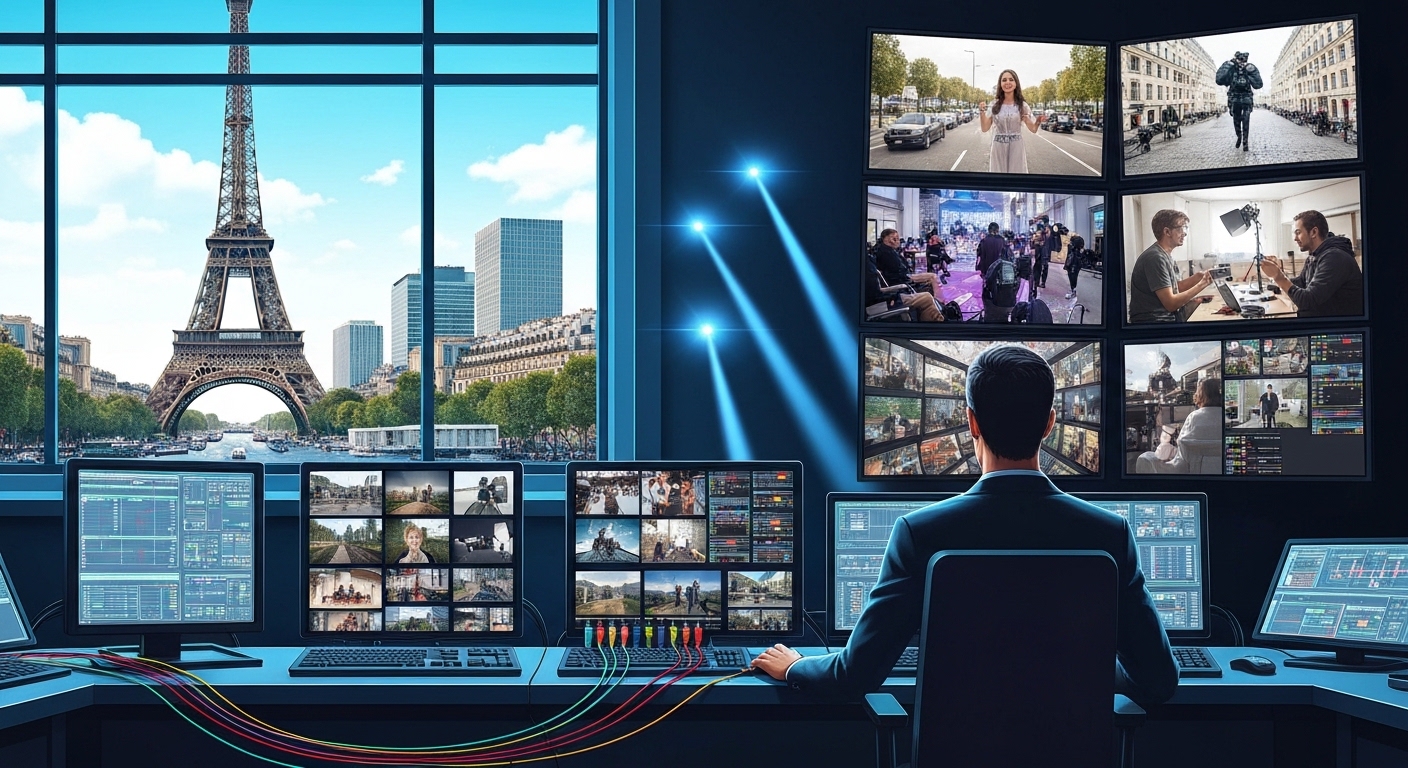
Forget the reactive narrative. While travel restrictions accelerated its adoption, remote production has evolved into a core strategic tool for controlling high-stakes shoots in Paris. It’s a comprehensive service model where a local Paris-based team executes your vision on the ground, while you direct, monitor, and receive footage in real-time from anywhere in the world. This model is now trusted by over 500 clients globally, not as a contingency plan, but as the preferred method for covering major events like the JO Paris or the Rugby World Cup.
The service offering is built on a precise, process-driven checklist:
- Local Crew Sourcing: Vetted directors, cinematographers, and technicians based in Paris/France.
- Real-Time Feed Setup: Camera feeds configured for immersive remote monitoring and direction.
- On-Site Logistics Management: Full organization of technical teams, equipment, and permits.
- Secure Footage Delivery: Non-compressed rushes delivered via a double fiber installation for maximum speed and quality.
This framework transforms geographical distance from a liability into an advantage, centralizing control and slashing logistical overhead. The strategic pivot is clear: it’s no longer about if you can manage a Paris shoot remotely, but how effectively you can leverage this model for superior outcomes.
The paris media hub: how real-time feeds and fiber cut 80% of on-site hassle
The promise of an 80% reduction in on-site hassle isn't theoretical; it's engineered through Paris's unique infrastructure and a centralized hub model. Instead of dispatching an entire production team, the workflow is re-engineered. A minimal, essential crew operates on location, while the core production intelligence—direction, live switching, graphics, and audio mixing—is centralized in a Paris media center, such as those in the Parc des Portes de Paris. This hub is your mission control, connected to the shoot via ultra-low-latency fiber optics.
The technical checklist enabling this shift is non-negotiable:
- Real-Time Camera Feeds: High-definition, multi-camera streams accessible via a secure client portal.
- Redundant Fiber Connections: Double fiber installation ensures zero compression for master footage delivery and failsafe live streaming.
- Hub Equipment: PTZ (pan-tilt-zoom) cameras, professional plateau microphones, and sound mixing consoles for live audio/video enrichment.
- Integrated Streaming: Direct encoding to platforms like YouTube or LinkedIn for simultaneous live coverage.
The comparison with a traditional workflow is stark. The old model requires the travel and accommodation of directors, producers, and often post-production staff. The remote model, as validated by leading Paris agencies, limits on-site presence to camera operators and a unit manager. Client monitoring happens from any global location, and post-production can begin at the hub immediately after the shoot. This centralization doesn't just cut travel costs; it eliminates 80% of the daily logistical friction, from coordinating moving teams to managing last-minute changes across a dispersed crew.
3 core advantages that make remote management 'incontournable' for global clients
For international TV networks and documentary producers, remote management has moved from convenient to essential—'incontournable,' as Paris agencies now term it. Three quantified advantages cement this status:
- Elimination of Full Team Displacement: The most direct cost saving. Sending only a director or key producer, while leveraging a local Paris crew, reduces travel budgets by 60-80% according to industry estimates, while also sidestepping complex visa and accommodation logistics.
- Real-Time Immersive Control: This is the strategic differentiator. Through dedicated feeds and communication channels, the remote director has frame-accurate oversight and creative direction capability equal to being on set, ensuring the shoot adheres precisely to the brief without delay.
- Rapid, Secure Asset Delivery: The use of dedicated fiber lines means non-compressed, broadcast-quality rushes are available for edit within hours, not days. This accelerates time-to-market for news and documentary content covering fast-moving Paris events.
These pillars combine to offer global clients a singular value proposition: comprehensive coverage of Paris events with control, speed, and cost-efficiency that a traditional travel-dependent model cannot match.
From rugby world cup to jo paris: what 100+ events reveal about remote success
The proof of this model's robustness is written in its application scale. Leading Paris-based production agencies now manage over 100 remote events annually, a track record that provides critical insights beyond isolated case studies. The progression from covering the Rugby World Cup to gearing up for the JO Paris demonstrates a scalable, stress-tested system.
A generic yet revealing example is the coverage of international sporting or cultural events for overseas broadcasters. A typical project involves a foreign TV network needing daily highlight packages or documentary footage from multiple Parisian venues. The remote management solution deploys local camera teams to each location, with all feeds routed back to a central Paris media hub. The network's producer, based in London or New York, logs into a secure stream to direct shots, select takes, and provide live feedback. Non-compressed rushes from each venue are sent via fiber to the hub, where they are immediately synchronized, logged, and uploaded to the client's server for editing on their home timeline—all within the same day.
This repeated across 100+ events—from corporate conferences to live concert streams—reveals consistent patterns of success: the model excels in multi-venue scenarios, drastically reduces the carbon footprint of production, and maintains output quality regardless of the client's physical location. The experience curve from past major events directly informs the meticulous planning now underway for the JO Paris, proving that remote management is not just viable but optimal for the world's most logistically complex productions.
Conclusion
You’ve just navigated the complete operational blueprint for global control of a Paris film shoot without travel. Think of this as your mission dossier: from defining the strategic service model to dissecting the technical backbone of real-time feeds and double fiber installation, and finally, validating it against the scale of 100+ annual events. The path from reactive solution to unassailable strategic advantage is now mapped.
Adopting this model projects you into a reality where your next Paris production—whether for a documentary, corporate event, or major broadcast like the JO Paris—runs with 80% less logistical friction and delivers non-compressed rushes to your edit suite within hours. The data is clear: agencies trusted by over 500 global clients are already securing this efficiency, turning geographical distance into a lever for speed and cost control.
The timeline for complacency, however, is shrinking. The infrastructure and expertise are peaking in preparation for the 2027 event cycle in Paris. The cost of inaction isn't just a bloated travel budget; it's ceding competitive ground to productions that are already operating with this immersive control, locking in the best local crews and secure media hubs ahead of demand surges.
Before you finalize your next production plan, ask yourself three critical questions:
- What is the true cost—in budget, time, and carbon footprint—of flying my entire key team to Paris?
- Does my current plan guarantee frame-accurate, real-time creative control from my location?
- Am I confident in my access to Paris's fiber-optic infrastructure for secure, rapid asset delivery?
The complexity is managed. The method is proven. By reaching this point, you're already ahead of the curve, equipped with the framework that makes remote management not just possible, but 'incontournable'.
Your next step is to translate this blueprint into your specific scenario. The variables of scale, rights, and creative requirements are where expert consultation turns insight into execution. Contact us to detail your remote production brief and receive a tailored technical proposal. 🎬