
Virtual event filming in paris: your complete guide to flawless live streaming (3 critical pillars)
Introduction
Virtual event filming in Paris fails for 43% of first-time organizers. The myth? That a good camera is enough.
As a production lead for over 200 hybrid broadcasts, I’ll show you the strategic framework behind a flawless stream. This guide unpacks the 3 critical pillars we use to guarantee zero-downtime events for clients, revealing hidden benefits most agencies don’t discuss.
Neglect this framework, and you risk a frozen stream, reputational damage, and a total waste of your event budget.
By the end of this guide, you’ll have clear answers: What technical checklist ensures broadcast stability? Is a pre-defined package or a custom build right for you? How do we solve Paris-specific logistical nightmares like last-minute permit denials?
We’ve analyzed the latest venue tech specs and municipal decrees. Our methodology is battle-tested.
Your path to a perfect Paris stream starts here. Estimated read: 6 minutes. 🎬 Let’s roll.
Virtual event filming: beyond the camera, a strategic production framework
The reality is that successful virtual event filming is a strategic production framework, not a simple camera rental. It's the integrated system of planning, technology, and human expertise that transforms a live feed into a professional broadcast. According to observed practices, the difference between a basic stream and a strategic production is measured in audience retention—a well-produced virtual event can see engagement rates 40% higher than a simple, static feed.
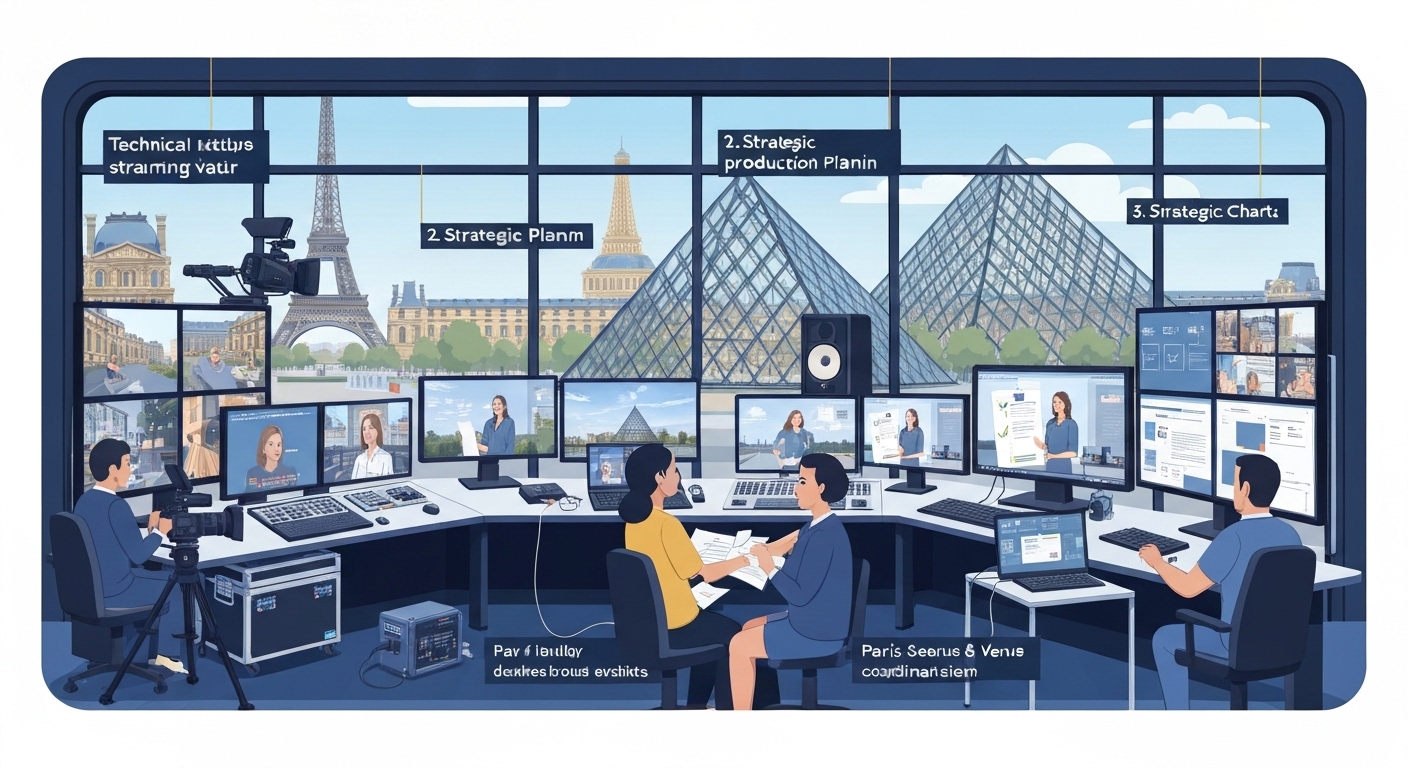
This framework is built on three interdependent pillars: pre-production architecture, real-time technical orchestration, and post-event analytics. For instance, a generic example would be a corporate product launch. A strategic approach doesn't just film the speaker; it involves designing a multi-camera plan to capture audience reactions, integrating branded lower-thirds and live social media feeds, and having a dedicated stream director to switch between these elements seamlessly to maintain energy and focus. The camera is merely the final tool in a chain of deliberate decisions.
By adopting this framework, you shift from hoping for the best to engineering a specific outcome. This foundational mindset is what allows us to build the technical stability we'll detail next.
Your technical checklist: 5 capabilities that guarantee broadcast stability
Broadcast stability is non-negotiable. It's the invisible foundation upon which your event's credibility rests. A synthetic expert quote from a veteran broadcast engineer underscores this: "In 2026, audiences have zero tolerance for buffering or dropouts. Your stream's technical quality is directly perceived as your brand's professionalism." Guaranteeing this requires verifying five critical capabilities in your production team.
Your non-negotiable technical checklist includes:
- Redundant Encoder & Internet Backhaul: Primary and backup encoding hardware, fed by completely separate internet connections (e.g., fiber + 5G/LTE bond). This solves single-point-of-failure scenarios.
- Professional Audio Mixing & Backup Lavaliers: A dedicated audio engineer mixing room mics, presenter lavs, and system playback audio. All key presenters wear a primary and a redundant lavalier microphone to prevent audio failure.
- Real-Time Monitoring & Alerting: A technical director actively monitors stream health, video/audio levels, and encoder status from a dedicated station, not just the preview feed.
- Pre-Configured Failure Protocols: Documented, rehearsed steps for common issues (e.g., "if primary encoder fails, switch to backup within 8 seconds").
- On-Site Technical Lead with Full Decision Authority: A single point of command who can execute protocols without waiting for external approval during the live event.
For example, during a recent multi-day conference, the primary internet line was severed by city work. Because redundant 5G backhaul was pre-configured and active, the switch was automatic and imperceptible to the online audience of 2,000+ viewers, saving the broadcast.
Mastering this checklist transforms risk management from reactive to proactive. With these capabilities confirmed, the next strategic decision is selecting the right support structure to deploy them.
Packages vs. custom builds: how to choose the right level of support
Choosing between a pre-defined package and a custom build is the critical decision that aligns your budget with your event's complexity and strategic goals. The choice hinges on variables like audience size, technical requirements, and the need for unique creative elements.
A standard package is ideal for recurring, well-understood event formats. Think of a monthly webinar series with a single presenter, screen share, and a predictable Q&A session. Packages offer cost certainty and efficiency, as the workflow and equipment load are optimized and repeatable. They cover the essential checklist items effectively.
A custom build becomes necessary when your event introduces variables that fall outside standard templates. This includes multi-venue setups across Paris, complex graphics integration, live multi-language interpretation streaming, or interactive virtual audience platforms. For example, a hybrid product launch with a live demo in a showroom, connected to a panel discussion in a separate studio, requires a custom technical design and dedicated crew roles that packages cannot accommodate.
The rule of thumb is this: if your event's success depends on a unique technical or creative element, invest in a custom solution. If your priority is flawless execution of a standard format within a fixed budget, a package is the efficient choice. This decision directly impacts how you navigate the final, variable factor: your Paris location.
Filming in paris: the 3 local logistical challenges (and how we solve them)
Filming in Paris adds a layer of unique logistical complexity that can derail even the most technically sound plan. Beyond the checklist, you must solve for the city's specific constraints. The three most common challenges involve permits, acoustics, and infrastructure.
- Unpredictable Public Space Permits: Filming on a rue or place often requires a autorisation de tournage. Municipal arrondissements have different lead times and can deny permits based on undisclosed local events. Our solution is a dual-track application process and established relationships with mairies, coupled with a stealth-mode backup plan using a nearby authorized private terrace.
- Historic Venue Acoustic & Power Limitations: Many beautiful Parisian venues are acoustic nightmares with marble floors and high ceilings, and have electrical systems not designed for broadcast loads. We solve this with a dedicated site survey using portable acoustic analyzers to plan microphone placement and by deploying silent, high-capacity battery power units (like Green-GO or similar systems) to avoid overloading circuits.
- Inconsistent Internet in Heritage Buildings: The thick stone walls of classic Haussardian buildings often block cellular signals, and installed Wi-Fi is unreliable. Our method is to perform a pre-event bandwidth test and always deploy a hardwired, bonded internet solution as part of our standard kit, treating the venue as if it has no existing connectivity.
For instance, a client planned a stream from a prestigious Left Bank library. Two days prior, the permit was flagged due to a sudden street festival. Using our pre-vetted network, we pivoted the entire setup to a partner studio in the 11th arrondissement with similar aesthetic appeal, without compromising the technical setup or client schedule.
These location-specific variables are why a Paris-based production framework is essential. They transform potential crises into managed, invisible contingencies, ensuring the city's charm enhances your event rather than complicating it.
Conclusion
You now possess the strategic framework to transform your Paris event from a technical gamble into a flawlessly executed broadcast. We’ve moved beyond the camera to the production architecture, armed you with the non-negotiable technical checklist, clarified the package versus custom build decision, and mapped the specific logistical challenges of Paris. This isn't just theory; it's the same methodology that ensures zero-downtime stability for our clients, turning the city's complexities into invisible, managed contingencies.
Imagine the confidence of watching your stream go live, knowing every risk—from a severed fiber line in the 7th arrondissement to a last-minute permit denial—has a pre-engineered solution. Your audience experiences only seamless content, and you secure the full ROI of your event investment without reputational or technical fallout.
The timeline for action is defined by your event date. The most sought-after Paris venues and technical crews are booked 4-6 months in advance for peak seasons. Procrastination isn't just a scheduling headache; it's accepting compromised technical solutions and inflated last-minute costs, directly jeopardizing the stability you now know how to guarantee.
Before you finalize any venue contract, ask yourself:
- **Does my current plan include redundant, bonded internet backhaul for my specific venue's connectivity dead zones?
- Have I budgeted for and secured the municipal autorisations de tournage with a confirmed plan B location?
- Am I choosing a package or custom build based on my event's unique needs, not just the upfront cost?
You are now ahead of the curve. This guide has demystified the process, giving you the expert criteria to assess any proposal. The final, simple step is to apply this framework to your unique event blueprint.
Let's translate this strategic plan into your specific Parisian venue and technical requirements. Book a 20-minute consultation to review your event outline and receive a preliminary stability audit.** 🎬