
Virtual production supervision in paris: your guarantee of seamless on-set integration (a guide for producers)
Introduction
Fewer than 50 true experts in France master virtual production supervision. This scarcity, confirmed by industry leaders in 2025, turns a Paris shoot into a high-stakes gamble without one.
As an insider, I’ll reveal the hidden benefits this role unlocks beyond the LED wall. This guide’s five sections dissect the exact methodology that guarantees seamless on-set integration.
The cost of inaction is stark: budget overruns from technical delays, creative compromises, and a final product that fails its visual promise. Your project’s financial and artistic viability is on the line.
So, what separates a true supervisor from a glorified technician? How does their 3-phase method de-risk your production? And what are the 5 non-negotiable tool categories they must command?
We’ve analyzed the latest France Compétences decree that formalized this métier in late 2025. Our structured breakdown translates this official recognition into your actionable framework for Paris.
Ready to move from risk to reliability? Your 7-minute read to a bulletproof production starts now. Let’s fix your virtual shoot.
Virtual production supervision: beyond the led wall, your key to real-time creative control
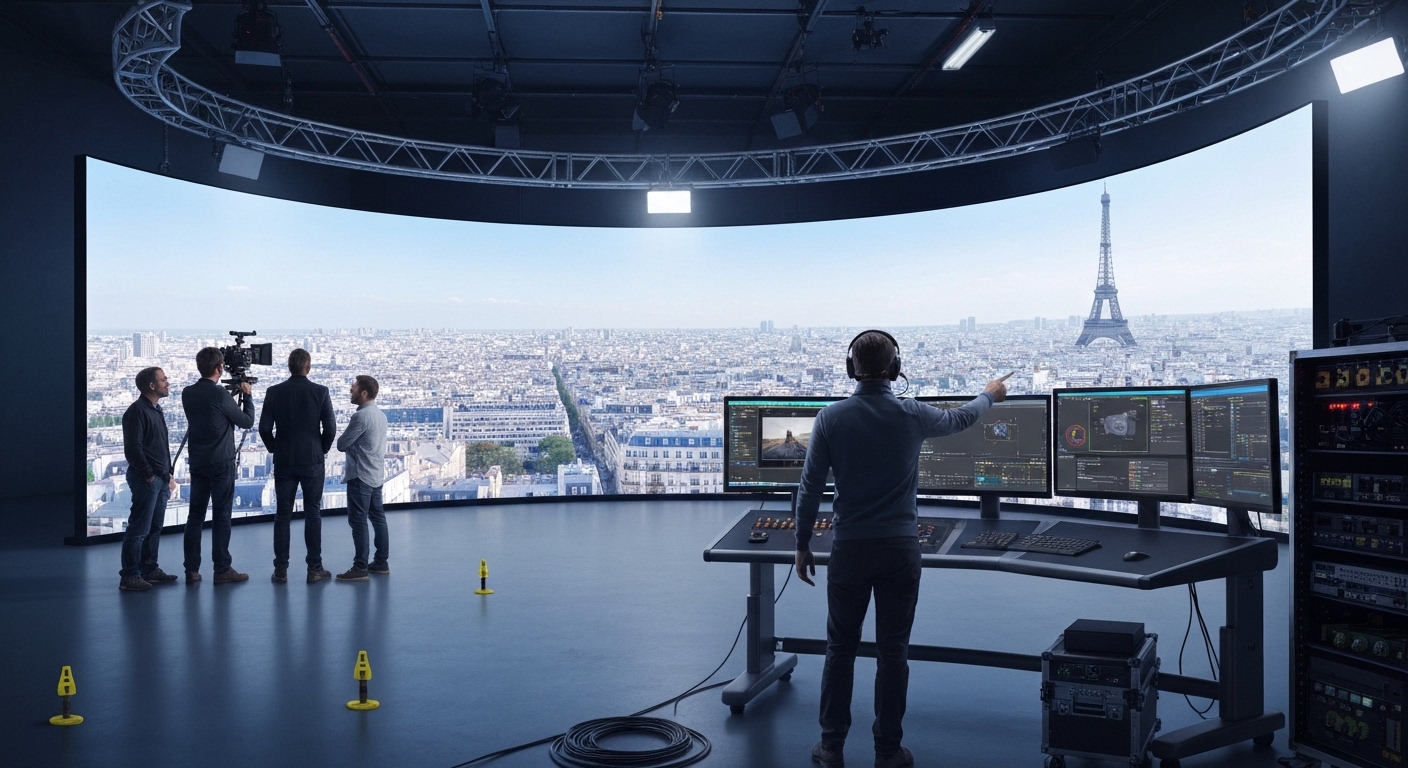
The reality of virtual production in 2026 is that the LED wall is merely the most visible component. The true value lies in the orchestration behind it. Officially recognized as a distinct métier by France Compétences in October 2025, the Virtual Production Supervisor is the central nervous system of a modern shoot. This role acts as the indispensable liaison between the technical teams managing the virtual environment, the VFX department, and the physical production crew on set. Their primary purpose is to manage the project from pre-visualization to final render, ensuring visual quality and providing adapted solutions in real-time.
Unlike a traditional VFX Supervisor who focuses on post-production, the VP Supervisor’s expertise is in on-set technical oversight during shooting. This shift from post to live action is critical. For example, they ensure that the lighting on the physical actor perfectly matches the virtual environment displayed on the LED wall, enabling in-camera compositing that eliminates weeks of post-production rotoscoping. Their core offering for Paris-based productions includes pre-production planning for virtual set conception, on-set execution for real-time VFX integration, and post-handoff support for a seamless transition to final VFX.
This strategic pivot from a post-production fixer to a live creative partner is the key benefit. By guaranteeing alignment between the real and virtual worlds as the camera rolls, the supervisor hands creative control back to the director and cinematographer in the moment, fundamentally changing the creative and financial dynamics of production.
Why true virtual production experts are rarer in paris than you think
Navigating the Parisian virtual production landscape reveals a critical bottleneck: a severe shortage of qualified experts. As Frédéric Fermon noted in industry analysis, “There are still few professionals specialized in this field in France. Those with real experience as a VP supervisor often come from other professions like cinematography or visual effects.” This scarcity is quantified by the training pipeline; the pioneering 12-month professional program at Paris-region institutions like École Méliès, with instructors from studios like MacGuff and Ubisoft, produces only a handful of certified experts annually.
The root of this rarity is the role's hybrid nature. A true expert must possess a rare combination of deep technical mastery (game engines, LED volume calibration, real-time rendering) and seasoned on-set production acumen (departmental liaison, schedule pressure management, creative problem-solving). Many technicians understand the tools, and many producers understand the schedule, but few can bridge the gap with authority. This is why many early practitioners evolved from Director of Photography or VFX backgrounds, bringing one half of the required skill set and having to rapidly acquire the other.
For a producer, the risk of engaging a partial expert is concrete. A technician without production sense can cause costly delays by prioritizing pixel perfection over the shooting schedule. Conversely, a producer without technical depth cannot anticipate the interdependencies between virtual asset readiness, camera tracking, and lighting. This expertise gap makes securing a true supervisor not just an operational choice, but a fundamental risk mitigation strategy for your project's budget and creative outcome.
The 3-phase supervision method: from pre-viz to perfect handoff
A professional Virtual Production Supervisor operates on a structured, three-phase methodology that de-risks the entire production lifecycle. This process is the antithesis of an ad-hoc "fixer" approach and is built on the official métier definition standardized after its 2025 recognition.
Phase 1: Strategic Pre-Production & Pre-Viz
This foundational phase happens months before the camera rolls. The supervisor plans the technical and artistic development, conceives virtual decors in collaboration with the art department, and establishes the pipeline between pre-visualization assets and the game engine. A critical task is conducting virtual camera and lighting tests to validate creative choices and technical feasibility, preventing expensive on-set discoveries.
Phase 2: On-Set Execution & Real-Time Synthesis
This is the core of the value proposition. On set, the supervisor:
- Manages the LED volume operation and real-time compositing.
- Acts as the privileged interlocutor between the Director, DOP, VFX lead, and Stage Manager.
- Continuously aligns real and virtual spaces, ensuring what the camera sees is final-pixel quality.
Unlike a Stage Manager who handles physical logistics, the supervisor’s focus is the integrity of the real-time synthesis between live action and the virtual world.
Phase 3: Post-Handoff & Seamless Transition
The supervisor’s role extends after the shoot wrap. They ensure a seamless handoff of all data—camera tracks, lighting logs, asset versions—to the post-production VFX team. This phase includes quality control to final render, guaranteeing that the work captured in-camera is accurately completed and that no creative intent is lost in translation. This closed-loop process transforms supervision from a cost into an investment that pays dividends across all three production stages.
The 5 essential tool categories your supervisor must master
Evaluating a supervisor’s expertise requires verifying their command over five non-negotiable tool categories:
- Game Engines: Mastery of Unity or Unreal Engine for real-time environment rendering and sequencing.
- Camera & Tracking Systems: Expertise with 360° cameras for asset creation and complex camera tracking solutions for spatial alignment.
- 3D Creation Suites: Proficiency in tools like Maya or Blender for asset adjustment and troubleshooting.
- LED Volume & Real-Time Compositing Tech: Deep understanding of LED wall management, color calibration, and in-camera VFX pipelines.
- Production & Review Platforms: Fluency in project management and collaborative review software to maintain pipeline integrity.
Navigating the paris virtual production ecosystem: your pathway to the right expertise
The final challenge for a producer is navigating Paris's complex and specialized virtual production ecosystem to find the right expert. The market is fragmented, with expertise residing in boutique technical studios, large VFX houses expanding into real-time, and a small pool of independent supervisors. According to observed practices, your pathway should be guided by your project's specific scale and ambition.
For high-volume feature films, you may need a supervisor embedded with a studio that owns a large-scale LED volume. For agile commercials or series, an independent supervisor who can rent and manage the right volume for your needs is often more efficient. The key is to match the expert’s specific experience—be it with specific LED volumes, particular game engines, or genres like automotive or fantasy—to your project's technical demands and creative vision.
Begin by defining your non-negotiable requirements: budget, timeline, visual style, and technical complexity. Use these to filter the ecosystem, seeking professionals who can articulate a clear methodology akin to the 3-phase process, not just a list of equipment. This strategic navigation moves you from a broad search to a targeted engagement, ensuring the supervisor you hire isn’t just a technician, but the strategic creative partner your production requires.
Conclusion
Your journey through the Parisian virtual production landscape has moved from recognizing a critical gap to possessing a structured framework for guaranteed on-set integration. You’re no longer just looking for a technician; you’re equipped to identify the strategic partner who bridges the technical and creative divide.
Imagine your next shoot: the director and DOP make bold, real-time creative choices, confident that the virtual environment will respond flawlessly. Your budget is protected from the cascading delays of technical misalignment, and your project meets its visual promise on schedule. This isn't hypothetical—it's the direct outcome of engaging a supervisor who masters the 3-phase method and the five essential tool categories. With the métier's official recognition by France Compétences in 2025, this level of expertise is now the benchmark, not an aspiration.
The timeline for action is defined by your production schedule. The cost of inaction isn't a future tax hike, but an immediate financial and creative risk on your current project. Every day spent navigating the complex ecosystem without a clear map increases the likelihood of budget overruns and compromised vision.
Before you move forward, ask yourself three critical questions:
- Does my current plan account for the pre-production phase where virtual assets and technical pipelines are locked?
- Am I prepared to evaluate candidates on their mastery of real-time synthesis and on-set problem-solving, not just their software list?
- What is the true cost to my production if the liaison between my physical crew and virtual teams fails?
The path is now clear, and the perceived complexity is manageable. You have the blueprint to de-risk your production and unlock creative control. The final step is to translate this framework into a solution tailored to your project's specific scale, ambition, and technical requirements.
Discuss your upcoming Paris-based film, series, or commercial with our experts to define your tailored supervision strategy. 🎬
Sources
- https://gamingcampus.fr/metiers/superviseur-de-production-virtuelle.html
- https://ecolegeorgesmelies.fr/fr/formations/formationprofessionnelle-superviseur-de-production-virtuelle/
- https://www.onisep.fr/metier/decouvrir-le-monde-professionnel/audiovisuel/superviseur-de-production-virtuelle-un-nouveau-metier-a-decouvrir
- https://www.lefilmfrancais.com/cinema/173654/le-metier-de-superviseur-de-production-virtuelle-officiellement-reconnu-par-france-competences
- https://ecolegeorgesmelies.fr/fr/ecole/actualites/superviseur-virtual-production-vers-la-naissance-dun-nouveau-metier/