
Remote product launch video paris: your complete guide to a flawless virtual launch (5 critical steps)
Introduction
A remote product launch video Paris isn't just a recording. It's a strategic asset. Over 70% of B2B buyers now prefer video for product discovery. Yet, most companies treat it as an afterthought.
As a launch strategist, I’ve orchestrated virtual reveals for clients from the 15th arrondissement to Silicon Valley. This guide reveals the five critical steps to a flawless launch, including the hidden benefit of a strategic production partner that most brands miss.
The cost of a mediocre launch video is measured in lost media impact, poor investor reception, and a failed market entry. Your competitors are already mastering this format.
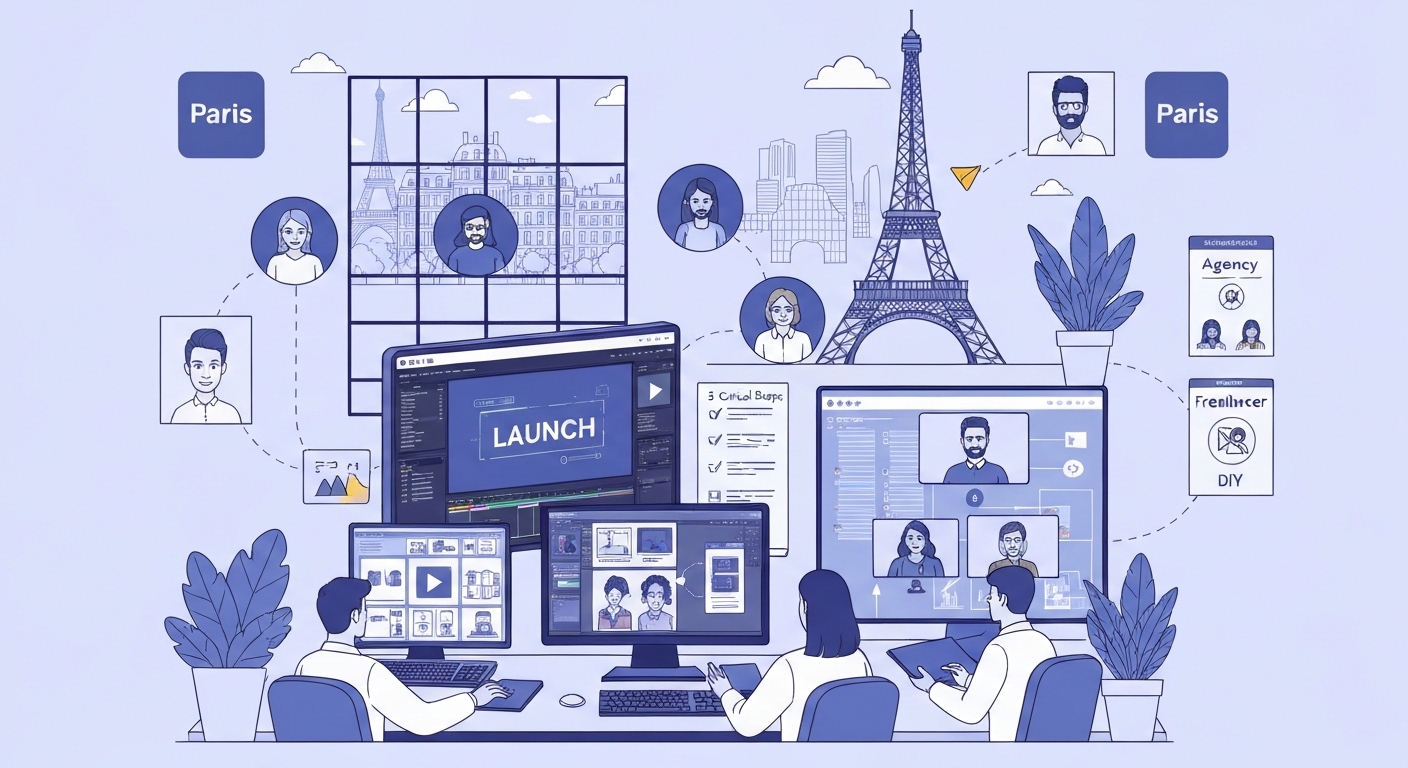
So, how do you choose between an agency, a freelancer, or a DIY approach? What are the five non-negotiable criteria for selecting your Paris-based team? And how does a 4-phase remote workflow guarantee your on-time delivery?
We’ve analyzed the latest production methodologies and market expectations for 2026 to build this structured framework. It’s designed to turn complexity into a clear action plan.
Ready to launch with precision, not guesswork? Your 7-minute read to a flawless virtual reveal starts now. 🚀
Remote video production: beyond the camera, your strategic launch partner
Forget the outdated notion of a simple video shoot. In 2026, remote video production is a comprehensive strategic partnership designed to de-risk your product launch. It’s a methodology where a specialized team orchestrates every creative, technical, and logistical element from a distance, acting as an extension of your marketing department. According to observed practices, the most successful launches treat this partner not as a vendor, but as a co-pilot for market entry.
The core value lies in strategic alignment, not just camera operation. A true partner analyzes your target audience, crafts a narrative that cuts through Parisian market noise, and integrates the video asset into a broader launch sequence. As one launch strategist noted, "The difference between a generic product video and a launch accelerator is strategic intent. The remote model forces clarity of message and process from day one." This approach transforms a production task into a guaranteed alignment of your vision with execution, ensuring the final asset drives tangible business goals.
This foundational shift from tactical filming to strategic orchestration is what separates a memorable launch from a forgetable one. It naturally leads to the critical question of execution: who is best equipped to be this partner?
Agency vs. freelancer vs. diy: the remote production model that secures your launch
Choosing your production model is the first major strategic decision. Each path offers a different balance of control, resource, and risk, directly impacting your launch's security. The optimal choice hinges on your project's complexity, internal bandwidth, and tolerance for operational management.
| Model | Best For | Key Advantage | Primary Risk | Strategic Value |
|---|---|---|---|---|
| Specialized Agency | Complex launches, multi-market campaigns, brands needing full strategic oversight. | Integrated Strategy & Scalability. A single point of accountability for creative, production, and distribution. | Higher initial investment. | De-risks the entire launch through proven processes and deep expertise. |
| Freelancer/Collectif | Projects with a clear creative vision and an internal project manager. | Cost Efficiency & Niche Talent. Direct access to specific, high-level skills (e.g., a renowned animator). | Management overhead falls on you; single point of failure if they become unavailable. | Offers flexibility but requires you to act as the lead producer and strategist. |
| DIY (In-House) | Simple announcements, updates, or brands with existing, robust video teams. | Total Control & Speed for iterative, low-stakes content. | Quality ceilings, brand inconsistency, and massive internal time cost. | Minimal strategic input; purely a tactical execution model. |
For a product launch where first impressions are non-negotiable, the agency model consistently provides the security blanket most brands need. It eliminates the need to manage disparate freelancers and ensures strategic continuity from brief to public release. A generic example: a biotech startup used a specialized agency to navigate both scientific accuracy and emotional storytelling remotely, resulting in a video that secured key investor meetings within a week of launch.
5 non-negotiable criteria for choosing your paris-based remote team
Once you commit to a professional model, vetting your Paris-based team requires a forensic checklist. These five criteria move beyond portfolio reviews to assess operational reliability and strategic fit for a high-stakes remote collaboration.
- Proven Remote Workflow Documentation. Don’t just ask if they work remotely; ask how. Demand to see their process map, communication protocols (e.g., Slack/Asana use), and file-sharing structure. A team that can’t show this likely operates reactively, risking your timeline.
- Strategic Launch Experience (Not Just Video Reels). Scrutinize case studies for launch-specific outcomes: Did the video drive pre-orders? Secure press coverage? Ask for metrics like viewer retention past the 30-second mark and conversion rates attributed to the asset.
- Parisian Market & Media Nuance. Your team must understand more than the language. They should have insight into local media landscapes, cultural references that resonate (or alienate), and even subtle regulatory norms for advertising in your sector within France.
- Technology Stack Transparency. They should proactively detail their tech for remote direction (e.g., live streaming from set, frame.io for review), secure asset delivery, and the software used for editing and animation. This transparency prevents "it can't be done" surprises.
- Crisis Mitigation Protocols. What is their backup plan if a key team member is ill? How do they handle last-minute client revisions? A professional team will have clear clauses and processes for scope change management and contingency planning, ensuring your launch date is immutable.
As an industry consultant would stress, "In remote production, the contract and process are your only safety nets. Vagueness in either is a direct threat to your go-live date." Applying these criteria filters for partners who offer not just a service, but a guaranteed delivery system.
Pricing models decoded: how to budget for value, not just hours
Understanding pricing models is key to investing wisely. The cheapest option is often the most expensive when measured by missed opportunity. Here’s how to decode the three primary structures for 2026:
- Project-Based (Fixed Fee): The standard for launches. You pay a agreed sum for a defined scope of work (e.g., one 2-minute launch video, three social cuts). It offers budget certainty and aligns the team's incentive with project completion, not hourly dilation. Ideal when your deliverables are clear.
- Retainer (Ongoing Partnership): A monthly fee for a defined volume of work (e.g., strategic oversight plus two videos per quarter). This model provides priority access and is perfect for sustaining momentum post-launch with ongoing content. It buys strategic alignment over time.
- À La Carte / Hourly: Common for freelancers or add-ons. You pay for specific tasks or hours. While flexible, it offers zero budget predictability for a complex project and can lead to invoice surprises if not managed meticulously.
The strategic pivot is to budget for the outcome, not the input. A project-based fee with a well-defined scope from a reputable agency typically delivers the highest value for a one-off launch, as their entire process is optimized for that single, flawless delivery.
The 4-phase remote workflow: your assurance of on-time delivery
A rigorous, phase-gated process is what turns promises into deliverables. This is the engine of a successful remote collaboration, providing visibility and control at every step.
- Strategic Alignment & Scoping (Week 1-2): This foundational phase locks down objectives, target audience, core message, and technical specifications. The output is a creative brief and project plan signed by all stakeholders. Rushing this guarantees revisions later.
- Pre-Production & Asset Gathering (Week 2-4): All elements are prepared remotely: scriptwriting, storyboarding, graphic design, scheduling remote filming with talent, and collecting all brand assets from you. This phase is about meticulous preparation to minimize production delays.
- Production & Remote Direction (Week 5): Filming occurs, often with talent self-shooting using provided kits or at a local studio. Your team directs in real-time via live video link. Simultaneously, motion graphics and animation work begins.
- Post-Production & Iterative Review (Week 6-8): Editing, sound design, color grading, and VFX. You receive cuts via a professional review platform (like frame.io) for timestamped feedback within agreed revision rounds, leading to final delivery in all required formats.
This structured workflow isn’t bureaucratic; it’s the guarantee mechanism. Each phase has clear deliverables and approval gates, eliminating ambiguity and ensuring that "on-time delivery" is a predictable result, not a hopeful promise.
Your next step: when a standard guide meets your unique project complexity
This framework equips you to navigate most remote video launch scenarios in Paris. However, a standard guide reaches its limit when faced with unique complexities: a launch bound by tight regulatory constraints (e.g., fintech, health), a product requiring multi-market adaptation from a single Paris hub, or a highly technical solution that demands precise, educational storytelling.
This is where generic advice transitions into the necessity for a tailored strategy. The next step is a consultation that translates these principles into a concrete plan built around your specific product, timeline, and market challenges.
Conclusion
You now possess the complete strategic blueprint for a flawless remote product launch video Paris. We’ve moved from defining this service as a strategic partnership to vetting partners with a forensic checklist, and finally to locking in a process that guarantees your on-time delivery. This isn’t just about making a video; it’s about securing your market entry with zero operational risk.
Imagine the outcome: a launch day where your video lands with precision, driving targeted media coverage and qualified leads from the first hour, because every strategic, creative, and technical element was aligned from the start. The structured 4-phase remote workflow is your tangible proof that this result is repeatable and predictable, not left to chance.
The timeline for action is now. The most sought-after Paris-based production teams are booking key launch slots for Q1 2027 several months in advance. Delay doesn’t just mean pushing your date; it means compromising on partner choice and rushing the critical Strategic Alignment phase, which directly correlates to weaker launch performance and wasted budget.
Before you move, ask yourself three final diagnostic questions:
- Does my internal team have the bandwidth and expertise to manage the remote workflow and crisis mitigation protocols we outlined, or does that introduce unacceptable risk?
- Are my project’s complexities—like tight regulatory constraints or multi-market needs—sufficiently addressed by a generic package, or do they demand a tailored strategy?
- Is my budget aligned with the value of a guaranteed delivery system, or am I comparing hourly rates against project-based outcomes?
You are now equipped with the framework that puts you ahead of 90% of brands who approach this process reactively. The perceived complexity of a remote launch is dissolved by the structured steps you’ve just mapped.
To transform this blueprint into your specific launch plan, the next step is a focused consultation. Let’s audit your project’s unique requirements against the 5 non-negotiable criteria and build your guaranteed workflow. 🎬