
French workplace culture: the advisor's guide to navigating labor laws and well-being (3 key pillars)
Introduction
The average French employee works 30.8 hours a week in 2026, not the legal 35. This is the first myth to dismantle about French workplace culture advisor production.
As an insider, I’ll decode the hidden benefits of this model and the three pillars that make it work. Misunderstanding them risks costly litigation, talent drain, and failed international projects.
What is the real function of the 35-hour week as a strategic foundation? How does a ~31-hour actual week structurally prevent burnout? And what does the 2024 4-day week pilot reveal about next-gen demands?
This guide analyzes the latest 2026 Finance Act context and Eurostat data. We move beyond theory to a structured methodology for application.
A 6-minute read. ⚖️ Let’s architect your advisory framework.
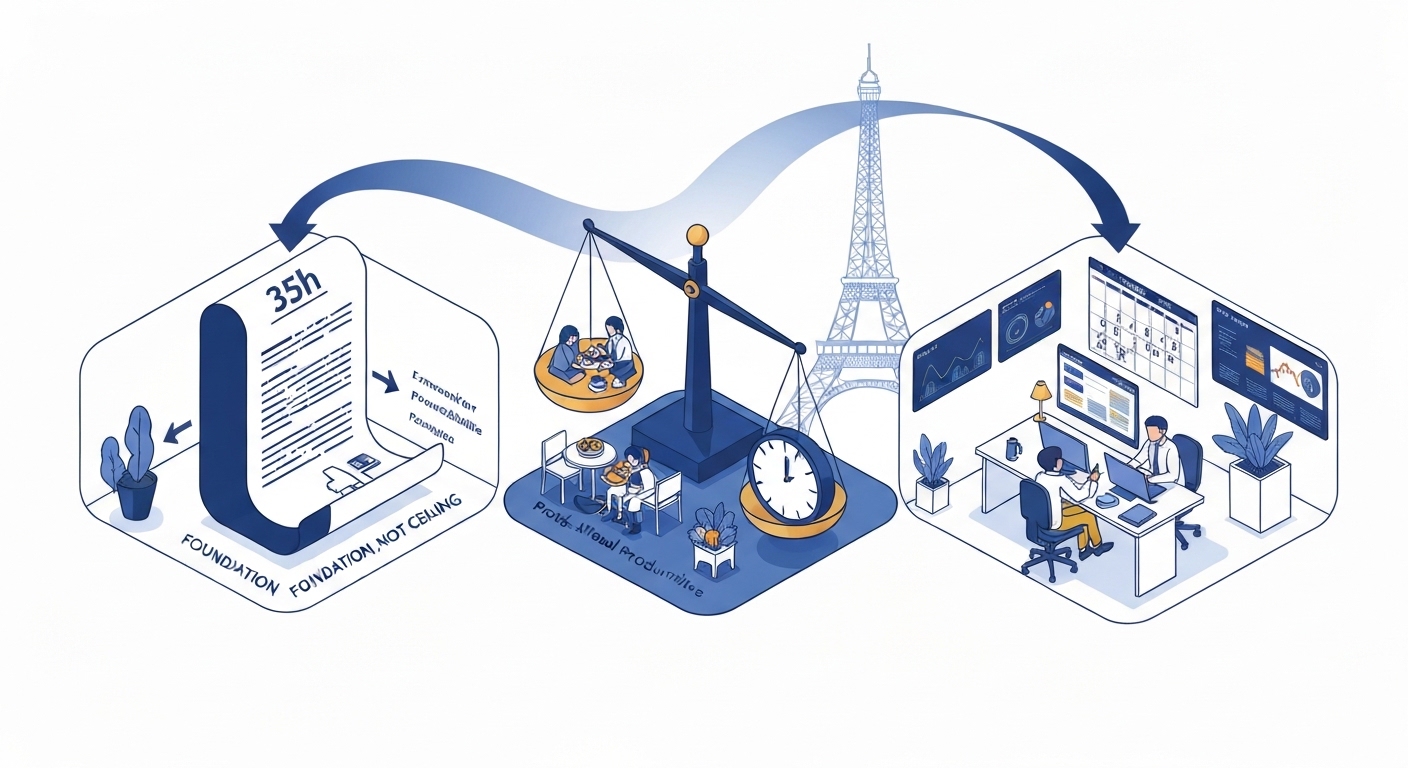
French labor law: why the 35-hour week is your foundation (not your ceiling)
The 35-hour workweek is often misunderstood as a rigid cap. In reality, it’s a strategic legal foundation designed to structure compensation, protect workers, and frame negotiations. The law sets a baseline of 35 hours for full-time work, but actual hours frequently exceed this. For instance, full-time employment averaged 39.90 hours per week in December 2024, according to Eurostat data.
This framework operates through two key mechanisms:
- Overtime Regulation: Hours beyond 35 are strictly governed. The Labor Code mandates a maximum of 10 hours per day and 44 hours per week, including overtime. These hours are subject to higher pay rates (typically +25% for the first 8 hours, +50% thereafter) and mandatory rest periods.
- Collective Bargaining: Sector-wide or company-specific agreements (conventions collectives) can establish forfaits jours (annualized day quotas) for certain salaried employees, legally allowing for variable weekly hours while respecting overall annual limits and the right to disconnect.
For an advisor, understanding this distinction is critical. A generic example: a tech firm with a 30% remote workforce must formalize disconnection protocols in its agreement to comply with the law, turning a legal constraint into a structured well-being policy. This foundation prevents litigation and creates a predictable framework for productivity.
Mastering this baseline is the first step to designing competitive and compliant employment packages that attract talent without legal risk.
Work-life balance: how france's ~31-hour week beats the 'always-on' burnout trap
While the legal foundation is 35 hours, the lived reality for many French employees is even more favorable to well-being. The average actual working week in France is estimated at 30.8 hours for 2026. This stands in stark contrast to the "always-on" cultures prevalent in many anglophone economies and creates a structural defense against burnout.
The data reveals a deliberate design:
- Comparative Advantage: France’s actual hours are significantly lower than the EU average of 36.0 hours (2024, ages 20-64). More tellingly, only 13.3% of French workers log over 40 hours weekly, compared to over 80% in some Eastern EU states.
- Cultural Operationalization: This isn't accidental. As a labor sociologist might note, "The 35-hour law codified a cultural preference for boundary-setting, which has cascaded into norms like lengthy lunch breaks, strong vacation uptake, and the right to disconnect." Companies operationalize this through collective agreements; for example, mandating that work phones are silenced after 7 PM and not funding employee mobile plans without a formal disconnection clause.
The result is a tangible competitive edge in talent retention and mental health. Employees in France are legally and culturally shielded from the chronic overwork that leads to burnout in less regulated markets. For an advisor, this means positioning France’s model not as a limitation, but as a proven well-being infrastructure that enhances sustainable productivity and employer branding.
The future of work in france: what the 2024 4-day week pilot reveals about next-gen demands
The evolution of French workplace culture is being actively tested, moving beyond the 35-hour paradigm. The landmark 2024 national 4-day week pilot, involving 50 companies and run in partnership with Emlyon Business School and 4 Day Week Global, is a clear signal of next-generation demands. This experiment tests a 32-hour workweek (4 days) with no reduction in pay, explicitly targeting improved well-being and productivity.
This pilot reveals three critical insights for advisors:
- The Demand for Autonomy: The trial responds to a generational shift, particularly among Millennials and Gen Z, who prioritize output over presence and value time sovereignty as much as financial compensation.
- Productivity Redefinition: The core hypothesis, pending full 2026 results, is that focused work in condensed time, supported by technology and process optimization, can maintain or increase output—a direct challenge to the long-hours-equal-results fallacy.
- Strategic Experimentation: France is not mandating a shift but facilitating large-scale experimentation. This allows companies to test radical flexibility within a supportive framework, de-risking innovation in organizational design.
For a workplace culture advisor, this pilot is a crucial leading indicator. It shows that the future competitive advantage lies in structured flexibility. The conversation is advancing from "how many hours" to "how best to work." Advising clients now requires understanding these experimental results and preparing frameworks for output-based evaluation, meeting efficiency, and holistic employee well-being that align with this accelerating trend.
Conclusion
You now possess the architectural blueprint for navigating French workplace culture, moving from a rigid legal framework to a dynamic competitive advantage in talent and well-being.
Implementing this framework positions you for immediate success: structuring compliant overtime, embedding the right to disconnect, and leveraging the ~31-hour actual week to build a resilient, attractive employer brand. The data is clear—with only 13.3% of French workers exceeding 40 hours, you’re adopting a model proven to sidestep the burnout and turnover plaguing “always-on” economies. The ongoing 2024 4-day week pilot is your leading indicator; companies that master structured flexibility today will lead the market tomorrow.
The strategic timeline is already active. The 50-company national pilot concludes in 2026, with its findings set to redefine best practices. Inaction now means playing catch-up in a market where top talent increasingly prioritizes time sovereignty and legal well-being infrastructures. The cost is a tangible competitive lag in recruitment and retention.
Before moving forward, assess your position:
- Is your overtime policy merely compliant, or strategically optimized within the 44-hour weekly ceiling?
- Does your remote work agreement explicitly formalize disconnection protocols to prevent litigation?
- Are you measuring productivity by output, ready to adapt to a 32-hour week model?
This isn’t about added complexity—it’s about operationalizing clarity. You’ve just moved ahead of the curve by understanding the foundation, the cultural advantage, and the future signal.
Your next step is to translate this blueprint into your specific context. Book a diagnostic session to map these three pillars onto your company’s structure, international team dynamics, and strategic goals. We’ll identify your immediate leverage points and build a phased integration plan. ➡️
Sources
- https://tradingeconomics.com/france/hours-worked-per-week-of-full-time-employment-eurostat-data.html
- https://4dayweek.io/country/france
- https://www.statista.com/statistics/419565/main-job-average-weekly-working-hours-france-y-on-y/
- https://parakar.eu/knowledge/fr/35-hour-workweek-overtime
- https://ec.europa.eu/eurostat/statistics-explained/index.php?title=Actual_and_usual_hours_of_work
- https://worldpopulationreview.com/country-rankings/average-work-week-by-country