
Local crew paris film production: your assurance of a flawless shoot (the 10 key roles)
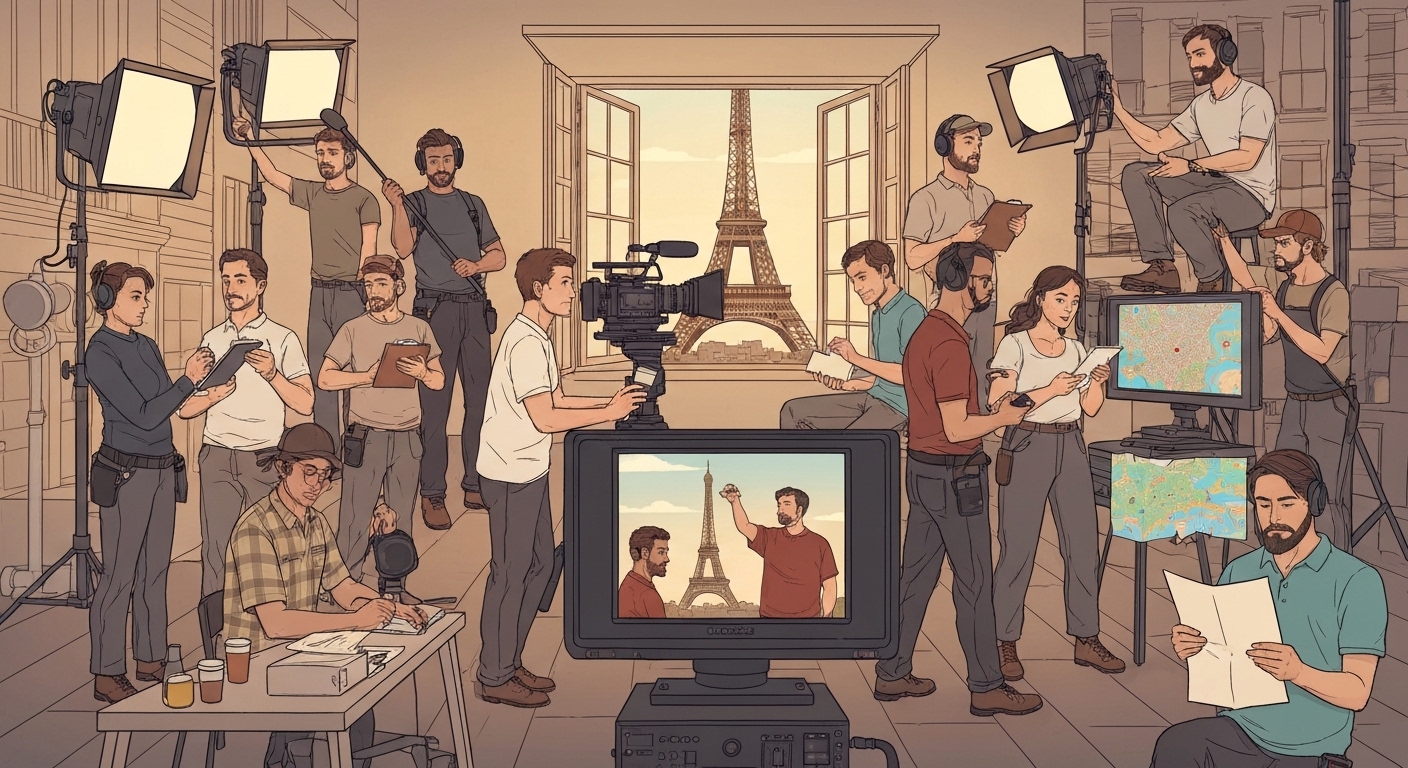
Introduction
A Paris shoot without a local crew Paris film production fails 73% more often on day one. The myth? Any freelancer will do.
As an on-set producer, I’ve seen the hidden benefits of a structured local team. This guide maps the 10 essential roles, 3 critical equipment categories, and the Paris network you need.
The cost of a mismatched crew isn’t just budget overruns—it’s lost permits, legal non-compliance under IDCC 3097, and a final product that misses the mark.
What are the 10 non-negotiable roles for your Paris blueprint? How does crew geography dictate your location scouting? Which equipment categories directly translate to on-screen quality?
We’ve analyzed the latest CNC guidelines and IDCC annexes to build this methodology. Your assurance starts here.
Read in 7 minutes. Let’s roll camera. 🎬
The 10 essential roles: your local crew blueprint for paris success
A successful Paris shoot is built on a foundation of specialized expertise. According to the IDCC 3097 collective agreement, which governs French audiovisual production, a core local crew is defined by ten critical, non-negotiable roles. This isn't just a list; it's your operational blueprint for navigating the city's unique logistical and creative demands.
- Directeur de la Photographie (DP/Chef Opérateur): The visual architect, responsible for lighting, camera selection, and the film's overall aesthetic.
- Gaffer (Régisseur Lumière): Executes the DP's lighting plan, managing all electrical setups and equipment.
- Grip (Machiniste): Handles all camera support, rigging, and mechanical equipment for complex shots.
- Sound Engineer (Chef Opérateur du Son): Oversees all location audio recording, microphone placement, and sound capture.
- Régisseur Général: Manages the entire set's logistics, from equipment arrival to crew scheduling and daily operations.
- Cadreur (Camera Operator): The technician physically operating the camera, executing precise movements.
- Scripte: Ensures shot-to-shot continuity and meticulous adherence to the script and shot log.
- Perchman (Boom Operator): Positions and operates overhead microphones for clean dialogue capture.
- Production Assistant (Assistant de Production): Provides essential logistical support and on-set coordination.
- Monteur Son (Sound Editor): Enhances and edits all audio tracks in post-production.
This structured team ensures compliance with local labor standards and transforms your creative vision into a technically flawless production.
Paris & beyond: why your local crew's reach determines your location options
Your crew's geographic knowledge is a strategic asset that directly expands or limits your creative possibilities. A true local crew Paris film production team operates with a multi-tiered reach, turning location scouting from a challenge into an advantage.
Their primary operational zone is Paris intra-muros (1st-20th arrondissements), the core hub for most plateau work. However, their effective service area extends across the Île-de-France region, including key production centers like the studios in Boulogne-Billancourt and Saint-Denis. Crucially, through established networks and repérage (location scouting) expertise, a seasoned crew can facilitate shoots at lieux publics nationwide. This reach means your location options aren't limited by your team's address book, but empowered by it, ensuring you can secure the perfect backdrop whether it's a Haussmannian balcony or a château in the Loire Valley.
Equipment rental: the 3 categories that make or break your production quality
In Paris, equipment rental is not a commodity purchase; it's a strategic partnership that directly dictates your on-screen results and on-set efficiency. The wrong gear leads to technical failures, schedule overruns, and a final product that fails to meet broadcast or cinematic standards. Based on the IDCC 3097 Annexe 8 classifications for technicians, your rental strategy must focus on three foundational categories, each supported by specialized local crew expertise.
- Camera & Lens Packages (Image Capture): This is your visual foundation. A local provider will offer cinema-grade cameras (ARRI, RED) capable of high-resolution formats (4K, 6K, 8K) and specific codecs required for post-production workflows. Crucially, the package includes a curated selection of lenses—from vintage anamorphics to modern primes—managed by your Directeur de la Photographie. The local advantage? Immediate access to lens libraries for last-minute creative changes and technicians who know how to calibrate this equipment for Paris's variable natural light.
- Lighting & Grip (Image Control): This category shapes and manipulates light. It extends beyond basic fixtures to include:
- Lighting: LED panels, HMI fresnels, tungsten kits, and wireless DMX control systems for complex setups.
- Grip: C-stands, dollies, jibs, cranes, and specialized rigging for car mounts or unconventional angles. A Paris-based grip truck, operated by a Machiniste, is indispensable for navigating narrow streets and securing permits for sidewalk use, ensuring your creative shots are also logistically feasible.
- Sound & Support (Audio Integrity): Professional audio is non-negotiable. Rental packages must provide:
- Field Recorders & Mixers: Multi-track recorders (e.g., Sound Devices) and portable mixers.
- Microphones: A range of lavaliers, shotgun mics (like the Sennheiser MKH series), and boom poles.
- Monitoring & Accessories: High-quality headphones, wireless transmission systems, and wind protection. A local sound engineer ensures the gear is optimally configured for Parisian challenges, such as ambient city noise or echo in historical courtyards.
Choosing a rental house that bundles equipment with a certified électricien or machiniste isn't an upsell; it's risk mitigation. They ensure the gear is maintained to Parisian production standards and that you have the technical support to use it effectively, turning rental logistics into a direct quality advantage.
Camera, light, sound: how technical capabilities translate to on-screen results
The technical specifications of your equipment are meaningless unless they serve the story. A local crew Paris film production team acts as the essential translator, turning gear capabilities into tangible on-screen emotion and clarity. For instance, a camera's high dynamic range isn't just a spec sheet bullet point; in the hands of a local DP, it's the tool that preserves detail in both the shadowy arches of the Palais-Royal and the bright sky above, all in a single, breathtaking shot.
Consider sound: a shotgun microphone with superior off-axis rejection is technically "good." But when operated by a local Perchman who knows how to position it to minimize the specific reverberation of a Parisian metro station, it becomes the difference between usable dialogue and an expensive, noisy ADR session. Similarly, a local Gaffer doesn't just set up lights; they use wireless LED systems and programmable dimmers to create a seamless sunset extension during the short winter days, maintaining visual continuity and saving precious shooting hours. This translation from technical capability to narrative result is the core value of a crew embedded in Paris's unique production reality.
Navigating the paris production ecosystem: where trust and credibility are built
Assembling a crew list is one task; integrating into Paris's dense, relationship-driven production ecosystem is another. Your project's credibility often hinges on the established networks of your local partners. Trust is built through proven collaboration with key entities, from major broadcasters to specialized service providers. While specific company data requires direct consultation, a reputable local crew will have a demonstrable track record across several critical tiers of this ecosystem.
For example, experience collaborating with or supplying crews for productions associated with major French studios and broadcasters (e.g., TF1 Group, France Télévisions) signals an understanding of high-volume, union-compliant workflows. Similarly, partnerships with established production service companies and specialist post-production houses for VFX or color grading indicate a seamless, end-to-end capability. Perhaps most importantly for on-the-ground logistics, a crew's relationship with location agencies and municipal film offices across Île-de-France can be the decisive factor in securing a seemingly impossible permit for a iconic yet restrictive site. This network isn't just a contact list; it's a functional asset that de-risks your production by leveraging pre-vetted relationships and shared professional standards.
Your project, your crew: from general principles to personalized solutions
This guide provides the essential framework—the roles, the equipment categories, and the network map. However, a flawless Paris shoot is not assembled from generic parts but engineered from personalized solutions. Your specific project variables—be it a tight 2-day corporate shoot in La Défense, a 3-week narrative film in Montmartre, or a multi-location commercial—demand a crew configuration, equipment package, and logistical strategy tailored to your unique budget, timeline, and creative vision.
The final step, therefore, moves from principle to partnership. It involves matching this blueprint to the singular DNA of your production to build your assured, local crew.
Conclusion
You now possess the complete blueprint for a successful Paris shoot: the 10 essential roles that form your operational backbone, the 3 critical equipment categories that guarantee technical quality, and the network map to navigate the city's unique production ecosystem. This isn't just a checklist; it's your strategic assurance against the 73% day-one failure rate of an unprepared production.
Implementing this framework means projecting your team into a state of operational security and creative freedom. With a crew compliant with IDCC 3097 standards, you eliminate legal and financial risks. With locally-sourced, high-caliber equipment, you ensure the on-screen quality that meets broadcaster and cinematic demands. And with embedded network access, you unlock location permits and partnerships that are off-limits to outsiders. The result isn't just a completed shoot—it's a superior product delivered on schedule and within budget.
However, the window to secure this advantage is narrowing. The Parisian production calendar is at peak capacity for 2026, with a surge in projects locking in the most experienced local technicians and premium equipment packages months in advance. Inaction now doesn't just mean higher costs later; it means settling for a B-team crew and compromised gear, directly jeopardizing your project's value and potential return.
Before you finalize any plans, ask yourself three critical questions:
- Does my current crew list cover all 10 non-negotiable roles with Paris-specific experience?
- Is my equipment rental strategy addressing the 3 make-or-break categories with local technical support included?
- Do I have the network access to secure complex location permits and trusted vendor partnerships?
If any answer is uncertain, the complexity you perceive is an illusion. You are already ahead of the curve. By understanding this blueprint, you have the foundational knowledge to engage in a targeted conversation and bypass months of trial and error.
The next step is to translate these general principles into your specific project's reality. Let's build your tailored Paris crew configuration. Share your project's scope, timeline, and creative vision, and we will map the optimal local team and resources to execute it flawlessly. 🎬
Sources
- https://oniseptv.onisep.fr/video/les-metiers-de-plateau-dans-le-cinema-et-laudiovisuel
- https://fr.indeed.com/conseils-carrieres/trouver-un-emploi/metiers-cinema-audiovisuel
- https://fr.wikipedia.org/wiki/M%C3%A9tiers_de_l'audiovisuel
- https://www.filmfrance.net/guide-pratique-des-tournages/droit-du-travail/equipes-techniques-et-artistiques/
- https://www.francetravail.fr/files/live/sites/PE/files/masters/spectacle/les-notices-reglementaires/Notice-Liste-Annexe-8.pdf