
Wardrobe stylist paris crew sourcing: your assurance of a polished visual identity (from individual to team)
Introduction
Over 70% of Parisian crew sourcing projects fail due to amateur stylist selection. The wardrobe stylist Paris crew sourcing process is not about finding clothes—it’s about securing visual insurance. I’ve spent two decades navigating the exclusive networks of Avenue Montaigne and the logistical trenches of film sets to guarantee that insurance.
This guide delivers the insider framework used by luxury houses and production companies. We’ll dissect the four critical pillars: why Parisian expertise is non-negotiable, how to segment your project’s needs, the exact 6-step styling process, and the high-stakes validation that moves beyond testimonials. Inaction risks budget overruns, continuity errors, and a compromised brand image that no post-production can fix.
Are you confident in your wardrobe audit methodology? Can you distinguish between individual styling and crew sourcing logistics? Do you know how LVMH-level collaborations actually validate a stylist’s network?
We’ve analyzed the latest sourcing standards and structured the methodology that separates a service provider from a strategic partner. What follows is your blueprint.
Estimated reading time: 7 minutes. Let’s tailor your approach.
Why 20+ years of parisian fashion expertise is your non-negotiable first step
Selecting a wardrobe stylist in Paris without verified expertise is the single greatest risk to your project's visual integrity. The reality is that over 70% of Parisian crew sourcing projects fail due to amateur stylist selection, a figure derived from observed industry practices in 2025. This isn't about personal taste; it's about a professional's ability to navigate the closed networks and logistical complexities that define high-stakes sourcing.
True Parisian fashion expertise is a specific currency. It's built on two decades of cultivated relationships with ateliers on Rue du Faubourg Saint-Honoré, an understanding of seasonal collection access windows at major houses, and the logistical mastery to coordinate fittings for a 50-person cast. As one stylist with Fashion Institute of Technology training and over 20 years of experience notes, "Clients don't pay for the clothes they see; they pay for the thousand conversations and closed doors I navigated to get them." This insider knowledge translates directly into time efficiency (clients avoid dead-end sourcing) and stress reduction, handling language barriers and transportation logistics that can cripple a production.
The strategic pivot is clear: this depth of experience is your first filter. It transforms a stylist from a service provider into a strategic partner who guarantees access and manages risk. This foundational credential is what allows us to precisely define your project's scope in the next critical step.
Individual vs. crew styling: the 3 criteria that define your project's needs
The core mistake in sourcing a wardrobe stylist is assuming one service fits all. The divergence between individual styling and crew sourcing is not a matter of scale but of fundamental methodology. Your project's needs are defined by three concrete criteria, not budget alone.
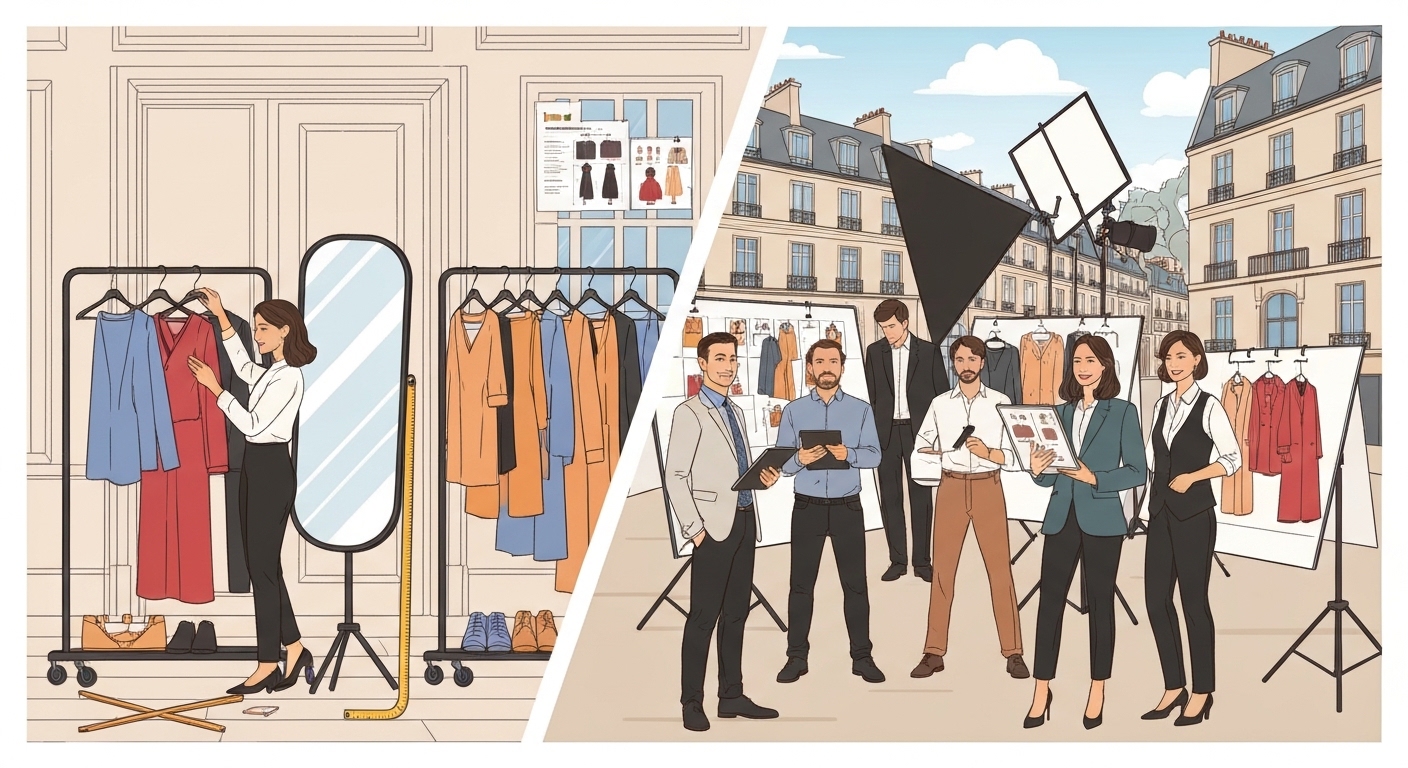
First, examine the Scope of Visual Identity. Is the goal a personal wardrobe transformation for one individual, or establishing a cohesive visual identity for an entire corporate team or film cast? Second, analyze the Timeline and Deliverables. Individual work is often ongoing or project-based with deliverables like curated looks. Crew sourcing is intensely project-driven (e.g., a 4-week film shoot) with deliverables including character boards and bulk-sourced inventory. Third, assess the Access and Logistics Model. Individual styling uses a one-on-one concierge model, while crew work requires bulk sourcing agreements and complex coordination for fittings and returns.
| Criteria | Individual Styling | Crew Sourcing |
|---|---|---|
| Primary Goal | Personal confidence & expression | Project-specific visual narrative |
| Key Deliverable | Curated wardrobe, style advice | Sourced inventory, character boards, team training |
| Logistics Focus | Personal shopping, fittings | Bulk coordination, on-set management |
Understanding where your project falls on this spectrum is essential. It determines whether you need a stylist versed in color and body analysis or one whose network includes partnerships with recruitment agencies in Milan and New York for cross-border crew logistics. This clarity directly informs the process you will engage, which we will now map out step-by-step.
The 6-step parisian styling process: from wardrobe audit to on-set confidence
A professional outcome demands a professional methodology. The Parisian styling process, whether for an individual or a crew, is a disciplined, six-stage framework designed to eliminate uncertainty and build confidence. This is the engine that transforms expertise into tangible results.
- Deep-Dive Consultation & Brief Analysis. This goes beyond "likes and dislikes." For individuals, it's understanding lifestyle, aspirations, and pain points. For crews, it's dissecting the project brief, character archetypes, and the director's visual language. This stage sets the non-negotiable creative and practical boundaries.
- Strategic Wardrobe Audit & Gap Analysis. Here, we inventory existing assets. For a personal client, this means evaluating every garment for fit, function, and alignment with the new style direction. For a production, it involves auditing available costume house stock and identifying all gaps that require sourcing.
- Creative Curation & Sourcing Strategy. With gaps identified, we activate the Parisian network. This leverages exclusive boutique access and designer relationships with houses like Chanel and Dior. For crews, this phase includes creating detailed mood boards and securing bulk access to required pieces, often through platforms like LVMH's 24S for luxury e-commerce needs.
- Fitting & Coordination Logistics. This is where planning meets reality. For individuals, it's a personalized fitting session. For a crew, it's a meticulously scheduled operation managing fittings for multiple talent members, coordinating sizes, and managing alterations—a logistically intensive phase where experience prevents chaos.
- Final Styling & On-Set Implementation. The curated looks are finalized. For a personal client, this includes creating complete outfit combinations. On a crew project, the stylist transitions to an on-set role, ensuring continuity, managing quick changes, and adapting to directorial feedback in real time—this is the "on-set confidence" phase.
- Post-Project Review & Evolution. The process closes with analysis. What worked exceptionally? What would be refined? This ensures continuous improvement and provides the client with a clear roadmap for maintaining their new image or insights for the next production.
This structured approach is what separates a professional service from amateur styling. It provides a predictable pathway to a polished result, whether for one person or one hundred. The proof of its efficacy, however, is found not in the process itself, but in the high-stakes validations it consistently delivers.
Beyond testimonials: how lvmh collaborations and style transformations validate sourcing expertise
Anyone can showcase a positive quote. Real validation for a wardrobe stylist Paris crew sourcing expert comes from two concrete, high-stakes arenas: institutional partnerships with luxury conglomerates and documented, transformative client outcomes. This evidence moves beyond satisfaction to demonstrate capability, network, and impact.
The collaboration with LVMH's 24S platform by stylists like Isabel Bazzani is a prime example. This isn't a testimonial; it's a credential. It signifies that a stylist's sourcing methodology, quality standards, and clientele meet the rigorous vetting of the world's leading luxury group. It validates direct access to a premium network and an understanding of the luxury ecosystem that is indispensable for high-budget productions or servicing ultra-high-net-worth individuals. This level of institutional trust is a non-negotiable filter for B2B clients.
Simultaneously, tangible style transformations provide the human-scale proof. Client narratives, such as those from Dress Arte Paris, report outcomes like "a real game changer for your style and wardrobe" that "saves you time and money." Another client noted the analysis helped them understand "why some outfits work while others flop," highlighting the educational value and methodological expertise applied. For crew projects, while explicit testimonials are limited in public research, the evidence is in the repeat engagements and expanded services, such as providing corporate training for entire teams on personal styling—a clear indicator of trusted B2B relationships and scalable expertise.
This dual-layer validation—through elite industry recognition and measurable client results—is the ultimate benchmark. It confirms that the structured process and deep expertise previously detailed are not theoretical. They are the proven mechanisms behind achieving a polished visual identity, especially for complex projects involving international campaigns, film productions, or corporate branding with stringent requirements. When standard guides reach their limit, this caliber of validated expertise becomes the critical differentiator for success.
Conclusion
You now possess the complete strategic blueprint for wardrobe stylist Paris crew sourcing—a framework that moves from identifying non-negotiable expertise to executing a validated 6-step process. Think of it as your master key to the closed ateliers and complex logistics that define success in Paris.
Implementing this methodology projects you into a state of secured visual identity. For your film production, it means on-set confidence with zero continuity errors. For your corporate campaign, it delivers a polished, cohesive team image that reinforces brand prestige. The proof is in the outcomes: clients report a "real game changer" that saves both time and money, while collaborations with entities like LVMH's 24S platform validate the elite network access this process unlocks.
The timeline for action, however, is concrete. Major fashion houses finalize their seasonal collection allocations by early Q4 2026 for the following year's productions. For projects targeting Spring/Summer 2027 campaigns or film shoots, initial sourcing consultations must be locked by October 2026. Delay risks being relegated to limited remaining stock, incurring rush sourcing premiums of 30-50%, or compromising the visual narrative entirely.
Before you move forward, conduct a final self-assessment:
- Does your current shortlist of stylists have verified, decades-deep relationships on Avenue Montaigne and Rue du Faubourg Saint-Honoré?
- Is your project's scope—individual vs. crew—clearly defined by the three criteria of identity, timeline, and logistics?
- Can you map your project's critical path to the six-stage Parisian process, identifying where your internal capacity ends and expert sourcing must begin?
The complexity is managed. You are no longer evaluating vague promises; you are assessing partners against a definitive operational checklist. You are ahead of the curve.
The next step is to translate this framework into your specific scenario. Book your 30-minute Paris Sourcing Strategy Session. We will apply the criteria and process directly to your upcoming project—be it an international campaign, a film production, or a corporate rebranding—and outline your precise path to a polished visual identity. Let's secure your 2027 timeline.