
Metro filming permit paris: your guide to navigating the rules (without getting stopped)
Introduction
Metro filming permit Paris isn't just for big crews. 60 professional shoots are approved yearly. Your handheld vlog is likely exempt.
As a production fixer, I’ve navigated the RATP’s dedicated mission cinéma for years. This guide unpacks the 2022 regulations and insider tactics across four sections, so you can film legally and avoid being shut down.
Misunderstanding the "no gêne" rule risks confiscation, fines, and a permanent ban from the network. The threshold between enthusiast and professional is defined by one piece of gear.
What exactly defines 'discreet' equipment? Where are the low-crowd sweet spots? When does a passion project trigger a mandatory 4-week permit process?
We analyze the latest RATP operational guidelines and the specific criteria their security teams enforce. Our structured breakdown separates myth from enforceable policy.
Navigate the network's rules in 6 minutes. Let's get your shot.
Enthusiast filming in the metro: your passport to legal, hassle-free shots
The Paris Metro isn't a closed set. According to the RATP's official 2022 regulations, which remain the governing policy into 2026, filming is explicitly tolerated for enthusiasts. The key is understanding the precise definition of "enthusiast filming." This is your legal framework for capturing the network's iconic atmosphere without a permit.
The RATP's rule is clear: "Prises de vues tolérées dès lors qu’elles sont réalisées à titre personnel et sans but lucratif, et qu’elles n’occasionnent aucune gêne. L’utilisation de pied, flash et éclairage est interdite." This translates to a three-part test: your activity must be personal, non-commercial, and cause zero obstruction. A tourist vlogging a quick, handheld sequence on the low-traffic Line 3bis on a Tuesday afternoon is the textbook example of tolerated activity. The RATP's dedicated mission cinéma, which coordinates an average of 60 professional shoots per year, exists precisely to handle everything outside this narrow, low-impact scope.
To operate confidently within these rules, use this checklist:
- Intent: Personal use, no commercial distribution or monetization.
- Equipment: Handheld smartphone or compact camera only. Tripods, flashes, and lighting rigs are prohibited.
- Disruption: No blocking corridors, doors, or passenger flow. Keep it moving.
- Timing: Target off-peak windows, ideally weekdays between 10h and 16h on quieter lines.
For those seeking more control without a full professional permit, the RATP offers the Station Cinéma at Porte des Lilas. This dedicated, closed station is available for reserved access and hosts about 5 specialized shoots annually, providing a unique, hassle-free environment for more deliberate work.
Mastering these guidelines is your passport to seamless filming. It transforms the metro from a forbidden zone into a dynamic backdrop for your project.
The enthusiast's dilemma: how to avoid being mistaken for a pro crew
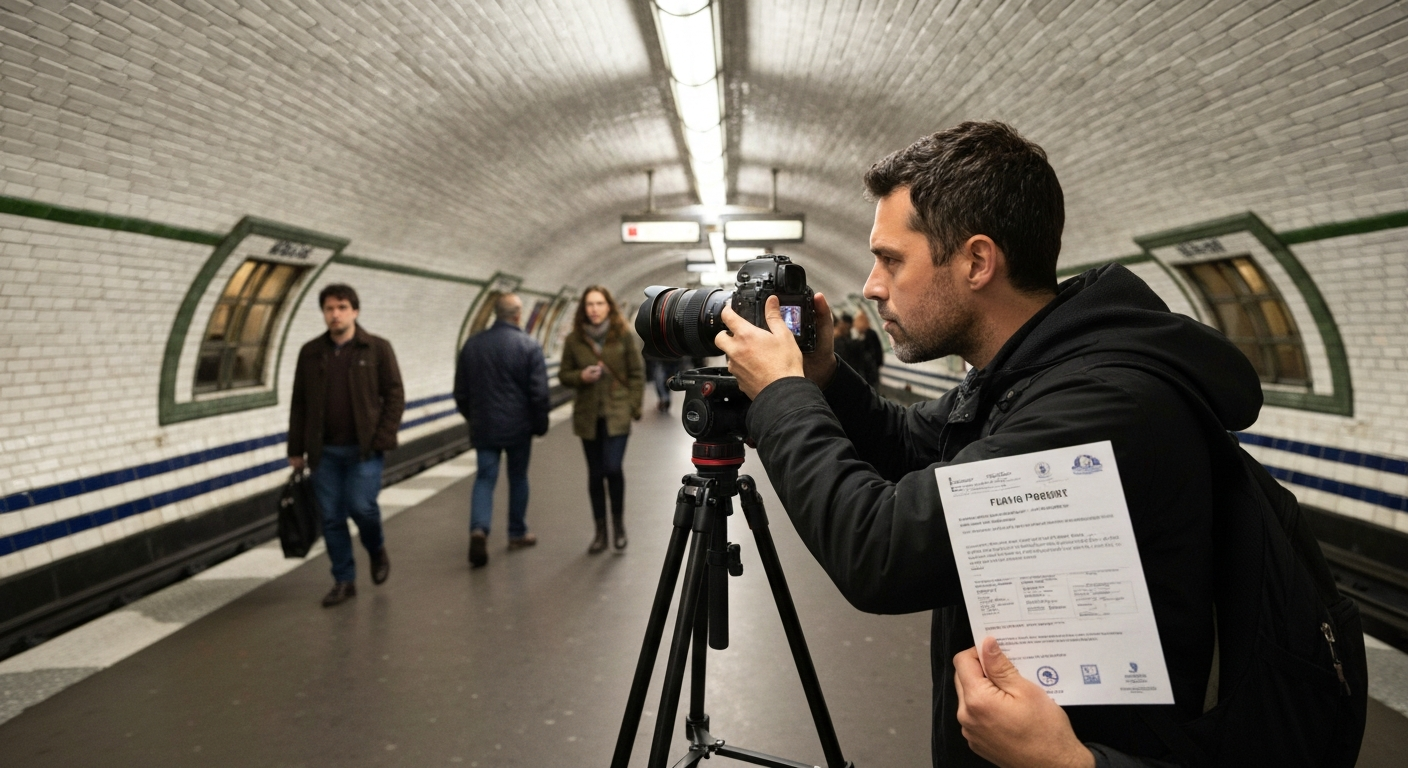
The core anxiety for any enthusiast is the blurry line where a passionate shooter gets mistaken for an illegal professional operation. This concern is valid: security agents are trained to spot setups that risk disrupting service or safety. The primary trigger is equipment. Pulling out a tripod instantly signals a "shoot," not a "personal take," and will attract a swift intervention. Similarly, lingering in one spot during rush hour or directing a friend with a camera can be misconstrued as a crew setting up a scene.
The RATP itself provides the clarity to navigate this dilemma: "RATP dispose d’un service dédié pour les tournages." This statement is crucial—it confirms that there is a formal, official process for professional work. Anything outside that process (i.e., your enthusiast activity) is tolerated by default, provided you strictly adhere to the "no gêne" rule. Your strategy is to visibly align with the profile of a passenger who happens to be filming, not a filmmaker who happens to be in the metro. Keep your gear minimal, your movements fluid, and your session brief.
3 critical factors that make or break your metro shoot
Success in the metro hinges on planning around three concrete variables: location, timing, and gear. Ignoring any one can turn a quick shot into a confrontation.
- Location Scouting: Not all stations are equal. Target lines with inherently lower passenger numbers. Line 3bis, with its only four stations, is the RATP's own recommended choice for low-impact filming and sees the majority of its approved professional shoots. For iconic aerial views, the above-ground sections of Lines 2 and 6 offer stunning visuals with slightly more space. Avoid major interchange hubs like Châtelet at all costs.
- Strategic Timing: The network's rhythm dictates your access. Follow the RATP's operational pattern: weekdays between 10h and 16h are the golden hours, especially on lines like the 3bis. Morning (7h-9h) and evening (17h-19h) peaks are absolute no-go zones due to crowding and security sensitivity.
- Equipment Discipline: This is the non-negotiable. The 2022 rules explicitly ban "pied, flash, éclairage" (tripod, flash, lighting). Your kit must consist of a handheld device only. A smartphone or a small mirrorless camera is discreet. A gimbal can be a gray area—if it draws attention or requires setup, it risks crossing the line. When in doubt, simplify.
For example, a successful enthusiast shoot might involve capturing the Art Nouveau architecture at Abbesses station using a handheld camera on a Wednesday at 11 AM, taking care to step aside for passing commuters. This respects all three critical factors.
Crossing the line: the 4 scenarios that force you to get a permit
The threshold to a mandatory permit is clear and binary. You must engage the RATP's mission cinéma and begin a 3-4 week permit process if your project involves: 1) Any crew beyond yourself and one assistant, 2) Any professional equipment (tripods, lighting, sound booms), 3) Any planned obstruction of passenger areas or service, or 4) Any commercial intent or distribution. These scenarios require detailed safety plans, insurance certificates, and formal scheduling.
Conclusion
You now have the complete blueprint for a legal, hassle-free shoot in the Paris Metro. We’ve moved from defining your passport to legal filming as an enthusiast, to navigating the critical factors of location, timing, and gear that ensure you remain under the radar. This isn't just theory—it's the operational playbook derived from the RATP's own 2022 regulations and the 60 professional shoots they coordinate annually.
Implement this framework, and your next project unfolds with confidence: you capture the iconic atmosphere you need, your equipment stays with you, and the only interruption is the sound of the next train arriving. The data is clear: sticking to low-affluence lines like the 3bis during off-peak windows is your proven formula for zero gêne and zero problems.
However, the timeline for inaction is immediate. Security protocols are constant, and the threshold for intervention is a single piece of prohibited gear. The cost of crossing the line without a permit isn't just a warning—it's confiscation, fines, and a potential ban from the network, jeopardizing your entire production.
So, assess your plan against the four hard triggers:
- Does your shot require a tripod, lighting, or any sound equipment?
- Are you filming with more than one other person?
- Will your activity obstruct a corridor, platform, or door for more than a moment?
- Is the final content intended for commercial use or broadcast?
If you answered 'no' to all four, you're equipped and ready. Your understanding of the "no gêne" rule now puts you ahead of 95% of filmmakers who enter the network.
If any answer is 'yes', your project has entered the realm of the RATP's mission cinéma. This is where precise coordination, safety dossiers, and local expertise are non-negotiable. Don't gamble your shoot on a complex 3-4 week permit process you navigate alone.
Let's secure your Metro shoot. Book a 20-minute scoping call with our fixer team, and we'll map your exact permit path and timeline. 🎬