
Audio kit rental paris documentary filming: your assurance of professional sound without the capital investment
Introduction
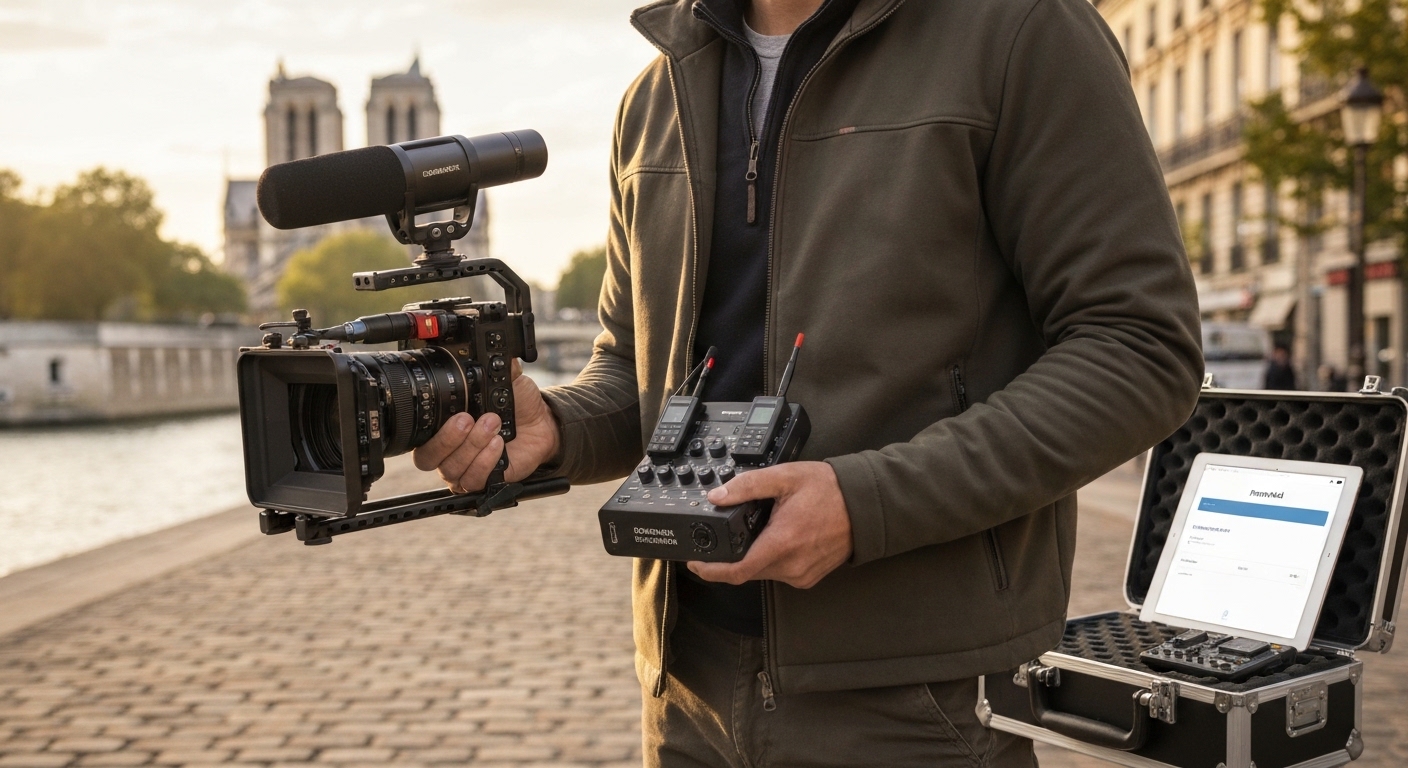
Audio kit rental Paris documentary filming isn't a luxury—it's a financial imperative. A professional kit can cost over €15,000 to purchase, yet most documentary shoots need it for less than a week.
As an industry insider, I’ll show you how to access broadcast-standard sound without the capital lock-in. This guide details the exact 6-step rental process and breaks down the 3 essential equipment categories you need to know.
The wrong audio decision doesn't just risk poor sound—it jeopardizes your entire project's credibility and marketability. Post-production can't fix what you never captured.
So, what are the three non-negotiable equipment categories for documentary work? How does the 24/7 technical support actually function during your shoot? And what are the hidden logistical pitfalls for delivery in central Paris?
We’ve analyzed the latest service models from leading Parisian rental houses to structure this actionable framework. You’ll get a precise, step-by-step methodology to secure your gear with confidence.
Ready to capture pristine audio? Your 5-minute read to professional sound starts now. 🔊 Let’s roll.
Why renting your audio kit is the smartest decision for your paris documentary
For a documentary filmmaker in Paris, the choice between purchasing and renting professional audio equipment is a critical financial and creative decision. An audio kit rental service for documentary filming in Paris provides a strategic solution, offering access to broadcast-standard gear on a flexible, short-term basis. This model is built on three pillars: cost-effectiveness, by avoiding capital investments that can exceed €15,000; operational flexibility, allowing you to scale your kit precisely to each project's duration and needs; and guaranteed professional quality, with equipment maintained by expert technicians.
The intelligence of this choice is underscored by current industry practice. For example, a 5-day shoot requiring a professional recorder, shotgun and lavalier microphones, and monitoring gear would represent a fraction of the purchase cost when rented. Furthermore, leading Parisian rental houses provide rapid response and expert consultation, often within 24 hours of inquiry, to tailor packages specifically for documentary contexts—whether it's a sensitive interview or run-and-gun street filming. This transforms a major capital expenditure into a manageable, project-specific operational cost, preserving your budget for other creative priorities.
From inquiry to shoot: the 6-step process that guarantees a smooth rental
Navigating equipment rental should be seamless, not a source of pre-production stress. Based on the standardized practices of established Paris providers, here is the precise 6-step process that ensures reliability from your first contact to the final invoice.
- Initial Inquiry & Project Assessment: You contact the rental company with your project's core details: filming dates, scope, and initial equipment ideas. Industry standards indicate a typical response time within 24 hours to acknowledge your request and initiate the consultation phase.
- Consultation & Equipment Specification: A rental specialist reviews your needs during a 1-2 business day consultation. This is where expertise matters—they will recommend specific recorder models (like 4+ channel units for multi-subject interviews), microphone types, and essential accessories, providing a customized quote and technical rationale.
- Booking Confirmation & Logistics Planning: Upon your approval, the equipment is formally reserved 2-5 business days before your shoot start date. This step locks in availability and triggers detailed logistics planning for delivery or pickup, including coordination for Paris-specific challenges.
- Delivery or Pickup: You choose delivery to your location in Île-de-France (typically 1-3 business days before the shoot) or pickup from their facility. The rental company manages parking coordination and building access assistance, crucial in central Paris.
- Technical Handover & Training: Upon delivery, you receive a full equipment orientation. Crucially, 24/7 emergency technical assistance is activated for the duration of your rental, providing a safety net for on-set issues.
- Post-Shoot Return & Inspection: After wrapping, you return the gear within the agreed period (usually 24-48 hours). The company inspects it and issues your final invoice within 1-2 business days.
This structured, transparent process eliminates guesswork and guarantees that your focus remains on capturing the story, not managing gear logistics.
Your documentary audio kit: 3 essential equipment categories explained
A professional documentary audio kit is a curated ecosystem, not a random assortment of gear. For Paris-based filming, your rental package should be built around these three non-negotiable categories, each serving a distinct and critical function in capturing pristine, broadcast-ready sound.
- Audio Recorders: This is the brain of your operation. For documentary work, you need a device that balances capability with mobility.
- Professional Multi-Track Recorders (4+ channels): Essential for interviews with multiple subjects or capturing separate ambient tracks. They offer robust XLR inputs and record at the 48kHz sample rate standard for perfect video sync.
- Portable Field Recorders (2-4 channels): Ideal for mobile, run-and-gun scenarios. Key specifications to verify are 8+ hours of battery life and file formats like WAV for uncompressed quality.
- Microphones: The choice of microphone is dictated by your shooting style and environment.
- Shotgun Microphones: With a supercardioid polar pattern, they isolate dialogue from background noise, making them indispensable for interviews and observational scenes in busy Parisian settings.
- Lavalier (Lapel) Microphones: Provide consistent, hands-free audio from your subject. Opt for wireless systems for mobile subjects or discreet wired options for seated interviews.
- Boundary/Condenser Microphones: Perfect for round-table discussions or capturing the ambient texture of a location, requiring phantom power from your recorder or mixer.
- Accessories & Support Equipment: This category ensures professional results and operational efficiency.
- Windshields & Boom Poles: A professional windshield is mandatory for any exterior work to combat wind noise, while a boom pole allows for optimal microphone placement.
- Monitoring Headphones: Professional-grade, closed-back headphones are non-negotiable for real-time quality control, allowing you to hear problems before they ruin a take.
- Essential Hardware: This includes ample XLR cables, shock mounts to isolate handling noise, and backup batteries. For complex setups, consider renting an audio interface with high-quality preamps.
Paris delivery & logistics: navigating access, parking, and timing for your shoot
Logistical hurdles in Paris can derail even the best-planned shoot. Professional rental services are engineered to solve them. They provide delivery across central Paris (1st-11th arrondissements) and key suburbs within a typical 0-15 km radius. Crucially, they proactively coordinate building access for historic properties with narrow stairwells and secure parking or loading zones for efficient handover. To align with production schedules, most offer flexible delivery windows, including early morning or evening slots, ensuring your gear arrives precisely when needed without disrupting the shoot day.
Your custom kit awaits: the simple next step to secure your gear
While this guide outlines the framework, every documentary has unique acoustic challenges and creative demands—whether it's wireless needs for a mobile subject or managing reverberation in a historic Parisian apartment. Translating these requirements into the perfect equipment list is where expert consultation adds decisive value.
The next step is simple: Contact us to discuss your documentary's specific audio needs. Provide your project details and shoot dates, and our specialists will assemble a custom kit proposal, ensuring your gear is not just professional, but perfectly tailored to your story.
Conclusion
You've just navigated the complete blueprint for securing professional sound for your Paris documentary without the financial anchor of a purchase. Think of this guide as your pre-production sound checklist—a strategic map that transforms the complex procurement of gear into a managed, predictable process. The core benefit is clear: access to broadcast-standard audio quality becomes an operational decision, not a capital crisis.
By following the structured 6-step rental process, you project yourself into a state of creative confidence and logistical security. Your shoot is backed by gear that is specified, delivered, and supported by experts. The data confirms it: with 24/7 emergency technical assistance standard during your rental period and delivery logistics that solve Parisian access and parking headaches, the risk is systematically removed from your equation. You gain the flexibility to scale your kit perfectly to each project's needs and duration, preserving capital for other creative priorities.
The only timeline that matters now is your own. The cost of inaction isn't a future tax hike, but a present and tangible creative compromise. Procrastination on securing your audio kit doesn't save money—it risks the entire audio integrity of your documentary. Post-production cannot salvage unusable dialogue or noise-polluted ambience. Every day of delay is a day your preferred equipment could be booked for another production.
Before you move on, ask yourself three quick questions:
- Is my current plan for audio capture based on convenience or on the technical specifications required for broadcast?
- Have I budgeted for the hidden logistical costs—time, parking, troubleshooting—of managing equipment myself?
- Am I absolutely certain my sound quality will meet the distribution standards demanded by festivals and platforms today?
If any answer gives you pause, recognize that the complexity is already solved. By understanding the three essential equipment categories and the proven rental workflow, you are now ahead of the curve. The final, simple step is to translate this knowledge into a kit perfectly tailored to your unique documentary scenario—its subjects, environments, and acoustic challenges.
Take the definitive action outlined in Section 1: initiate your expert consultation. Share your project details and shoot dates with our specialists to receive your custom audio kit proposal and guarantee your gear.