
Choose film or video production: the 5-point framework for your perfect project
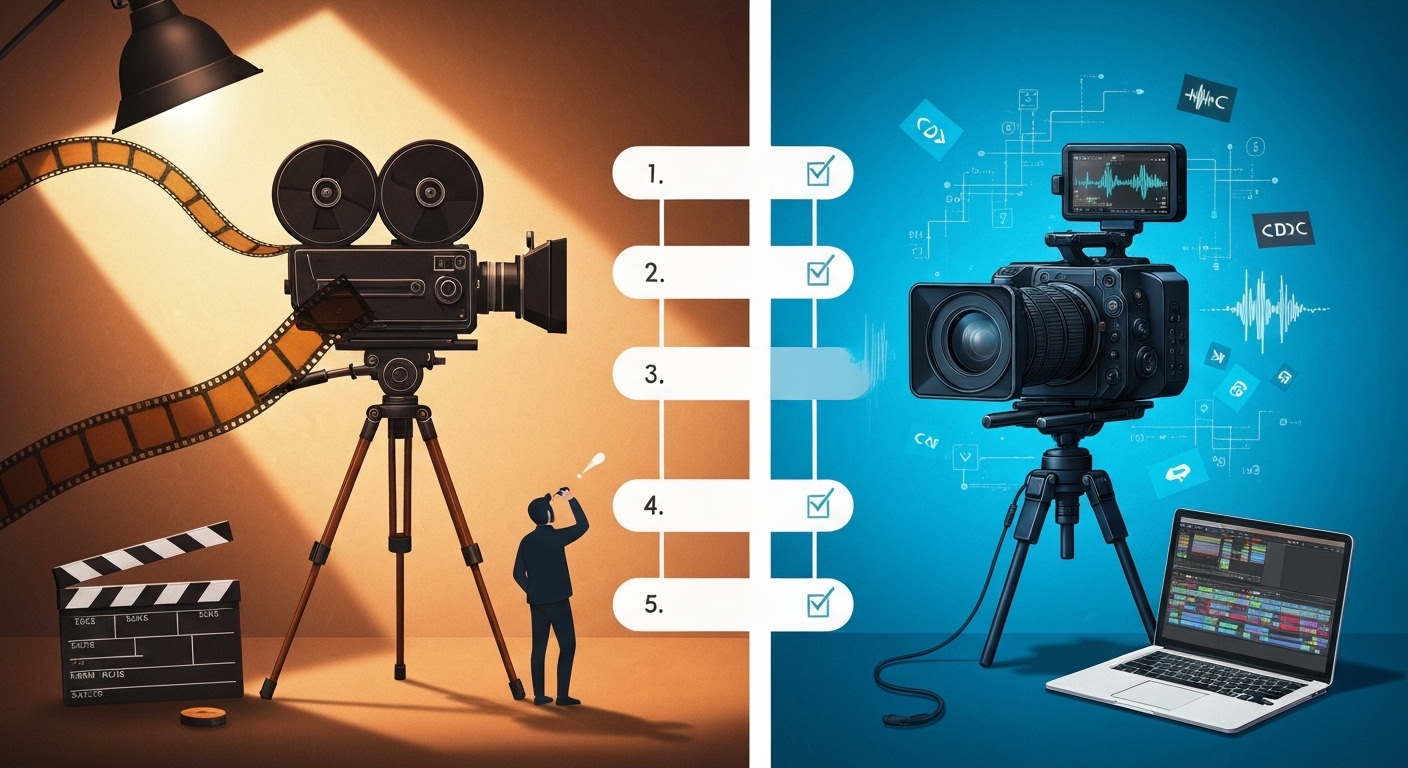
Introduction
Choosing between film or video production isn't about preference. It's a technical specification that defines your project's DNA. Over 95% of projects now use digital sensors, yet the aesthetic and budgetary divide remains stark.
As an industry strategist, I’ve structured the core differences into a 5-point framework. This insider breakdown reveals hidden cost drivers and the single workflow stage where 70% of budgets bleed.
The wrong choice costs more than money. It risks a mismatched aesthetic that audiences feel unconsciously, undermining your narrative authority and brand perception.
Will you prioritize organic grain or digital sharpness? Does your budget allow for lab development, or demand laptop-speed workflows? What does the convergence of ARRI Alexa and film emulation mean for your "cinematic" look?
We’ve analyzed the latest technical forums and production standards to move past outdated debates. Our methodology dissects each variable—from highlight roll-off to post-production codecs.
Your perfect project match is a 7-minute read away. Let’s cut through the noise and roll camera.
Film vs video: why the core distinction determines your project's dna
The choice between film and video is not a matter of semantics; it’s a foundational decision that dictates your project’s budget, timeline, aesthetic, and final impact. While the terms are often used interchangeably, they refer to fundamentally different mediums. Film production captures visuals using photochemical film stock, a process that chemically imprints light to create organic texture and depth. In contrast, video production relies on digital sensors and codecs to record moving images electronically, prioritizing speed, flexibility, and cost-efficiency. This core distinction—a physical, chemical process versus an electronic, digital one—informs every subsequent choice, from the cameras you rent to the post-production suite you book. Getting this right from the start is what separates a project with a coherent, intentional identity from one that feels technically and aesthetically disjointed.
From celluloid to codecs: how origins shape modern workflows
To understand today’s workflows, look to yesterday’s technologies. Film’s lineage traces back to celluloid strips, a physical medium that required chemical development in a lab before a single frame could be viewed. This created a linear, deliberate, and costly process centered around scarcity—every roll of film was a finite resource. Video, born from television broadcast technology, introduced the paradigm of electronic signals and instant playback. This heritage of immediacy shapes modern digital video’s entire ethos: rapid capture, instant review, and non-linear editing. For example, a director on a film set historically had to wait for "dailies" from the lab, while a video director can review a take seconds later on a monitor. These origins are not just history; they are embedded in the DNA of each medium’s contemporary workflow, influencing the pace, cost, and creative rhythm of your production today.
Grain vs noise: the technical battle that defines your visual signature
The most tangible technical difference between film and video lies in their visual texture: grain versus noise. This isn't a minor detail; it's the signature of your medium. Film grain is an organic byproduct of silver halide crystals on the film stock. It’s often described as aesthetically pleasing, adding texture and depth in a predictable, filmic pattern. Digital video, however, produces noise—a digital artifact from the sensor’s amplification of light, especially in low-light conditions. This noise manifests as random, colored speckles that can degrade image quality.
As one technical analysis from EOSHD notes, “Film grain is simple black dots in predictable patterns, video noise is coloured dots... moving quickly.” This fundamental difference cascades through the image:
- Highlight Handling: Film is renowned for its smooth highlight roll-off, where overexposed areas blend gracefully. Digital video can suffer from abrupt "clipping," where highlights become pure, detail-less white.
- Color Science: The photochemical response of film stock creates a distinct, often warmer color rendition. Digital color is derived from sensor data and algorithms, offering immense flexibility but requiring skilled grading to avoid a sterile, digital look.
- Dynamic Range: While modern digital cinema cameras like the ARRI Alexa have narrowed the gap by expertly emulating film’s characteristics, the technical pursuit of a "film look" with digital tools is essentially an attempt to replicate these organic qualities—the grain structure, the roll-off, and the color depth—within an electronic workflow.
Choosing your medium means choosing which of these technical battles you want to fight—or embrace—to achieve your desired visual signature.
Lab vs laptop: 3 workflow stages where time and money divergge
The practical divergence between film and video crystallizes in three key workflow stages, directly impacting your schedule and budget:
- Acquisition & On-Set Review: Film requires meticulous stock management, loading, and unloading magazines. Crucially, there is no instant playback; directors rely on monitors showing a video tap, but true quality assessment waits for lab-processed dailies. Video provides immediate digital playback on-set, allowing for instant corrections and faster shooting days.
- Processing & Ingest: Film’s non-negotiable step is physical lab development (and potentially telecine scanning to digital), adding days to the timeline and significant cost per foot of stock. Video workflow involves a Digital Imaging Technician (DIT) transferring files directly to storage drives, enabling editing to begin almost immediately.
- Post-Production Flexibility: Film, once scanned, enters a digital post workflow similar to video. However, the "look" is more baked-in from the stock and development. Video offers total flexibility in post; the raw digital files can be pushed, colored, and manipulated extensively, for better or worse. The initial choice locks you into a path of either working with a photochemical foundation or sculpting from a digital one.
Organic warmth vs digital sharpness: what your audience unconsciously feels
Beyond specs, the choice influences subconscious audience perception. The organic warmth and texture of film often evoke nostalgia, authenticity, and cinematic grandeur. Its slight imperfections and grain can feel human and timeless, which is why directors like Christopher Nolan use it for epic narrative features. The audience feels the texture. Conversely, the pristine sharpness and clarity of high-end digital video can project modernity, precision, and immediacy—ideal for commercials, corporate videos, or nature documentaries where clinical detail is paramount. However, poorly executed digital video can feel sterile, harsh, or "soap-opera-like," breaking cinematic immersion. Your medium subtly cues the audience on how to emotionally engage with the content, making the aesthetic choice a direct communication tool.
Budget reality check: why film costs more (and when video saves more)
The cost disparity remains the most concrete differentiator. Film production incurs significant hard costs that video eliminates: purchasing film stock, lab development fees, telecine scanning, and the rental of specialized cameras. A single minute of 35mm film can cost hundreds in stock and processing alone before a single edit. Video’s costs are primarily in equipment rental and personnel, with negligible media costs. Therefore, video saves more on projects with high shooting ratios, tight turnarounds, or limited budgets. However, for a project where the specific, irreplicable aesthetic of film is a non-negotiable artistic requirement, its cost becomes an investment in the final product's unique value. The budget question isn't just "which is cheaper?" but "what is the cost of not achieving the intended look?"
Narrative features vs social clips: mapping your goal to the right medium
Your project’s ultimate goal is the best compass for this decision. Map your objective to the medium’s native strengths:
- Choose Film (or High-End Digital Emulation) For: Theatrical narrative features, prestige television, and artistic projects where a timeless, textured, and emotionally resonant aesthetic is paramount. The process itself—its deliberateness and physicality—can also benefit the performance and directorial approach.
- Choose Video For: Commercials, corporate communications, social media content, documentaries, live events, and any project requiring rapid iteration, high-volume shooting, or real-time delivery. Its flexibility and efficiency are unmatched for content that lives on digital platforms.
Most projects clearly lean towards one pole. A feature film festival submission has different demands than a viral TikTok series. Aligning your medium with your distribution platform and audience expectation is a strategic imperative.
The blurring line: why your 'film look' might be digital
Today, the line is intentionally blurred. With digital cinema cameras (ARRI, RED, Sony Venice) and advanced color grading software, skilled cinematographers can create imagery that convincingly mimics the organic qualities of film. Many "films" released in theaters are shot digitally. The distinction is less about the physical medium and more about the artistic intent and technical execution. The modern question is often: "Do we want a filmic aesthetic?" rather than "Will we shoot on film?" This convergence means expertise in crafting the look—through lighting, lens choice, and color science—has become as critical as the choice of capture medium itself.
Your 5-point choice checklist: from budget to aesthetic, make the call
Synthesize everything with this actionable framework. For your project, decide:
- Primary Audience & Platform: Is it for theatrical/cinematic release or digital/social platforms?
- Non-Negotiable Aesthetic: Do you require the organic texture of film, or is digital sharpness acceptable/desired?
- Budget & Timeline Reality: Can you accommodate film's hard costs and lab delays, or do you need video's speed and lower media costs?
- Creative Process: Will the discipline of film benefit the production, or does the project need the flexible, iterative nature of video?
- Post-Production Vision: Do you want a more "baked-in" starting point (film) or maximum flexibility for digital manipulation (video)?
Answering these points will guide you to the medium that aligns with your project’s DNA, ensuring every subsequent decision supports a coherent, powerful final product.
Conclusion
You've navigated the critical path from defining your project's DNA to weighing the technical battle of grain versus noise. You now possess the 5-Point Framework to make a confident, strategic choice for your project.
Applying this framework, you can project your success: a project that aligns perfectly with its budget, timeline, and desired emotional impact. You'll avoid the costly mismatch of using a film workflow for a social media campaign or the aesthetic compromise of a digital look for a cinematic feature. The data is clear—while digital workflows dominate for speed and cost, the organic warmth and depth of film remain the gold standard for prestige narrative work, a distinction audiences unconsciously feel.
However, the industry's timeline is accelerating. The convergence of technology means the 'film look' is increasingly accessible digitally, but mastering this requires expertise available now. The cost of inaction isn't just a budgetary overrun; it's a project that fails to connect because its medium clashes with its message.
Before you finalize your plan, ask yourself three critical questions:
- Does my budget have a hidden line item for film stock, processing, and scanning?
- Is my desired aesthetic organic grain or digital sharpness, and does my team have the skill to achieve it with either medium?
- Does my post-production timeline account for a lab development process, or does it demand instant playback?
The complexity is manageable. You are now equipped with a professional framework that cuts through the noise. The final step is to apply this checklist to the unique contours of your specific vision, goals, and constraints.
Take your 5-Point Checklist and run a final diagnostic on your project plan with our team. We’ll help you map your creative goals to the perfect technical execution. 🎬
Sources
- https://www.venturevideos.com/insight/video-production-vs.-film-production
- https://www.everywow.ch/en/2023/12/comparing-video-production-vs-film-production/
- https://royaldigitalagency.com/blogs/video-production-vs-film-production/
- https://www.eoshd.com/comments/topic/8594-the-technical-difference-between-film-video-how-to-achieve-filmic-image-quality/
- https://www.simply-thrilled.com/post/what-are-the-differences-between-video-and-film-production