
Cultural mediator services paris france: your bridge to authentic cultural access (a practical guide)
Introduction
A cultural mediator is not a tour guide. In Paris, over 80% of major institutions now list mediation as a core budget line for 2026. This article is your cultural mediator services Paris France blueprint.
As an insider, I’ll decode the hidden mechanics of this field—from the RNCP-certified skill set to the unspoken networking rules that secure Parisian contracts. This guide’s six sections will map your path from concept to career.
Without this knowledge, you risk misaligned projects, rejected funding, and missed connections in France’s most competitive cultural market.
Ready to move beyond theory? We’ll answer: What exactly defines cultural mediation versus simple explanation? What are the four key roles that make a mediator indispensable? And crucially, what are the two biggest hurdles to building a career in Paris?
Our analysis is grounded in the latest 2026 RNCP framework (E1103) and institutional mandates. We employ a structured, actionable methodology used by professionals.
Your roadmap to authentic cultural access starts now. Estimated read: 8 minutes. ⏱️ Let’s build your bridge.
Cultural mediation: beyond translation, the art of creating dialogue
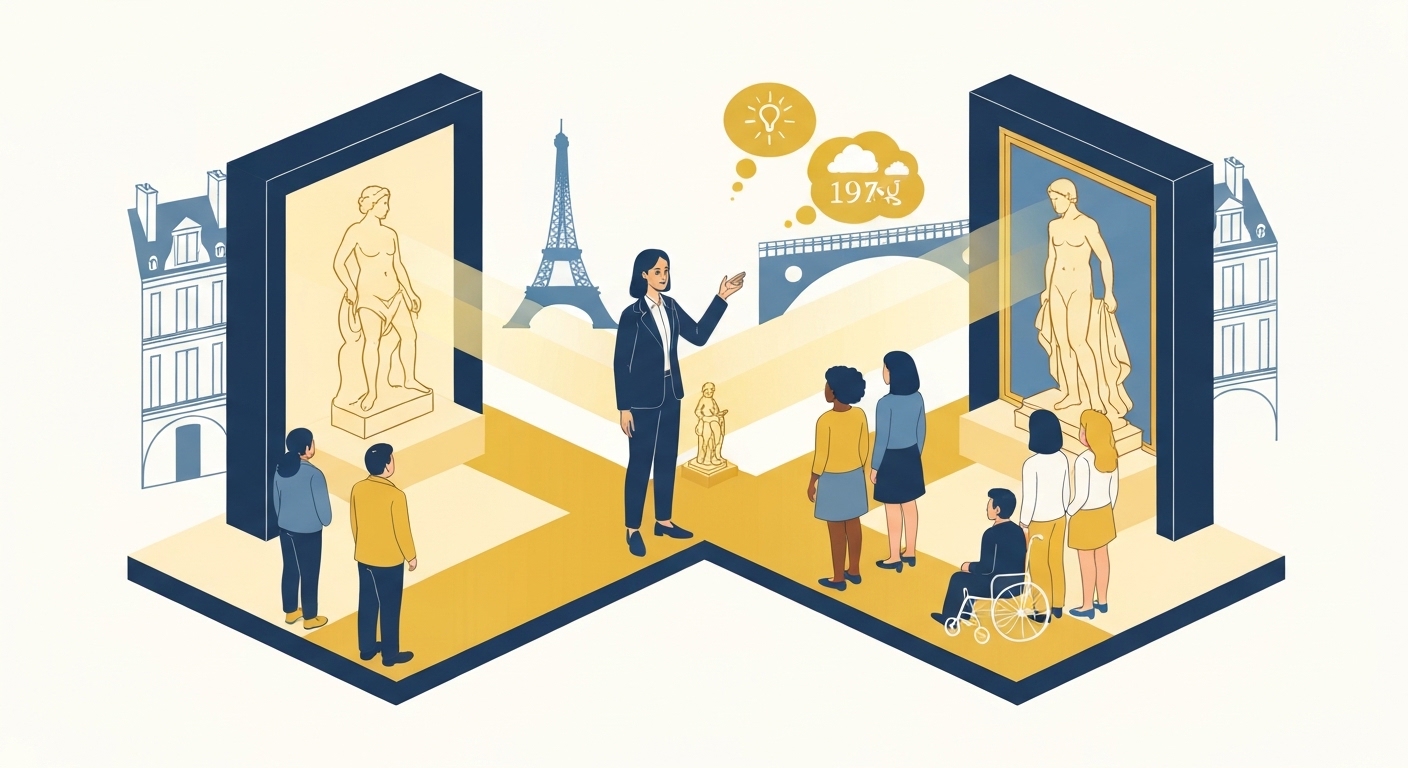
Cultural mediation is not about simply translating facts. According to the official RNCP 14595 certification (validated for 2026), it is defined as "the set of projects that aim to establish a dialogue between culture, an artistic production or event, or a heritage 'object,' and the public." This moves beyond explanation to create a two-way exchange, fostering physical, social, and intellectual access through workshops, guided visits, and artist encounters.
This practice is a direct application of France's national policies on cultural rights and artistic education (EAC), making it a strategic function for public funding and social inclusion. It transforms a passive viewing into an active, shared experience. Understanding this core definition is the first step to leveraging its power, which we see operationalized in the specific roles a mediator plays.
The cultural mediator's toolkit: 4 key roles that transform visitor experience
A cultural mediator acts as the essential bridge, wielding a multifaceted toolkit defined by the RNCP framework (ROME E1103). Their work systematically transforms a standard visit into a personalized journey. The four key roles are:
- The Strategist & Planner: They translate an institution's cultural policy into concrete projects. This involves designing program calendars, budgeting, and planning actions like workshops or concerts that align with seasonal themes and audience goals.
- The Facilitator & Educator: This is the most visible role. They welcome diverse publics, provide keys to understanding complex works, and lead participatory activities. For example, at the Philharmonie de Paris, mediators run instrumental workshops to prepare audiences for a concert, demystifying the music before the first note is played.
- The Networker & Liaison: They maintain a crucial carnet d'adresses (address book) of artists, community leaders, and partner organizations. This network is indispensable for sourcing talent, co-creating events, and ensuring projects resonate with specific communities.
- The Analyst & Communicator: They conduct trend analysis to adapt offerings and handle the communication for their events, from social media promotion to post-event feedback collection.
Mastering these roles creates profound engagement. To see this toolkit in action, we must examine the primary career paths where these skills are deployed across France.
Where cultural mediators work: the 3 main career paths in france (and their realities)
The profession, classified under ROME code E1103, offers three distinct primary career paths, each with its own contractual realities and demand drivers. Understanding these paths is crucial for navigating the job market.
- The Public Sector Mediator (Fonctionnaire Territorial):
- Reality: Employed by cities, departments, or regions (e.g., managing a municipal museum's outreach program). Access is via competitive civil service exams (concours). This path offers high job security and structured career progression but can involve slower project innovation due to administrative processes.
- The Institutional Mediator (Salarié du Secteur Privé ou Associatif):
- Reality: Directly employed by major museums, private foundations, large festivals, or production companies. Positions are often tied to specific exhibitions or long-term programming. Demand is directly linked to cultural programming cycles, leading to project-based contracts. For instance, a major Parisian museum will hire a team for a 6-month blockbuster exhibition.
- The Freelance Mediator (Intermittent du Spectacle ou Indépendant):
- Reality: Works on short-term contracts for multiple institutions or as part of a collective. Many join networks like the Paris-based Collectif WOW. This path offers great variety and autonomy but requires relentless networking and personal administration for billing and securing the next contract.
While national employment statistics for 2026 are pending publication, observed practice confirms high demand in Parisian museums and cultural institutions, driven by continuous programming and audience diversification goals. To tap into this demand, especially in the capital, requires a specific strategy.
Building a career in paris: the essential checklist and the 2 biggest hurdles to anticipate
Succeeding in Paris's dense cultural ecosystem requires more than just skills. Follow this essential checklist and prepare for the two most significant hurdles.
The Essential Checklist:
- Master the RNCP Framework: Your competency in the E1103 roles is your professional currency.
- Build a Paris-Specific Network: Attend professional salons, connect with collectives, and engage with programs at institutions like the Cité de la Musique.
- Develop Niche Expertise: Specialize in a domain (e.g., digital mediation, contemporary dance, accessible programming) to stand out.
- Perfect Your French Proficiency: Fluency at a B2+ level is a non-negotiable requirement for public interaction and institutional collaboration.
The 2 Biggest Hurdles to Anticipate:
- The "Carnet d'Adresses" Barrier: As one seasoned professional notes, "In Paris, your network is your first CV." Breaking into the close-knit circles of institutional programmers without internal referrals is the single most common challenge for newcomers. Your portfolio matters, but a recommendation matters more.
- The Administrative Labyrinth: For non-EU candidates, navigating the **Talent Passport or salarié visa process** requires meticulous preparation with official service-public.fr resources. For all, understanding the complexities of intermittent du spectacle status or public tender processes (marchés publics) for freelancers is a significant operational hurdle.
With these barriers in mind, the process for an institution or project leader to find the right mediator becomes a critical skill.
How to find & hire the right mediator in paris: a 5-step framework for success
Identifying and engaging the ideal cultural mediator in Paris requires a structured approach to navigate the field's diversity. This five-step framework ensures you find a partner, not just a provider.
- Define the Core Need & Audience: Precisely outline the project's goal (e.g., "engage teenagers with Renaissance art") and target public. This clarity will filter candidates.
- Source Through Specialized Channels: Look beyond generic job boards. Search professional association rosters, platforms like Collectif WOW for independents, and the career pages of analogous institutions (e.g., if you run a gallery, check who the Pompidou Center uses).
- Evaluate Against the RNCP Toolkit: During interviews, assess concrete experience in the four key roles. Ask for specific examples of past strategies, facilitated workshops, and network partnerships they leveraged.
- Review Past Projects & Methodologies: Request case studies or project summaries. Look for evidence of impact measurement, adaptability, and how they handle feedback from diverse groups.
- Clarify Contractual & Creative Terms: Clearly agree on deliverables, timelines, communication protocols, and intellectual property. For freelance engagements, ensure the contract aligns with their status (auto-entrepreneur, portage salarial).
This framework leads to successful partnerships, the value of which is best understood through concrete examples.
Inside paris museums: 3 concrete scenarios where a mediator makes the difference
- The Daunting Contemporary Exhibition: At the Musée d'Art Moderne, a visitor is perplexed by a complex video installation. A mediator doesn't just explain it; they facilitate a short group discussion, using guided questions to help the visitor connect the work to contemporary social themes, transforming confusion into personal relevance.
- The Family Workshop: At the Philharmonie de Paris, a mediator leads a "Sound Discovery" workshop for children before a family concert. Using simple instruments and movement, they decode the musical concepts to be heard, ensuring the children are active, engaged listeners rather than restless attendees.
- The Community Partnership Program: For a temporary exhibition on immigration, a museum's mediation team partners with local community centers. The mediator co-creates a storytelling session where elders from the community share their own narratives alongside the historical artifacts, creating a living, dialogic experience that standard audio guides cannot provide.
Conclusion
You now possess the complete blueprint for cultural mediator services Paris France. We’ve moved from the foundational definition—establishing a dialogue, not a monologue—through the four key roles of the mediator’s toolkit, and mapped the three main career paths with their practical realities. You’ve seen the essential checklist for Paris and the framework to hire the right professional. This journey equips you with more than information; it provides a structured methodology to either build a career or design a project with precision.
Imagine the outcome of applying this methodology: your cultural project achieves authentic, measurable engagement because it’s built on the RNCP E1103 framework, not guesswork. Your institution avoids the costly misstep of a one-size-fits-all approach, instead creating resonant experiences that fulfill public service mandates and justify funding. For the aspiring mediator, this means entering the market not as a hopeful candidate, but as a strategic professional who speaks the language of institutions and understands the levers of impact.
The timeline for action is not arbitrary. Major Parisian institutions are finalizing their 2027 programming and budgets now. The strategic planning cycle for the next cultural season is already underway. Delaying your move means missing the window to be included in these plans, potentially ceding opportunities to those who are already prepared with a clear strategy and a professional network.
Before you move forward, ask yourself these three critical questions based on the guide:
- For Project Leaders: Does my current plan address all four key roles of the mediator, or am I risking a gap in strategy, facilitation, networking, or analysis?
- For Institutions: Am I evaluating potential mediators against the concrete RNCP framework and Paris-specific hurdles, or relying on a generic CV?
- For Aspiring Mediators: Is my carnet d’adresses and niche expertise developed enough to overcome the primary networking barrier in Paris’s competitive ecosystem?
The complexity you may have perceived at the outset has been deconstructed into actionable steps. You are now ahead of the curve, equipped with the professional framework that separates ad-hoc efforts from institutional-grade cultural mediation.
Your next step is to apply this framework to your specific context. Whether you are refining a project proposal, beginning a job search, or seeking to hire, the structured approach from Section 5 is your operational guide. Use it to draft your brief, audit your skills, or initiate your search with precision.
Sources
- https://www.francecompetences.fr/recherche/rncp/14595/
- https://metiers.philharmoniedeparis.fr/mediateur-culturel.aspx
- https://www.cidj.com/s-orienter/metiers/mediateur-culturel-mediatrice-culturelle
- https://oniseptv.onisep.fr/video/mediateur-culturel
- https://www.hellowork.com/fr-fr/metiers/mediateur-culturel.html