
Digital cinematography workflow: the complete guide to mastering the modern pipeline (from pre-vis to post)
Introduction
The digital cinematography workflow is not just about cameras. It's a 40-year evolution where 70% of VFX now relies on cloud pipelines. Forget the myth that cinematography ends on set.
As an insider, I’ll detail the hidden benefits of this integrated pipeline across four critical sections. Mastering it is non-negotiable for modern cinematographers.
Ignoring this holistic view risks creative compromise, budget overruns, and technical obsolescence. Your role is now defined by data management as much as lighting.
Are you prepared to demarcate on-set from post-production responsibilities? Can you leverage virtual production workflows for real-time decisions? Do you understand the three new core skills required beyond operating a camera?
This guide analyzes the latest standards, from ArriRaw metadata to Unreal Engine integration, providing a structured methodology for 2026.
Your complete roadmap to mastering the modern pipeline awaits. Estimated read: 8 minutes. 🎬 Let's develop your workflow.
Why 40 years of digital evolution redefined every step of filmmaking
The modern digital cinematography workflow is a complete pipeline, not a single tool. Its evolution, spanning four decades, has systematically replaced analog processes with integrated digital systems, fundamentally altering creative and technical control. The shift began not with cameras, but with editing: 1984-1985 saw the first digital editing systems like Lucasfilm's EditDroid, while 1989 marked the widespread adoption of Avid/1 software, moving montage from physical splicing to a non-linear timeline.
This digital foundation enabled the camera revolution. The early 2000s introduced the first HD digital cameras for major features like Star Wars Episode II (2002). The pivotal 2006-2012 period normalized digital acquisition with cameras like the Arri Alexa and RED, offering larger sensors and better dynamic range, as seen in Slumdog Millionaire (2008). The introduction of ArriRaw uncompressed formats in 2012 (e.g., Amour) gave cinematographers a digital negative with the flexibility of film. Today, the workflow extends into virtual production and LED volumes (e.g., The Mandalorian), integrating real-time rendering with on-set capture.
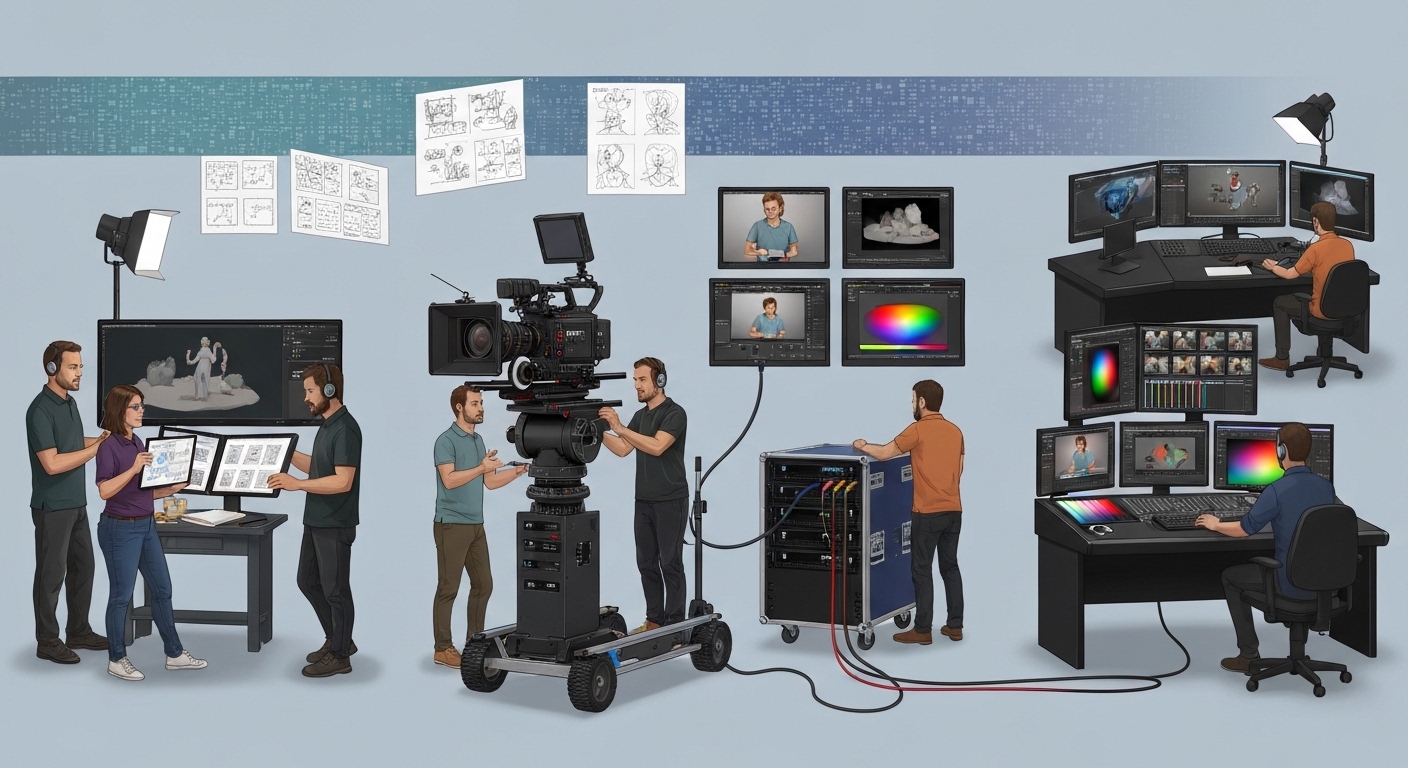
This historical pivot means every phase is now data-centric:
- Pre-Production: Tools like Unreal Engine enable virtual scouting and lighting pre-visualization.
- Acquisition: Choices between RAW (ArriRaw, REDCODE) and compressed codecs dictate post-production flexibility.
- On-Set: The role of the Digital Imaging Technician (DIT) is critical for data management, LUT application, and dailies.
- Post-Production: The shift from on-premise suites to cloud-based collaboration (e.g., AWS for dailies, Frame.io for editing) allows for real-time, global workflows, with industry analysts noting over 70% of VFX pipelines now leverage cloud infrastructure.
Understanding this evolution is not academic; it's the blueprint for the integrated, data-driven pipeline that defines professional cinematography in 2026, where creative decisions are inextricably linked to technical workflow choices.
From camera operator to data manager: the 3 new core skills for cinematographers
The cinematographer's role has expanded beyond lighting and composition into the realm of data stewardship. As expert analysis notes, "Digital workflows are now the foundation that arranges and coordinates the collective work and action of the film team." This demands three new core competencies.
First, technical data literacy. The DP must now understand codecs, data rates, and color science to make informed acquisition choices. For instance, selecting **ArriRaw for Amour (2012) preserved maximum dynamic range for the film's nuanced interiors, a decision made with the full post pipeline in mind. Second, on-set color management. The cinematographer collaborates with the DIT to establish and monitor Look-Up Tables (LUTs), ensuring the intended color palette is baked into dailies and communicated to post, solving the classic problem of color inconsistency across departments. Third, metadata and asset management oversight. Every shot is now a data package; the DP must ensure critical metadata for the colorist and VFX teams is accurately captured and preserved throughout the workflow.
Mastering these skills transforms the cinematographer from a department head into the central node of a digital pipeline**, ensuring creative vision survives the journey from sensor to screen.
On-set vs. post-production: demarcating the cinematographer's digital toolkit
A clear boundary between on-set and post-production responsibilities is essential for an efficient workflow. The cinematographer's primary digital toolkit is focused on acquisition and initial image control, while handing off a well-prepared asset for finishing.
The On-Set Toolkit (Cinematographer's Domain):
- Cameras & Recorders: Selecting the camera system (Arri Alexa, RED, Sony Venice) and recording format (e.g., ArriRaw, ProRes RAW).
- Monitoring & LUTs: Using calibrated on-set monitors and LUT boxes to visualize the final grade during shooting.
- Data Management: Overseeing the DIT who offloads, verifies, and backs up media, often initiating cloud uploads for dailies.
The Post-Production Toolkit (Handoff to Specialists):
- Editing: Using software like Avid Media Composer (the industry standard for narrative film).
- Grading: Advanced digital étalonnage on consoles like DaVinci Resolve or Baselight for final color correction.
- VFX & Finishing: Specialized software (Nuke, Flame) for compositing and final output.
The demarcation is clear: the cinematographer captures and controls the image's foundational look on set. They solve problems like high data rates by choosing between RAW and compressed formats and ensure quality via metadata standards. The post team then uses these pristine, well-documented assets for creative finishing. This separation, enabled by digital tools, allows for specialized expertise while maintaining a cohesive vision.
Why industry veteran insight is non-negotiable for complex workflows
For workflows involving virtual production, hybrid shoots, or unique creative demands, generalized knowledge reaches its limits. Navigating the integration of LED volumes, real-time engines, and traditional cinematography—or managing the data deluge of 8K multi-camera shoots—requires practiced judgment. This is where the insight of an industry veteran, someone with credits on pioneering digital films and a deep understanding of the pipeline's evolution, becomes critical. Their experience provides the contextual framework to anticipate pitfalls, optimize collaboration between departments, and ensure that technical complexity serves the story, not the other way around.
Conclusion
You’ve just navigated the complete blueprint of the modern digital cinematography workflow—a journey from the foundational shifts of the 1980s to the integrated, data-driven pipeline that defines professional filmmaking today. Think of this guide as your master shot list for the entire production process, where every technical decision is a creative one.
Implementing this framework projects you into a state of creative sovereignty and technical confidence. You’ll move from reactive problem-solving to proactive vision-keeping, ensuring the look you design on set survives intact through post. The data proves it: with over 70% of VFX pipelines now cloud-based, mastering this workflow isn't just about efficiency—it's about accessing global talent, enabling real-time collaboration, and future-proofing your projects against rapid technological obsolescence.
However, the industry’s timeline waits for no one. The acceleration towards virtual production and cloud-native post is not a distant trend; it’s the 2026-2027 standard. Projects that cling to fragmented, legacy workflows face a steep cost: creative compromise from poor handoffs, budget overruns from inefficient data management, and competitive irrelevance as peers leverage integrated pipelines for faster, more ambitious storytelling.
Before your next call sheet is finalized, ask yourself these three questions:
- Is my on-set LUT and metadata strategy robust enough to guarantee the colorist receives exactly what I envisioned?
- Have I clearly demarcated responsibilities between my DIT and the post house to prevent costly data mishaps or versioning errors?
- Does my plan account for the specific demands of hybrid or virtual production shoots, where real-time engine data must flow seamlessly with camera feeds?
If any doubt remains, remember this: the complexity is manageable. You are now equipped with the architectural knowledge—the evolution, the core skills, the tool demarcation—that places you ahead of the curve. The final, critical step is adapting this universal blueprint to the unique contours of your specific story, team, and technical challenges.
Let’s develop your project’s customized workflow. Book a consultation to translate this framework into a bulletproof plan for your next shoot. 🎬