
French business protocol film production: your legal and administrative assurance for corporate projects
Introduction
Over 90% of corporate films lack mandatory RCA registration. This exposes your company to fines up to 20% of turnover. French business protocol film production is not a simple video shoot—it's a regulated legal act.
As an insider, I'll reveal the hidden administrative levers and contractual safeguards that protect your budget and reputation. This guide dissects the 2026 framework across four critical sections.
The cost of inaction is severe: unenforceable contracts, CNC sanctions, and the loss of your intellectual property. Your communication asset becomes a liability.
Do you know which three administrative bodies hold the keys to your film's legality? Can you distinguish a contractual framework that protects you from a standard service agreement? Have you verified the 5-point legal checklist that shields your project?
We analyze the latest CNC decrees and the consolidated Code du cinéma. Our structured methodology moves from regulatory foundations to actionable compliance.
Your roadmap to assured production starts now. Estimated reading time: 7 minutes. Let’s roll the legal credits on your project.
Why 3 administrative bodies hold the keys to your film's legality
Navigating the French audiovisual landscape requires more than creative vision; it demands precise administrative navigation. Your project's legality hinges on three distinct bodies, each with a non-negotiable role in the 2026 regulatory framework. Ignoring any one of them exposes your production to significant financial and operational risk.
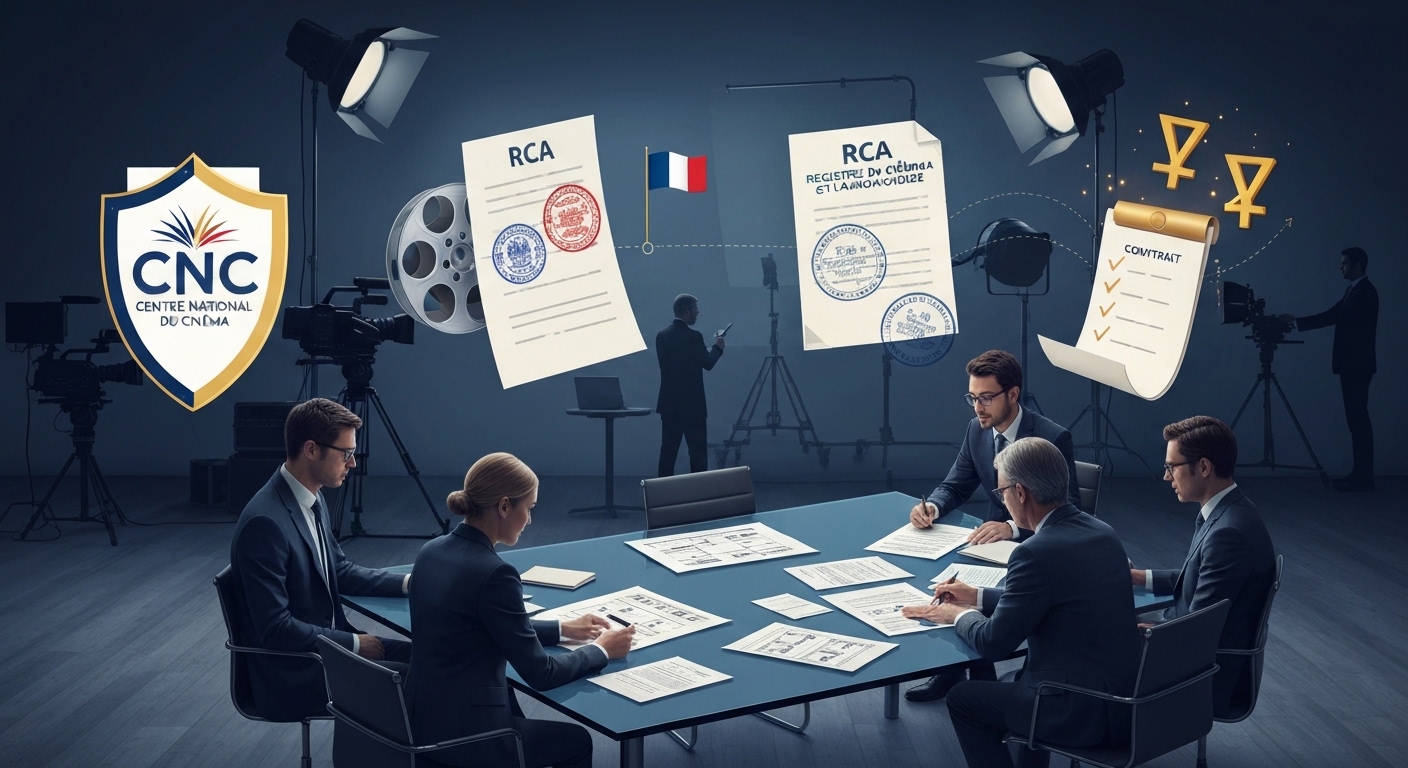
The Centre national du cinéma et de l'image animée (CNC) is the central regulator. It oversees all cinematographic works, requiring mandatory declarations from producers and distributors. Its authority extends to imposing sanctions, including fines of up to 20% of a company's turnover and operational closures for non-compliance. For a business protocol film, the CNC's oversight ensures the project adheres to the broader industry code, regardless of its non-artistic, corporate purpose.
Second, the Registre public du cinéma et de l'audiovisuel (RCA) provides the legal bedrock for your production contract. Registration here is not optional for formal production entities; it is the act that makes your contract opposable to third parties. This step is critical for corporate legal and HR teams to verify the enforceability of agreements and the chain of title for the finished work.
Finally, the Société des Auteurs et Compositeurs Dramatiques (SACD) manages the complex web of author rights inherent in any commissioned audiovisual work. While your contract will cede economic rights, the SACD framework ensures the moral rights of authors are respected and that remuneration structures, such as the rémunération non proportionnelle proportionnelle (RNPP) defined in CPI L.132-25, are correctly applied.
Mastering this triad transforms your film from a simple corporate video into a legally sound, protected asset. This foundational compliance is what separates a professional protocol from an amateur project.
Business protocol film: beyond a simple video, a contractual framework that protects you
A business protocol film is fundamentally a contrat de commande—a commissioned work. While there is no explicit "business protocol film" category in the Code du cinéma, it falls squarely under the legal definition of 'œuvres cinématographiques ou audiovisuelles'. The key differentiator is its contractual DNA: a commissioner (commanditaire) engages an author or producer to create a work with a pre-defined object, theme, and duration for a specific corporate use.
This framework creates a structured exchange of obligations that protects all parties. The producer (délégué) is legally bound to finance the project, secure all necessary rights (image, location, music via SACEM), and deliver the agreed-upon work, bearing liability for any budget overruns. The commissioner's power lies in defining the precise purpose, approving deliverables, and securing a comprehensive cession of economic rights for the intended uses. Crucially, the author retains inalienable moral rights, while economic rights must be transferred explicitly in writing, with the exception of the composer's rights per CPI L.132-24.
Consider these concrete applications:
- A global tech firm commissions a training film for 10,000 new hires. The contract meticulously defines global internal diffusion rights, e-learning platform integration, and clauses for future updates.
- A luxury group produces a brand heritage film for investor relations. The protocol ensures exclusive control over the film's use in financial communications and strictly prohibits public advertising without further negotiation.
This contractual rigor transforms the video from a disposable service into a durable, owned asset, shielding your company from disputes over scope, usage, and intellectual property.
The 5-point legal checklist that shields your project from sanctions
Relying on a handshake or a generic service agreement is the fastest way to encounter CNC sanctions or an unenforceable contract. Based on the consolidated 2026 legal framework, here is the non-negotiable checklist to secure your production.
- Mandatory RCA Registration: Verify that your production contract is published in the Registre public du cinéma et de l'audiovisuel (RCA). This is not a formality; it is the legal act that makes the contract opposable to third parties and is obligatory for any production involving a registered company. An unregistered contract is a critical vulnerability.
- Explicit & Comprehensive Rights Cession: Your contract must contain a precise cession clause for economic copyrights. It should enumerate every intended use (e.g., internal training, corporate website, investor events, social media) and specify territories and duration. Vague language like "all media" is insufficient and legally risky. Remember, the composer's rights require a separate, specific agreement.
- CNC Declaration Compliance: Confirm that your producer is fulfilling all mandatory declarations to the CNC regarding the cinematographic work. Even for non-commercial diffusion, the project falls under CNC oversight. Non-compliance can trigger the sanctions regime.
- Clear Definition of the Producer's Role: Legally distinguish between the producteur délégué (who holds financial and editorial responsibility and the rights) and a producteur exécutif (who merely executes production tasks). Contracting with the wrong entity can leave you with no rights to the finished film. As highlighted in industry analysis, "Le producteur s’engage à livrer ce qui a été convenu... à ses frais et à ses dépens" – this guarantee of delivery is a core producer obligation.
- Sanctions Clause Awareness: Understand the repercussions of breaching the Cinema Code. The CNC can impose fines up to 20% of annual turnover and order the temporary closure of operations. Your contract should outline responsibilities for ensuring compliance to mitigate this risk.
This checklist is your first line of defense. It systematically addresses the points where most corporate film projects stumble from a legal perspective.
Real-world protocol: how successful projects navigate complexity (and where yours might need expert guidance)
Successful projects, like those showcased by professional associations, treat legal protocol as integral to pre-production. They engage experts early to navigate RCA registration, tailor rights cessions, and structure approvals. However, complexity arises swiftly. If your project involves international diffusion, complex underlying IP (e.g., adapting proprietary software visuals), recurring productions, or co-commissioning with partners, the standard framework reaches its limits. This is where generic checklists fall short and the nuanced guidance of a specialized legal expert becomes indispensable to design a bespoke contractual architecture for your specific needs.
Conclusion
Your journey through the French business protocol film landscape is akin to navigating a complex legal and administrative blueprint. You’ve moved from understanding the three pivotal administrative bodies—the CNC, RCA, and SACD—to defining the project as a protective contractual framework, and finally arming yourself with a 5-point legal checklist. The core benefit is clear: transforming a corporate video from a potential liability into a legally assured, owned asset.
By applying this framework, you project your production into a state of security. Your contracts become opposable, your intellectual property is definitively yours, and you operate in full compliance with the CNC’s oversight, avoiding the fines of up to 20% of turnover that sanction non-compliant producers. This isn't theoretical; it's the documented standard for enforceable corporate film projects in 2026.
The timeline for action is not defined by a distant reform but by the immediate risk of inaction. Launching a production without this protocol exposes you to delays, unenforceable agreements, and financial penalties from day one. The cost of proceeding without this assurance is measured in legal vulnerability and wasted budget.
Now, conduct a rapid self-assessment on your current or planned project:
- Is your production contract registered with the RCA to guarantee its opposability?
- Does your rights cession clause explicitly list every intended use and territory, beyond vague "all media" language?
- Have you confirmed your producer’s role and their compliance with CNC declarations?
If any answer is uncertain, the stakes are your project's legality and your company's financial exposure.
The complexity is manageable. You are now equipped with the precise map—the definitions, checklists, and regulatory references—that places you ahead of the vast majority of corporate commissioners. The final, critical step is to adapt this general framework to the specific contours of your project.
To move from understanding to execution, schedule a consultation to design your project's bespoke legal protocol. We will review your specific scenario—be it international diffusion, complex IP, or co-commissioning—and build your contractual safeguards. 🎬
Sources
- https://www.legifrance.gouv.fr/loda/id/LEGISCTA000006117945
- https://www.artcena.fr/precis-juridique/droits-dauteurs-et-droits-voisins/droit-dauteur/commande-dune-oeuvre
- https://bnf.libguides.com/droit-films
- https://www.diplomatie.gouv.fr/IMG/pdf/guide_des_contrats_audiovisuels_et_cinematographiques_cle8de4fc.pdf
- https://www.sacd.fr/fr/contrat-audiovisuel-ce-quil-faut-retenir
- https://creatricks.fr/article/production-audiovisuelle-enjeux-juridiques/
- https://www.cnc.fr/a-propos-du-cnc/missions/reglementer/diffusion-non-commerciale
- https://www.laciedesreals.fr/filmdecommande