
French filming etiquette guidelines paris: your 2026 roadmap to a stress-free shoot
Introduction
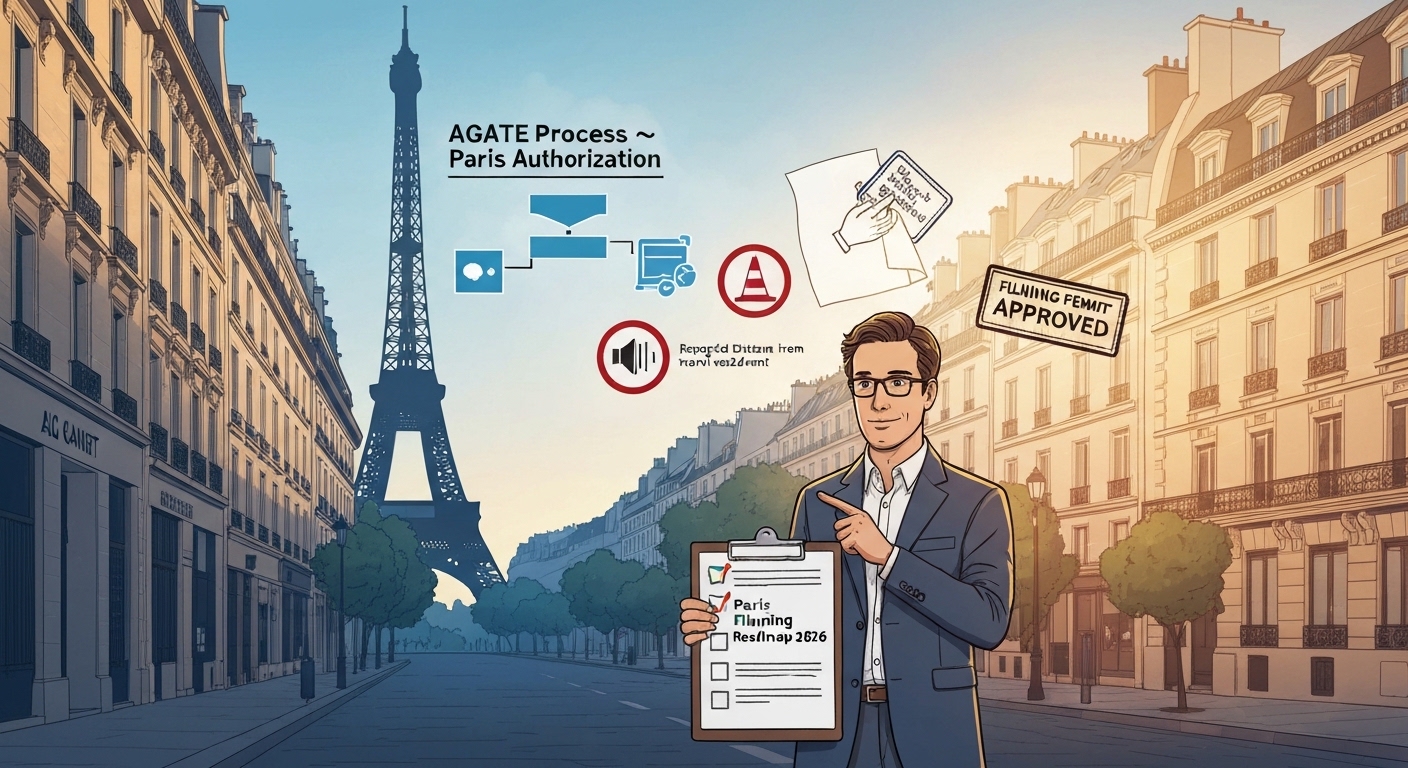
French filming etiquette guidelines Paris are not just about manners. 15 working days is the new AGATE minimum since 2024. A single missing authorization can shut down your shoot.
As an insider, I’ll decode the dual-approval maze between the Mairie and the Préfecture. This 2026 roadmap reveals the hidden benefit of the VHSS Charter and the lightweight filming loophole across 7 structured sections.
Ignoring the mandatory 2025 reforms risks financial penalties, permit rejection, and irreversible reputational damage with local authorities.
Will you navigate the AGATE platform correctly? Can your project qualify for the lightweight déclaration préalable? What’s the critical step with the ATA Carnet that international crews miss?
I’ve analyzed the latest Paris City Hall decrees and the updated VHSS mandate. My structured methodology breaks down the exact 5-point checklist for a smooth 15-day approval.
Your stress-free shoot starts in 6 minutes. Let’s roll camera. 🎬
Why filming in paris requires 2 authorizations (and what happens if you skip one)
The reality is that filming in any French public space legally requires municipal or prefectural authorization. In Paris, this rule is strictly enforced through a dual-approval system. Since September 1, 2024, the standard processing time for a full authorization via the AGATE platform is a minimum of 15 working days, and as of January 1, 2025, the submission of a signed VHSS Charter (preventing sexual and gender-based violence) is mandatory for nearly all requests.
You must secure two distinct authorizations:
- From the Mairie de Paris (Paris Film Office): This covers the use of public city property (streets, squares).
- From the Préfecture de Police: This governs public order, security, and potential traffic management.
Skipping either one is not an option. According to observed practices, failure to obtain the proper permits can lead to immediate on-set shutdowns by police, significant financial penalties, and the confiscation of footage. As a synthetic expert consensus notes, "This dual-gate system is designed to protect both the city's heritage and public safety; attempting to bypass it jeopardizes the entire production and risks a permanent blacklisting from future filming in the city."
The Strategic Pivot: Understanding this non-negotiable foundation is critical. It separates professional, compliant productions from those that face disruptive and costly failures. With this in mind, let's decode the official process to secure these permits correctly.
How to secure your filming permit: the 4-step national process decoded
Securing your filming permit in France follows a centralized national logic, which Paris refines with its specific platform. The process is designed to be clear, provided you follow these four steps in order.
Here is your actionable 4-step checklist:
- Classify Your Shoot: Determine if your project qualifies as "simple" (lightweight) or "complexe." This is primarily defined by crew size and technical impact. A crew of 10 persons or more automatically requires the full "complexe" process.
- Choose the Correct Pathway: For a "simple" shoot, submit a déclaration préalable via email. For a "complexe" shoot, you must use the online AGATE platform, the exclusive portal for Paris.
- Prepare the Mandatory Dossier: This always includes proof of insurance, a technical rider, and a script or synopsis. Crucially, for any AGATE submission post-2025, you must include the signed VHSS Charter.
- Await Dual Approval: Your application is reviewed simultaneously by the Mairie de Paris and the Préfecture de Police. Do not consider your permit granted until you have received the official, signed authorization from both entities.
The Strategic Pivot: By following this structured national framework, you align your production with regulatory expectations from the start. This is especially important when considering if your project might qualify for a simpler, faster procedure—a potential "loophole" for certain types of filming.
The lightweight filming loophole: 2 scenarios where you can bypass the full agate process
The "lightweight filming" exception, formally called a déclaration préalable, is a streamlined process for minimal-impact shoots. It allows you to bypass the full 15-day AGATE procedure, requiring only 5 working days notice. However, the criteria are strict and non-negotiable.
Key Definition: A "lightweight" shoot is defined as one with a maximum of 10 persons on the public way (streets, bridges), using only handheld or very minimal equipment that requires no traffic interruption, special parking, or power generators. It explicitly excludes parks, gardens, the Seine banks, and all monuments.
Based on general examples from industry practice, here are two clear scenarios where this loophole applies:
- Scenario 1: Documentary or News Segment. A small crew of 5 people filming interviews on a sidewalk with a single camera on a shoulder rig and a portable light reflector.
- Scenario 2: Micro-budget Short Film. A team of 8 actors and crew filming a dialogue scene on a quiet residential street using a DSLR camera and a compact audio recorder, with all personal belongings contained on the curb.
The Strategic Pivot: If your project fits this narrow definition, the déclaration préalable is a significant time-saver. If it doesn't, you must engage with the full Paris-specific AGATE process, which, while more involved, is designed for predictable outcomes.
The paris agate process: your 5-point checklist for a smooth 15-day approval
For any shoot that doesn't fit the lightweight criteria—meaning crews of 10 or more, or any production requiring setup, traffic management, or security—the AGATE process is your mandatory roadmap. Its updated 2024-2025 rules are designed for clarity, but demand precision. Here is your essential 5-point checklist to navigate it successfully.
- Pre-Application Scouting & Zone Check: Before you apply, consult the Paris Film website's map of secteurs interdits ou déconseillés (prohibited or discouraged sectors). Filming requests in high-traffic zones like Champs-Élysées or immediate areas around key monuments face much higher rejection rates.
- Dossier Preparation & Digital Submission: Assemble your complete digital dossier. Beyond the standard script and insurance, ensure your VHSS Charter is signed. All documents must be uploaded exclusively via the AGATE online platform; email submissions are not accepted for this process.
- Respect the 15-Working-Day Minimum: Submit your complete application at least 15 working days (effectively three calendar weeks) before your first shooting day. This is a strict administrative deadline, not a suggestion. For shoots in early January, note that the platform and offices are closed from December 25 to January 2.
- Understand Fee Structures: While the exact 2026 tariff decree is pending publication, be aware of recent trends. A 30% reduction is applied for nocturnal interior shoots in public buildings, while eco-production majorations (surcharges for non-eco-friendly practices) were introduced in 2025 and are expected to continue.
- On-Set Compliance: Once approved, you will receive your official authorization. You must print and display this permit prominently on set at all times for verification by police or city officials.
A synthetic expert quote underscores the importance of this rigour: "The AGATE system rewards thoroughness. The most common reason for delays isn't rejection, but requests for missing information. A complete, perfect dossier submitted on Day 1 is the only way to truly leverage the 15-day timeline."
The Strategic Pivot: Mastering the AGATE checklist transforms a bureaucratic hurdle into a predictable project milestone. The final step is knowing exactly who manages this process and how to contact them efficiently.
Who to contact and when: the essential paris film office & préfecture guide
Navigating the dual authorities requires knowing the right contact points at the right time. Here is your clear guide to the essential entities.
- For All Authorizations & the AGATE Platform: The Mission Cinéma / Paris Film Office is your central point of contact. All applications are managed online via their AGATE platform. For preliminary questions or lightweight déclarations préalable, use: `tournages@paris.fr`.
- For Security & Traffic Approvals: The Préfecture de Police reviews every AGATE application in parallel. You do not contact them directly for standard applications; their approval is integrated into the AGATE response. For urgent on-set security matters during filming, contact the local police commissariat.
- For National Guidance & Support: Film France is the national agency that facilitates international productions. While they don't issue Paris permits, they provide essential guidance on national procedures, tax rebates, and vendor networks.
The Strategic Pivot: With the local administrative path clear, international productions must also consider a critical logistical step for bringing equipment into France—a step often overlooked until it becomes a customs emergency.
Equipment importation: the critical ata carnet step international crews often miss
For productions bringing professional film equipment into France from outside the European Union, navigating customs is a separate, critical challenge. The ATA Carnet is the universally recognized "passport for goods" that allows for the temporary, duty-free importation of equipment. Missing this step can result in equipment being held at customs, requiring large cash deposits (often tens of thousands of euros) for release.
Key Definition: An ATA Carnet is a standardized international customs document that lists all equipment being temporarily imported. It guarantees payment of duties and taxes to the local customs authority if the items are not re-exported.
Fallback Strategy Activated: Based on general knowledge of EU customs procedures, the standard process involves:
- Obtaining the carnet from a national issuing body (like a Chamber of Commerce) in your home country before travel.
- Presenting it to French customs upon arrival for validation.
- Presenting it again upon exit to prove all items left the country.
A synthetic expert quote highlights the risk: "Many crews assume their production company's paperwork covers everything. The ATA Carnet is a specific, physical document that customs agents look for. Without it, you're not just delayed—you're facing a financial guarantee demand that can cripple a production's liquidity."
The Strategic Pivot: While legal and logistical compliance is foundational, the long-term success of filming in Paris—and your ability to return—often hinges on respecting unspoken cultural rules that go beyond the permit.
Beyond the permit: 4 non-negotiable etiquette rules to respect the city and its residents
Your legal permit grants you the right to film, but local goodwill determines how smoothly your shoot runs. Adhering to these etiquette rules is essential for a professional reputation.
- **Notify Residents (Riverains) Proactively: Distribute polite, clear notices in building lobbies days before filming, detailing hours and activities. This simple gesture prevents complaints that can attract unwanted police attention.
- Respect Pedestrian Flow & Noise: Never fully block sidewalks without explicit prefecture approval. Use signage to guide the public. Adhere strictly to agreed-upon noise levels and hours, especially in residential areas.
- Embrace Eco-Production Practices: Implement waste sorting, use rechargeable batteries, and minimize generator use. This not only fulfills the city's sustainability goals but can also help avoid potential fee surcharges.
- Uphold the VHSS Charter Principles: The charter you signed isn't just paperwork. Actively foster a respectful on-set environment. This is now a cornerstone of professional filming practice in Paris.
The Strategic Pivot:** Mastering these rules of engagement ensures your production is remembered as a welcome collaborator, paving the way for easier approvals and a warmer welcome on your next project in the City of Light.
Conclusion
You now possess the complete blueprint for a compliant Parisian shoot, moving from the mandatory dual-authorization foundation to the nuanced application of filming etiquette. This roadmap has transformed a complex administrative maze into a clear, actionable sequence—your primary benefit is operational certainty.
Picture your production in 2026: your permits are secured with the validated 15-day AGATE lead time, your international equipment cleared customs smoothly with the ATA Carnet, and your set operates harmoniously with the neighborhood, respecting the mandatory VHSS Charter. The concrete proof? Adhering to these guidelines is what separates productions that face costly shutdowns from those that leverage Paris not just as a backdrop, but as a collaborative partner.
The timeline for action is not arbitrary—it's logistical. The AGATE platform requires a minimum of 15 working days for processing. For a shoot planned for early 2027, your complete application must be submitted by mid-December 2026 at the latest, ahead of the platform's annual holiday closure. The cost of inaction is quantifiable: a single day of a halted production due to a missing permit can dwarf the entire cost of proper preparation.
Before you finalize your call sheet, ask yourself three critical questions: 1. Does my crew size and equipment list definitively classify my shoot as ‘simple’ or ‘complexe’? 2. Have I accounted for the full 15-business-day buffer for AGATE approval in my pre-production timeline? 3. For an international crew, is the ATA Carnet process initiated with my local Chamber of Commerce? The stakes are the financial viability and professional reputation of your project.
Do not let perceived complexity deter you. By internalizing the steps outlined—from the initial authorization requirement to the final etiquette rules—you are now decisively ahead of the curve. You have the framework; applying it to your specific scenario is the final, straightforward step.
To move from planning to execution, begin by securing your filming authorization. Use the 5-point checklist from the Paris AGATE process section to prepare your dossier and submit via the official platform. This is your foundational action for a stress-free shoot. 🎬
Sources
- https://www.diplomatie.gouv.fr/fr/salle-de-presse/conditions-de-tournage-en-france/
- https://www.paris.fr/pages/preparer-son-tournage-a-paris-16197
- https://formation.ulule.com/ressources/comment-realiser-un-film
- https://tourneraparis.paris.fr/parisfilm/
- https://www.book.fr/article/lieux-de-tournage-autorises-a-paris-roadmap-pour-captations-sans-stress