
Jib arm crane rental paris production: your complete guide to securing the right gear (5 critical steps)
Introduction
Forget the myth that any crane will do. In 2026, a basic jib rental in Paris costs €500/day—yet 70% of productions still choose the wrong model. This isn't just about gear; it's about securing cinematic fluidity.
As an industry insider, I’ve structured this guide into five critical sections to reveal the hidden benefits of a strategic rental, from insurance loopholes to Paris-specific logistics.
The cost of inaction is a rigid, uninspired shot list and budget blown on incompatible equipment.
So, what separates a standard audiovisual equipment rental from a complete production package? How does geographic specificity in Paris alter your logistics versus Provence? And what are the 13 essential equipment categories most producers overlook?
We’ve analyzed the latest provider catalogs and standardized processes to give you a structured methodology.
Your complete blueprint for a flawless shoot is below. Estimated read time: 7 minutes. Let’s elevate your production value. 🎬
Audiovisual equipment rental: why it's your smartest production decision
Far from a simple transaction, audiovisual equipment rental is a strategic financial and operational lever for modern productions. It transforms a significant capital expenditure into a predictable, scalable operating cost. In 2026, this model grants immediate access to a comprehensive portfolio—from Jimmy Jib Triangle cranes with 12m reach to specialized Canon broadcast lenses—without the burden of maintenance, storage, or rapid technological obsolescence.
The benefit is twofold: financial agility and guaranteed technical currency. You pay only for the gear you need, when you need it, and it's always the latest generation maintained to professional standards. This strategic pivot allows you to allocate budget to creative talent and on-screen production value, not depreciating assets. Understanding this foundational advantage is key before navigating the specifics of the market.
Paris vs. provence: navigating the geographic specifics of french rental markets
Your location dictates logistics, availability, and cost. A production in Provence might source from a regional specialist like Easy Grip, which operates a fleet of 10 dedicated jib cranes from its Aix-en-Provence base, covering the entire PACA region and Corsica. In contrast, the Paris market is denser with specialized houses like Pleine Image Loc (Place de Clichy) and Loca Images, offering appointment-based access in central arrondissements.
This geographic specificity impacts more than pickup. Parisian operations are optimized for tight urban shoots and complex permits, while southern providers may offer better rates for long-duration exterior shoots. The key is aligning with a provider whose primary service area matches your location to ensure swift support and logistical familiarity. This regional understanding directly influences the feasibility and smooth execution of your equipment plan.
Jimmy jib crane rental: the industry standard for fluid cinematic movement
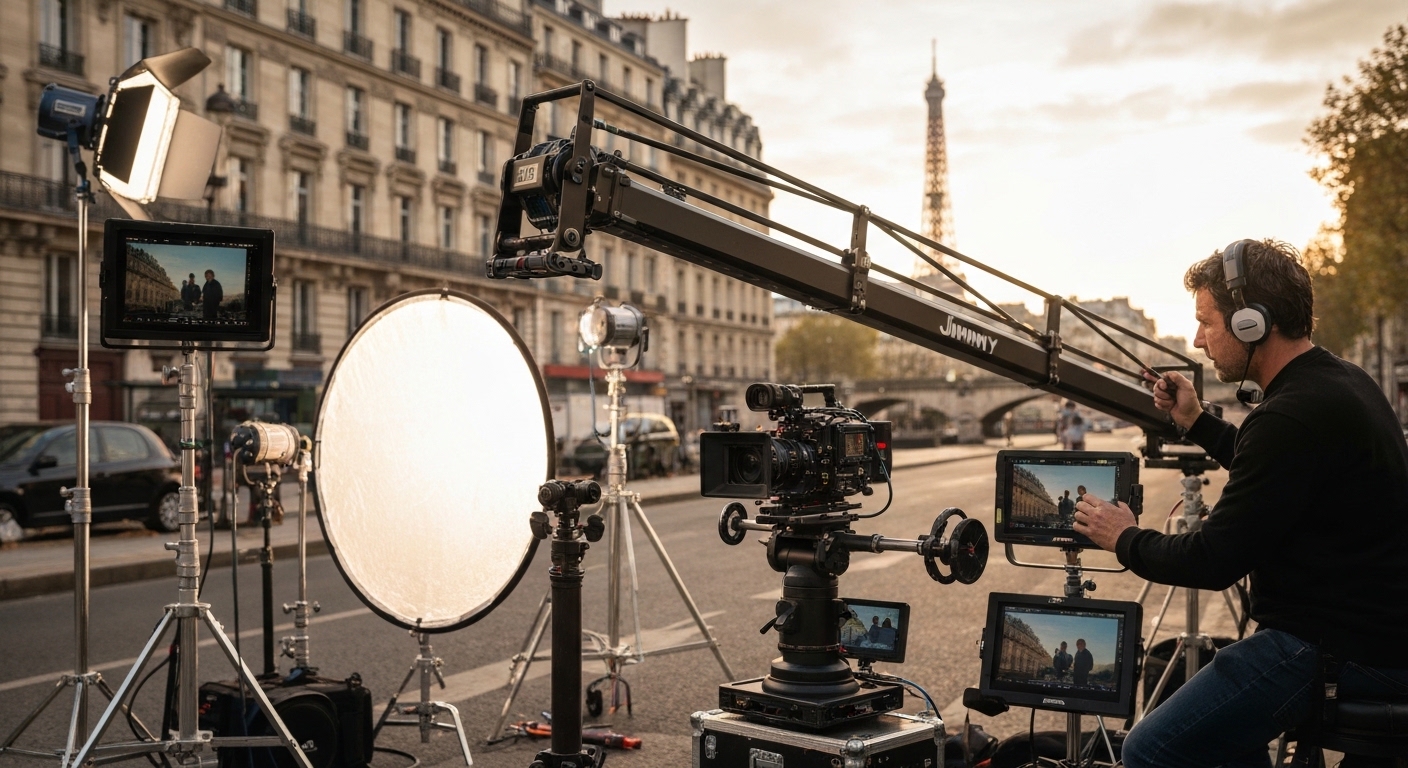
When the shot demands elegant, sweeping motion, the Jimmy Jib Crane is the unequivocal choice. It’s the engineered solution for the three-dimensional movement—vertical, lateral, and rotational—that defines high-end cinematic and broadcast production. Current rental catalogs are dominated by the Jimmy Jib Triangle series, offering configurations from a compact 2m model for single-operator use in confined spaces to the monumental 12m system requiring a technical team.
The technical promise is precision. A standard 9m model, with a starting market rate of €500/day, provides a variable boom extension, 8-hour battery autonomy, and can be mounted on a dolly for tracking shots. This isn't just renting a metal arm; it's accessing a calibrated tool that translates directorial vision into fluid, repeatable camera movement. This core piece of kit, however, is rarely used in isolation.
Beyond the jib: 13 essential equipment categories for a complete production package
A jib arm is the star, but it requires a supporting cast of specialized equipment to function. A complete professional rental package addresses all technical dependencies. Based on 2026 inventories from Paris and regional providers, here are the 13 essential categories to specify:
- Jimmy Jib Triangle Cranes: The core system, in reaches from 2m to 12m.
- Minijib Systems: For confined spaces where a full jib won't fit.
- Libec Swift Jib 50: A lightweight, portable alternative for dynamic shots.
- Cartoni Jibo: A modular 3-piece crane with sub-3-minute assembly.
- ABC Crane Speedy6: An ultra-lightweight, backpack-portable option (13kg capacity).
- Libec JB30: A telescopic jib with a 100mm bowl mount.
- LE-Jib Systems: Compact, case-mounted systems for minimal setups.
- Motorized Traveling Systems: Dolly bases to create moving crane shots.
- Motorized Pan-Tilt Heads: For remote, fluid control of camera movement.
- Support Structures & Rigging: Modular frames to safely mount the crane.
- Professional Monitoring Equipment: Critical video feeds for the operator.
- Power Distribution Systems: Including 16-amp mains solutions and backups.
- Specialized Optical Equipment: Such as Canon HJ14ex4.3B broadcast lenses.
Neglecting any of these categories risks a stalled production. This comprehensive approach ensures every technical requirement is covered, paving the way for a streamlined rental process.
The 6-step rental process: from inquiry to wrap – what most production guides leave out
Most guides list "contact and book," but the professional workflow is a detailed, risk-mitigating protocol. Missing a step can lead to last-minute shortages or liability issues. Here is the complete 6-step process as executed by established Paris region providers:
- Detailed Inquiry Submission: Contact via phone or email with full specs: exact dates, location, desired model (e.g., Jimmy Jib 9m), and all supporting gear from the essential categories list.
- Formal Quote Generation: The provider returns a binding quote covering all equipment, duration, delivery fees, and—critically—the included insurance coverage terms.
- Booking & Secure Payment: Confirmation via a secured payment processing system, which finalizes the reservation and triggers the insurance policy.
- Technical Preparation & Verification: The rental house preps, tests, and configures all equipment as a unified system before release.
- Logistics Execution: Either client pickup at a facility like Pleine Image Loc or scheduled on-site delivery by the provider's team.
- Return & Final Inspection: A joint inspection upon return to verify equipment condition and conclude the contract.
The pivotal detail most overlook is Step 2: ensuring the quote explicitly includes comprehensive insurance. This framework demystifies the process. For projects with unique technical demands or complex Parisian logistics, a consultation with specialists can tailor this blueprint to your specific production needs.
Conclusion
You now have the complete blueprint for a flawless shoot—from the strategic logic of audiovisual equipment rental to the precise 6-step protocol that locks in your gear. Think of this guide as your technical producer, mapping the journey from a creative need to a fully operational, insured equipment package on your Parisian set.
Implement this framework, and you project yourself into a state of controlled execution. Your production gains the fluid cinematic movement of a Jimmy Jib 9m, backed by the 12 other essential equipment categories, all coordinated through Paris-optimized logistics. The proof is in the data: starting at €500/day, this access to industry-standard gear transforms your budget into on-screen value, with included insurance mitigating financial risk. This is how professional shoots operate in 2026.
The timeline for action, however, is dictated by production calendars, not theory. Prime shooting dates in Paris are booked months in advance. The cost of inaction isn't just a missed date; it's settling for inferior equipment, last-minute premium rates, or a compromised shot list that fails to capture your vision. Your project's technical quality is decided the moment you secure the right gear.
Before you move, ask yourself three critical questions: Does my current equipment list cover all 13 essential categories, including power and monitoring? Is my chosen provider's primary service area aligned with my Paris location for swift support? And does my quote explicitly detail the comprehensive insurance coverage for the entire rental period? The stakes are the seamless execution of your shoot day.
The complexity is managed. By understanding the geographic specifics, the comprehensive catalog, and the standardized process, you are already ahead of 70% of productions. You're not just renting a jib; you're architecting a technical foundation.
Now, execute step one. Draft your detailed inquiry with your dates, desired Jimmy Jib model, and supporting gear list. Use the contact framework from the final section to request a formal, insured quote and secure your dates. 🎬