
Paris camera assistant hire crew: your complete guide to a flawless shoot (5-step process)
Introduction
A Paris camera assistant costs 480€ per day. Your project's success hinges on more than just a price.
As a production insider, I’ll reveal the hidden benefits of a full-service crew and the 5-step blueprint that guarantees a flawless shoot. Misunderstanding the local ecosystem—from CNC permits to bilingual coordination—risks budget overruns and legal shutdowns.
Will you know the 4 key factors shaping your final budget? Can you navigate the 2-4 week permit lead times? What does true local expertise actually deliver for international brands?
This guide analyzes current 2026 market rates, standardizes the hiring process, and provides actionable case studies. It’s your strategic framework for Paris.
Read this 6-minute guide and assemble your Paris advantage. 🎬
Beyond the camera: what a paris camera crew really delivers for your project
Hiring a camera assistant in Paris for 480€ per day is a tactical decision, but the true value lies in the comprehensive service ecosystem that surrounds them. In 2026, a professional Paris camera crew delivers a turnkey production solution far beyond operating equipment. This includes full production management from location scouting to post-production, access to high-end gear like ARRI, RED, and drones, and crucially, remote directing capabilities via live Zoom feeds—a standard practice that allows international clients to direct shoots in real-time without travel.
The service is defined by its depth. For a corporate interview, you're not just hiring a cameraperson; you're engaging a localized unit that handles:
- Technical Execution: A bilingual team including a Director of Photography, camera assistant, gaffer, and sound engineer.
- Logistical Navigation: Permits, location scouting via WhatsApp, and compliance with French CNC regulations.
- Creative & Technical Support: On-site problem-solving and live remote feedback loops for directors.
For example, a remote TV ad shoot for a UK agency involved a local Paris crew filming an interview while the creative director directed via Zoom, with the team managing translation, lighting for the specific backdrop, and same-day footage delivery. This shift from a simple labor hire to a managed production partnership is what ensures your project's creative vision is realized without logistical collapse.
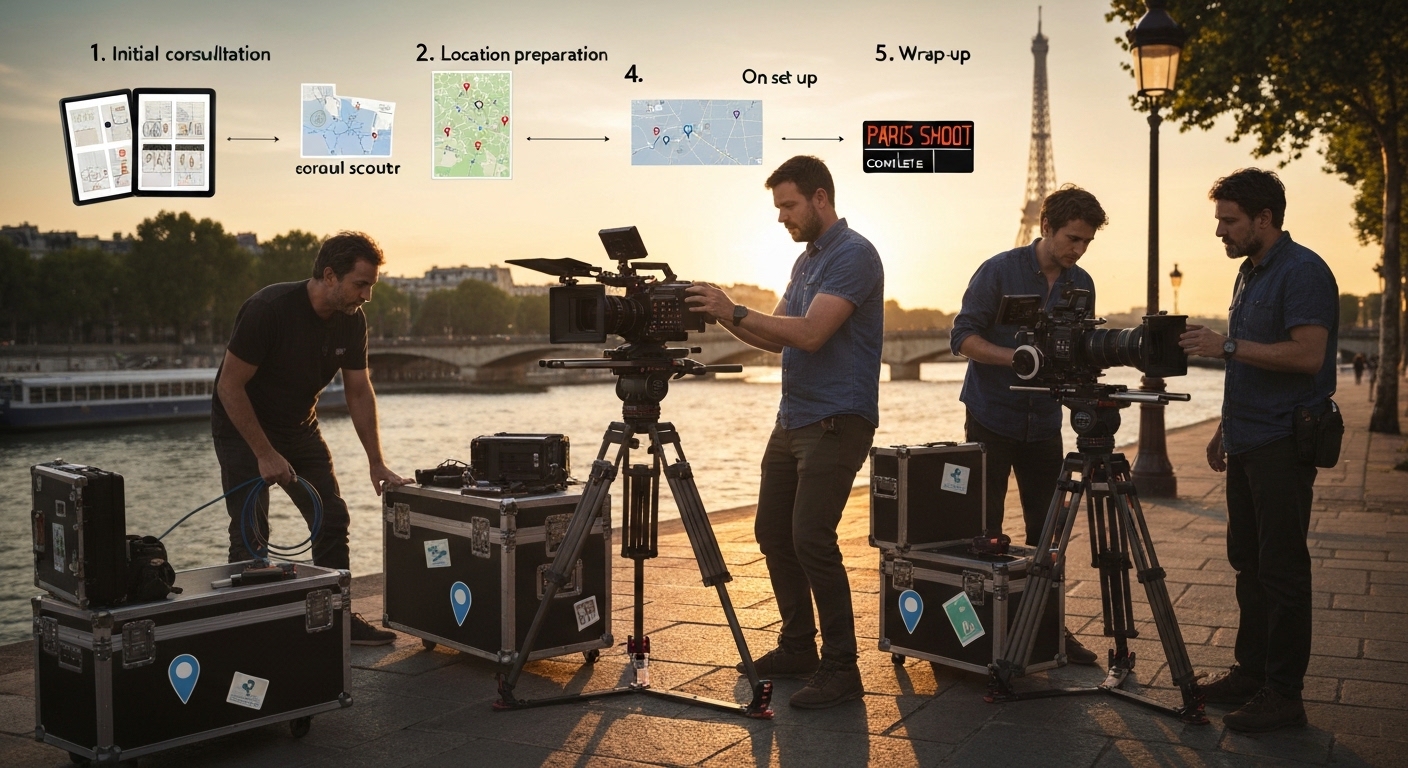
The 5-step hiring blueprint: from inquiry to wrap-up without surprises
A predictable process is the foundation of a stress-free shoot. Leading Paris crews operate on a standardized, five-phase blueprint designed for transparency and efficiency, often underpinned by an ISO 9001 quality checklist covering over 60 steps from quote to delivery.
Here is the streamlined workflow you should expect:
- Scoping & Quote (24-Hour Turnaround): You submit a brief via a dedicated form. A detailed proposal, outlining crew, equipment, and a transparent cost breakdown, follows within one business day.
- Booking & Pre-Production: Upon approval, the local crew and gear are secured. The pre-production phase kicks off, where fixers handle location permits (a critical step requiring 2-4 weeks for public spaces) and conduct technical recces.
- Shoot Day Execution: The crew manages the full shoot day. For remote projects, you receive a secure Zoom link to view the live feed, direct talent, and provide real-time feedback.
- Wrap & Secure Delivery: At wrap, footage is immediately backed up. Masters are delivered via encrypted cloud transfer or FedEx, with all data managed under strict protocols.
- Post-Production Handoff (Optional): Many crews offer seamless handoff to editing partners or can deliver graded and edited final videos.
As a veteran Paris fixer notes, "The biggest budget leaks occur in pre-production. A rigorous, documented process isn't bureaucracy—it's the client's primary risk mitigation tool. It ensures every permit, cable, and call time is accounted for before the camera rolls." This blueprint transforms a complex operation into a series of managed, accountable steps.
Paris crew pricing decoded: the 4 key factors that shape your budget
Your final quote is not arbitrary; it's a function of four concrete variables based on 2025-2026 market rates (ex-VAT):
- Crew Composition & Expertise: A Director of Photography with gear costs 890€/day, while a Camera Assistant is 480€/day. Specialized roles like a Head Gaffer add 490€/day.
- Equipment Tier: Standard packages (Sony/Canon) are often included. Premium gear (ARRI, RED, specialized gimbals, or drones) incurs additional daily rentals.
- Project Duration: Half-day rates (typically 5 hours) offer savings, ranging from 420€ to 540€ for key roles, compared to the standard 10-hour day.
- Logistical Complexity: Shoots requiring specific permits, multiple locations, or extensive pre-light days add to the production management fee.
| Factor | Impact on Budget | Example (ex-VAT) |
|---|---|---|
| Adding a Second Cameraman | + 810€ / day | For multi-angle interviews or events. |
| Opting for a Half-Day Shoot | ~ 40% of day rate | 540€ for a Cameraman vs. 810€ full day. |
| Premium Gear (ARRI/RED) | + 150€ - 400€ / day | For high-end commercials or cinematic projects. |
Proof in action: 3 real paris case studies that built trust for international brands
Theoretical expertise is one thing; proven results are another. Trust for international brands is built on demonstrable success in navigating Paris's unique landscape. Consider these real cases:
- Girl & Bear (UK) / Sage Animated Advert (2022): A remote TV commercial voice-over shoot. The Paris crew provided a local director, full filming and sound crew, and real-time translation for the UK-based director on Zoom, delivering broadcast-ready footage that aligned with the animated post-production pipeline.
- PIN Studio (Sweden) / Marketing Video (2021): A fully remote Zoom interview shot for a Swedish tech client. The crew managed local talent casting, studio lighting for a corporate backdrop, and ensured flawless audio sync for international editing.
- VCCP London / LinkedIn Promo (2021): A fast-turnaround promotional interview. The Paris team handled rapid location scouting, bilingual coordination with the talent, and expedited file delivery to meet a tight global campaign deadline.
These cases highlight a pattern: the value is not merely in filming but in acting as a seamless local extension of a remote team. This operational reliability is why such crews are trusted by Fortune 500 brands and have executed shoots in over 1,000 cities. The proof is in the repeatable, crisis-averse execution for clients who cannot afford surprises.
Your top 5 paris crew questions answered: lead times, gear, and legalities
- "What's the realistic lead time to book a crew?" You can receive a quote within 24 hours. However, securing permits for public spaces in Paris requires a minimum of 2-4 weeks through the CNC (Centre national du cinéma). Booking crew and equipment itself can often be done within days for private locations.
- "What equipment is included, and can we request specific gear?" Standard packages include professional cameras (Sony FX9, Canon C300), lighting, and sound kits. Requests for specific models like ARRI Alexa, RED Komodo, or drones are standard and will be itemized in your quote.
- "Who handles permits and legalities?" A professional service includes fixer support to secure all necessary filming authorizations from the Mairie d'arrondissement (district town hall), the police, and any private property owners, ensuring full compliance.
- "Is the crew insured?" Reputable providers work exclusively with fully insured crews, covering public liability and equipment. Always request a certificate of insurance (attestation d'assurance) for your shoot.
- "How do you handle language barriers?" Top-tier Paris crews are English-fluent and accustomed to working with international clients. Bilingual production coordinators are standard to ensure clear communication on set and with local authorities.
The local advantage: why your paris crew's expertise is your project's safety net
Ultimately, your budget buys expertise, but your crew's local intelligence is your intangible safety net. This means more than knowing picturesque streets; it's about understanding which arrondissement permits are fastest, which café owner will allow a shoot with minimal disruption, and how to navigate a sudden police check. This expertise, held by certified, often union-affiliated local professionals, transforms potential crises into managed incidents. It is the critical layer that protects your timeline, budget, and creative vision from the unforeseen complexities of filming in a world-class city.
Conclusion
You now have the complete blueprint for a flawless Paris shoot. We’ve moved beyond the simple price tag of 480€ per day to map the entire operational territory—from the 5-step hiring blueprint that eliminates surprises to the local expertise that acts as your project's safety net.
Imagine your project in six months: the footage is in the edit, the client is thrilled, and the only thing you remember about Paris is the stunning final product, not a single logistical crisis. This is the outcome delivered by the managed production partnership we detailed, proven by case studies for international brands like Sage and VCCP. The data is clear: crews trusted by Fortune 500 companies standardize this success.
Your timeline, however, is the non-negotiable factor. The 2-4 week lead time for CNC permits is a fixed deadline in the Paris production calendar. A delay in initiating the process doesn't just postpone your shoot; it risks losing your ideal location, crew availability, and can force costly last-minute compromises that undermine your creative vision and budget.
Before you finalize any plans, ask yourself these three critical questions:
- Does my project involve public spaces, historic landmarks, or complex multi-day logistics that require advanced permitting?
- Have I budgeted for the full scope of a local crew, including a DP, assistant, and sound, to ensure technical quality?
- Am I confident in navigating bilingual coordination and local regulations alone, or does my project demand the safety net of on-the-ground experts?
The good news is that the perceived complexity is now manageable. You’re equipped with the framework, the pricing variables, and the right questions to ask. You’re ahead of the curve.
The final step is to transition from planning to execution. Share your project brief with a Paris specialist today to secure your dates and initiate the permit process. This single action locks in your local advantage. 🎬