
Paris editor hire post-production: your complete guide to finding the right expertise (4 key criteria)
Introduction
Hiring a Paris editor for post-production isn't just about finding an editor. It's about vetting 34+ studios for a strategic partner. A wrong choice risks your project's technical compliance and final delivery.
As an insider, I'll reveal the hidden benefits of a true Parisian partnership and the 4 key criteria that separate vendors from collaborators. This guide dissects the 5-phase post-production workflow and the 3 technical pillars of a pro studio.
The cost of inaction? A project that fails Netflix's 4K validation, mismatched color spaces, or a sound mix that doesn't meet Dolby standards. Your investment becomes a liability.
What are the 5 definitive phases that transform raw footage? How does the professional 4-step editing workflow ensure narrative lock? What 3 credibility signals prove a studio is top-tier?
We've analyzed the latest platform standards and studio validations for 2026. Our structured methodology cuts through the market noise.
Ready to decode the Paris post-production landscape? Your 6-minute read to a flawless hire starts now. 🎬 Let's assemble your project's success.
Hiring a paris editor: beyond the studio, your strategic partner
Hiring a Paris editor for post-production is a strategic decision that extends far beyond renting a workstation. In a market with over 34 studios listed in Paris alone, the choice defines your project's final quality and compliance. A true partner offers a comprehensive service—from montage and sound design to color grading and final delivery for film, TV, and digital platforms—available for hire by the project or as a dedicated team.
The value lies in strategic accompaniment: flexibility for short or long-term projects, full project ownership from rushes to delivery, and access to Netflix-validated infrastructure and 20+ years of expertise from studios founded by industry figures like Luc Besson. Central Paris locations in the 11th or 20th arrondissements ensure quick access for producers, with some facilities offering 24/7 availability. This transforms a simple vendor transaction into a collaborative alliance focused on your project's success, allowing you to concentrate on core production while experts handle the technical execution.
Choosing this path means securing a partner invested in delivering a platform-ready product, not just an edited sequence. This strategic foundation is critical before diving into the specific processes you are hiring them to perform.
Post-production decoded: the 5 phases that transform raw footage
Post-production is the definitive, final stage of audiovisual creation where raw footage is systematically transformed into a polished, narrative-driven product. For a client looking to hire, understanding this structured 5-phase workflow is essential to evaluate a studio's comprehensive service offering and ensure no critical step is overlooked.
The transformation follows a precise sequence:
- Editing (Montage): The assembly of footage into a coherent narrative sequence, establishing the story's pace and structure.
- Color Grading (Étalonnage): The adjustment of color tones and contrast for visual consistency, mood enhancement, and compliance with delivery standards like Rec.709 or Dolby Vision.
- Sound Design & Mixing: The editing of dialogue, addition of sound effects (SFX) and music, and the final balance of all audio elements in formats like 5.1 or stereo.
- VFX & Graphics: The integration of visual effects, motion graphics, and compositing to enhance the visual storytelling.
- Finalization & Delivery: The creation of Digital Cinema Packages (DCP), compression for streaming, and quality assurance for broadcast or platform-specific delivery.
This end-to-end process ensures narrative coherence, emotional impact, and technical readiness for any target platform. Mastering this workflow is what separates amateur edits from professional finishes, setting the stage for the editor's detailed methodology.
Inside the edit suite: the 4-step professional workflow (from assembly to lock)
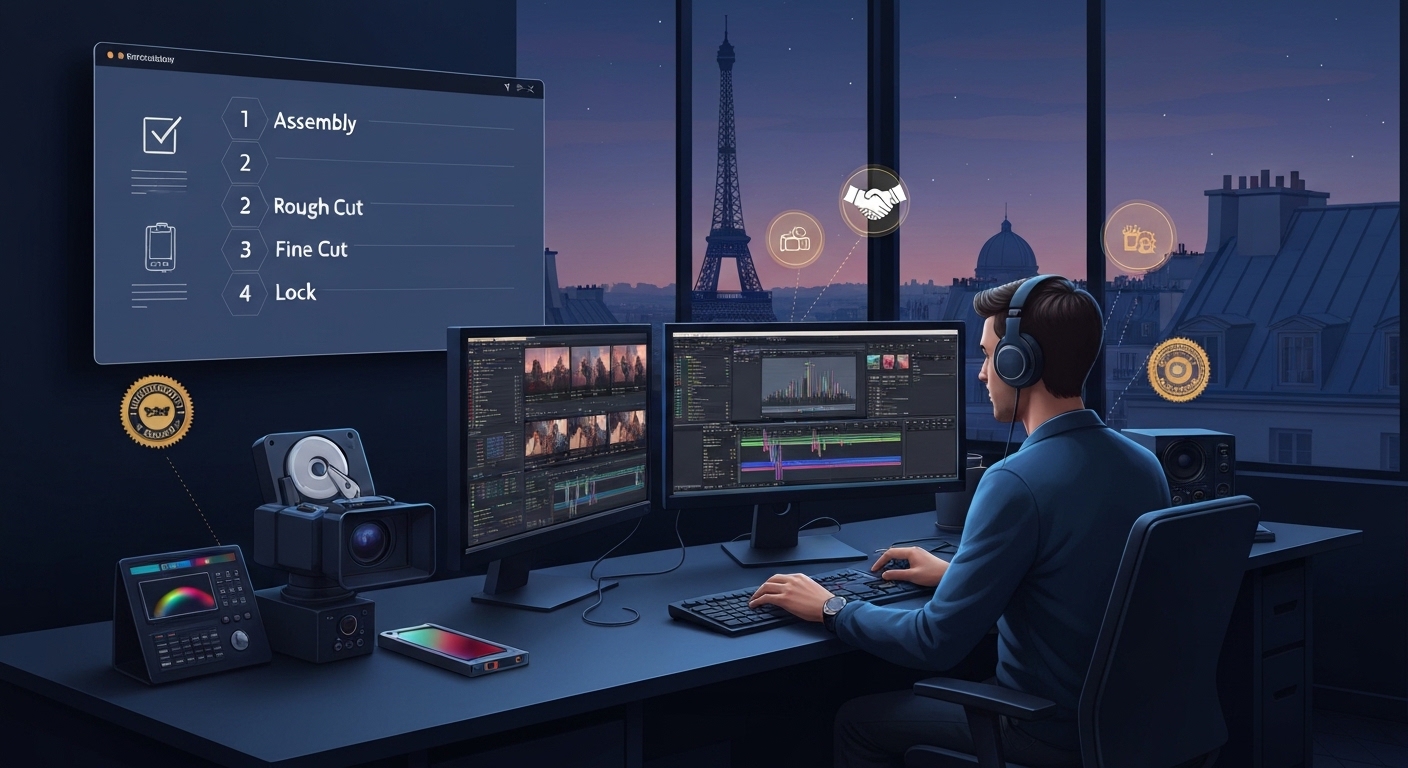
The editor's core methodology is a rigorous, iterative 4-step professional workflow designed to evolve a project from disjointed rushes to a client-approved "picture lock." This process ensures creative alignment and technical precision at every stage.
- Assembly Edit: The editor organizes all rushes (raw footage) into a basic chronological or script-based sequence. This phase is about logging, selecting the best takes, and building a foundational timeline. The goal is a complete but rough narrative skeleton.
- Rough Cut: This step establishes the project's pacing and core story structure. Superfluous scenes are cut, and the fundamental flow is solidified. It's the first view of the film's rhythm and is typically the version presented for initial client feedback on narrative direction.
- Fine Cut: Every edit is now refined. This includes precise timing of cuts, polishing transitions, integrating preliminary visual effects and graphics, and ensuring seamless audio alignment. The fine cut is 95% of the final product and undergoes detailed review.
- Picture Lock: Upon final client approval of the fine cut, the edit is "locked." No more changes are made to the timing or visual sequence. This lock is critical as it triggers all subsequent costly and time-sensitive processes like final color grading, sound mixing, and VFX rendering. As a senior editor would note, "Locking the picture is the keystone; it allows every other department to build their work on a stable foundation, preventing wasted resources and ensuring a cohesive final product."
This disciplined progression from assembly to lock guarantees efficiency, manages client expectations, and provides the stable base required for the final technical polish.
Software vs. hardware: the 3 technical pillars of a pro paris studio
Evaluating a studio's technical capability requires examining three interdependent pillars: the software for creation, the hardware for execution, and the infrastructure for delivery. This technical trifecta separates professional facilities from basic edit suites.
| Pillar | Key Components | Professional Standard (Paris 2026) |
|---|---|---|
| Professional Software | Editing, Grading, Audio Suites | Adobe Premiere Pro, Avid Media Composer, DaVinci Resolve (for grading), Pro Tools |
| High-Performance Hardware | Editing Stations, Monitoring, Storage | 45+ dedicated edit stations, Calibrated HDR/4K reference monitors, High-speed shared storage arrays |
| Delivery-Ready Infrastructure | Grading Suites, Mix Theaters, Compliance | Netflix-validated 4K suites, Dolby Atmos mixing theaters, DCP creation for cinema |
The synergy is critical: Powerful hardware (like the 600m² facilities at some studios) runs the professional software smoothly, while specialized infrastructure (such as 5.1 mixing auditoriums) ensures the final product meets exacting platform specifications like Dolby Vision or broadcast loudness standards. A weakness in any pillar risks bottlenecks, compatibility issues, or failed technical delivery.
How to spot a top-tier studio: the 3 credibility signals you can't ignore
Amidst many options, three concrete signals validate a studio's credibility. First, seek quantified social proof: look for 20+ years of operation or partnerships with major clients like France Télévisions or Netflix. Second, verify technical certifications, specifically Netflix Post-Technical Partner validation, which audits a facility's entire workflow. Third, examine their project portfolio for diversity and relevance—a studio serving Luc Besson's films and premium streaming series demonstrates scalable, high-stakes expertise. Ignoring these signals increases the risk of partnering with a vendor incapable of handling complex, compliance-driven deliverables.
Conclusion
You now have the complete blueprint for hiring a Paris editor. We’ve moved from understanding the strategic partnership a top studio offers, through the 5-phase transformation of post-production, into the editor’s precise 4-step workflow, and finally, the 3 technical pillars and 3 credibility signals that separate true experts from vendors.
Applying this framework places you in a position of strength: you can now evaluate studios not as a blank slate, but as an informed client. The result is a project that achieves narrative coherence, technical compliance, and platform-ready delivery from a partner invested in your success.
However, the final, critical step is applying this knowledge to your project’s unique DNA. A generic checklist meets its limit when faced with specific creative ambitions, a tight festival deadline, or complex deliverables like Netflix 4K validation or a Dolby Atmos mix. The nuance of matching your exact needs to a studio’s specific capabilities and current availability is where a direct conversation becomes invaluable.
Before you finalize any decision, ask yourself these three questions:
- Does my project’s timeline align with the studio’s picture lock requirement to trigger final grading and sound?
- Are my delivery specifications (e.g., Dolby Vision, broadcast loudness) explicitly supported by their validated infrastructure?
- Does the studio’s portfolio demonstrate experience with projects of similar scale and technical complexity?
You are now ahead of the curve. The complexity of the choice has been decoded into a clear action plan. The only remaining task is to connect this framework with the specific details of your production.
Let’s match your project’s unique requirements with the ideal Paris studio’s expertise and availability. Describe your post-production plan to us, and we’ll facilitate a direct introduction to the right strategic partner. 🎬