
Paris filming permit system: your complete guide to navigating the agate process (5 key steps)
Introduction
Paris filming permit system applications are refused for lateness. The 15-working-day AGATE deadline is non-negotiable.
As an insider, I’ll decode the exact 5-step process Paris Film uses. This guide reveals the hidden contacts and critical exemptions that streamline your 2026 shoot.
Misunderstanding the VHSS Charter mandate or contacting the wrong department risks costly delays and location forfeiture. Your production’s viability depends on this navigation.
Is Paris Film your true single point of entry? What’s the critical rule separating a minor declaration from a full AGATE permit? Who are the three key departmental contacts for animals, police, and monuments?
We’ve analyzed the latest 2025 AGATE updates and the mandatory VHSS decree. Our structured methodology breaks down the bureaucracy into actionable steps.
Your roadmap to a compliant shoot is below. Estimated read: 6 minutes. Let’s get your project the green light. 🎬
Paris film: your single point of entry (and what it doesn't handle)
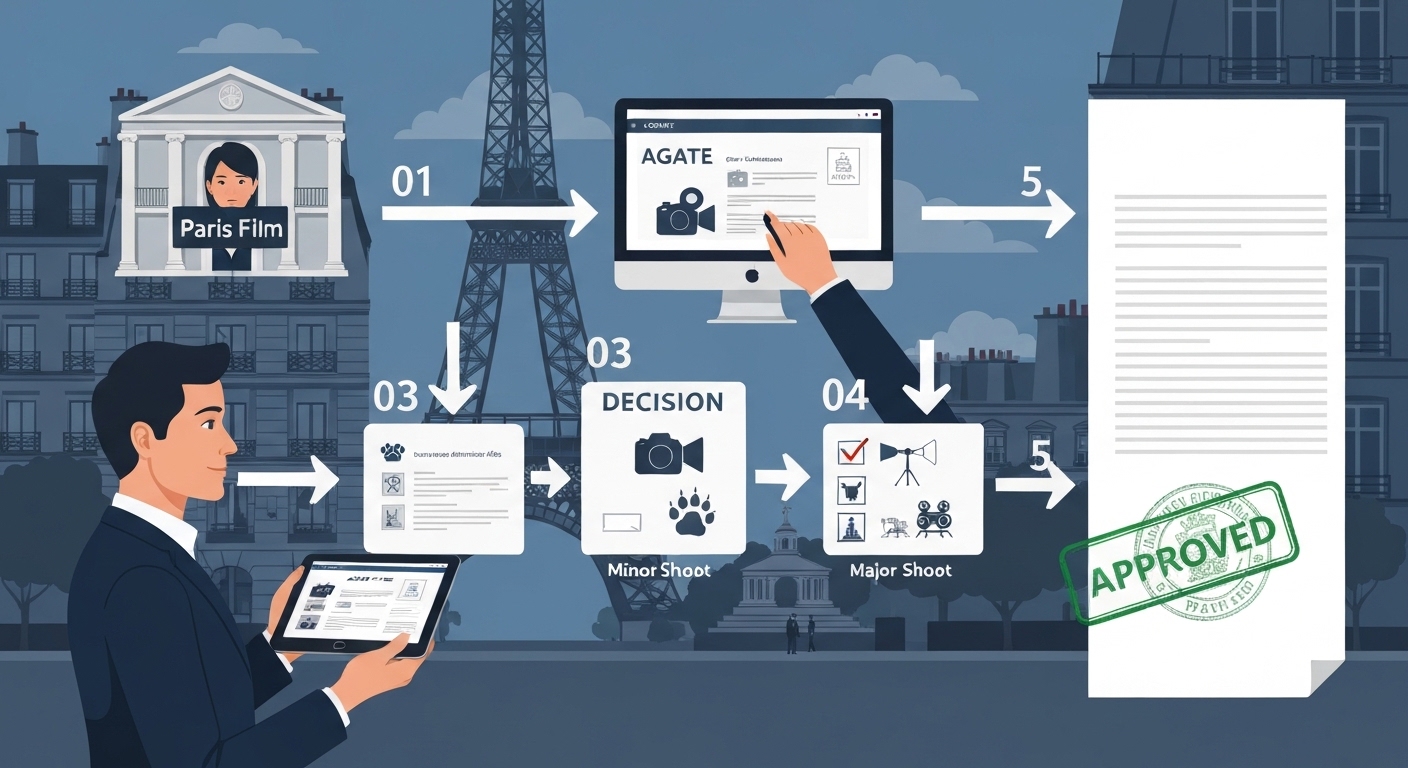
Navigating the Paris filming permit system begins with a single, critical entity. Paris Film is the official office designated by the City of Paris as the single point of entry for all shooting authorization requests on public space. This means for fiction, commercials, documentaries, and music videos, your application journey starts and is coordinated through them via the AGATE platform.
However, understanding its limits is as crucial as knowing its role. Paris Film does not handle everything. According to the latest 2025 guidelines, you must contact `presse@paris.fr` for news reports or streaming TV shows. More importantly, their authority stops at the gates of Paris's most iconic landmarks. Emblematic sites like the Eiffel Tower, the Louvre, or the banks of the Seine are managed by independent entities (like the Centre des monuments nationaux or private operators), requiring separate, direct negotiations. While Paris Film is your primary coordinator for city-managed spaces, understanding the broader network of French film commissions provides essential context for shoots that extend beyond municipal jurisdiction.
This clear delineation prevents misdirected applications and sets the stage for a streamlined process. With your central contact identified, you can now focus on the core procedural engine: the AGATE permit.
The agate permit process: your 5-step checklist for a successful application
The AGATE platform is the mandatory digital gateway for all formal filming requests in Paris. Since the key reform of September 1, 2024, the standard deadline is a non-negotiable 15 working days (approximately three weeks) for all arrondissements. Here is your actionable 5-step checklist to navigate it successfully:
- Submit Early via AGATE: Initiate your application at least 15 working days before your first shoot day. For shoots in early January 2026, plan to submit before the office closure from December 25, 2025, to January 2, 2026.
- Attach the Mandatory VHSS Charter: Since January 1, 2025, a signed "Charter for the Prevention of Sexual and Gender-based Violence" is compulsory. Upload it under the 'Fiches Techniques' section. Missing this document will stall your application.
- Provide Complete Project Dossier: Include the project title, director, production company details, budget, exact dates/times, number of shoot days, and proof of insurance. Incomplete information invites delays.
- Anticipate Internal Coordination: Paris Film uses your submission to coordinate internally with relevant city services (e.g., roads, cleanliness) and, if needed, the Police Prefecture for street filming. Your comprehensive data enables this.
- Complete Post-Shoot Form: Upon authorization, you’ll receive a Google Form to provide a brief report after filming, closing the administrative loop.
Applications submitted late are routinely refused. This structured Paris-specific process is your blueprint for compliance. For the foundational principles that underpin this system, you can explore our guide to general filming authorizations in France.
Prior declaration or agate? the critical rule for minor vs. major shoots
A common point of confusion is whether a small-scale project requires the full AGATE permit. The critical rule is this: Any filming activity that impacts public space, uses professional equipment beyond a handheld or tripod camera, or involves a crew requires an AGATE permit. The platform is designed for all structured shoots.
The alternative—often referred to as a prior declaration or exempt filming—applies only to genuinely minor, non-disruptive operations. According to observed practices and general French regulations, this typically includes:
- Handheld or tripod-based news reporting.
- Architectural or fashion photography with minimal equipment and no public obstruction.
- Student or training exercises with no professional broadcast intent.
If your activity has any logistical footprint—such as parking a equipment van, setting up lighting, or cordoning off an area—you must use AGATE. The 15-working-day deadline and the mandatory VHSS Charter apply universally. This clear distinction prevents producers from accidentally operating without authorization. This rule exists within a wider framework, so consulting the official terms and conditions for filming in France is always prudent.
Who to contact and when: your authority checklist for complex shoots
For complex productions involving stunts, period vehicles, night shoots, or sensitive locations, direct contact with specific authorities becomes essential. While Paris Film coordinates the core permit, proactive engagement with these entities is your responsibility and can make or break your schedule. Use this checklist to identify who to contact and when.
- At the Project Planning Stage (Weeks in Advance):
- Police Prefecture (`+33 1 53 71 42 35`): Contact for any shoot requiring street closures, traffic management, pyrotechnics, or uniformed officer presence. This is non-negotiable for action sequences or large-scale street filming.
- Specific Monument/Museum Management: For locations like the Panthéon or Sainte-Chapelle, you must contact the managing body (e.g., `tournages@monum.fr` for national monuments) directly and in parallel with your AGATE application. Their approval is separate from the city permit.
- Ministry of Armed Forces (`mission.cinema@dicod.fr`): Essential for any narrative involving military imagery, uniforms, or filming near defense installations.
- During the AGATE Application (Upon Submission):
- Paris Film (`tournages@paris.fr`): Your main point of contact for the permit itself. Use this line to flag complex elements in your application so they can prioritize internal coordination.
- Ministry of Justice (`perrine.piat@justice.gouv.fr`): Required if your script involves scenes set in or around courthouses, prisons, or any depiction of the judicial system.
- Pre-Production (Days Before Shooting):
- City Technical Services: Paris Film will coordinate, but confirming arrangements for waste management, special parking (for craft services, generators), and any temporary street furniture removal is advised.
Proactive, early contact with these authorities demonstrates professionalism and mitigates the risk of last-minute vetoes. The most common needs often fall into three specific departmental categories.
3 key departmental contacts you need for animals, police, and monuments
Based on the latest validated 2026 directory, these are the three most critical direct contacts for specialized approvals. Save them for your production Rolodex.
- For Animal Actors & Health: Adeline Montcharmont, Chief Veterinary Inspector for Paris. All shoots involving animals, whether pets or trained actors, require her office's approval for animal welfare compliance. Email: `adeline.montcharmont@paris.gouv.fr`.
- For Police Coordination & Security: The Police Headquarters liaison team. For direct dialogue on security plans, traffic control, and officer deployment, the key contacts are Deputy Head Lotfi Khelifa and Juliette Blanchet (generic contact: `+33 1 53 71 42 35`).
- For National Monuments & Museums: The Centre des monuments nationaux (CMN) filming office. This is your gateway to iconic state-owned sites like the Arc de Triomphe or Conciergerie. Proposals must be sent to `tournages@monum.fr` for artistic and logistical review.
A full public directory of every city department is not available, as Paris Film acts as the central coordinator post-AGATE submission. However, initiating contact with these three offices directly for complex elements is a best practice that prevents bottlenecks. For the most current administrative details and official forms, always refer to the detailed Paris filming permits page.
Conclusion
You now possess the complete blueprint for the Paris filming permit system. Think of it as your project's technical dossier—a clear map from initial inquiry through AGATE submission to final authorization. The path to a compliant, disruption-free shoot in Paris is no longer a bureaucratic maze but a defined, five-step checklist.
With this guide, you're positioned to secure your permits within the mandated 15-working-day window, integrate the non-negotiable VHSS Charter, and pre-emptively coordinate with the correct departmental contacts for animals, police, or monuments. The data is clear: productions that master this framework avoid the primary cause of refusal—lateness—and the secondary pitfalls of misdirected applications. Your 2026 shoot transitions from a logistical challenge to a managed process.
The timeline is fixed. The AGATE platform's 15-working-day deadline is a hard rule, not a suggestion. For shoots in early January 2026, the cost of inaction is a guaranteed delay, as submissions must be completed before the annual closure from December 25, 2025, to January 2, 2026. A postponed application doesn't just risk a location; it cascades into crew availability and budget overruns.
Before you proceed, run a quick self-assessment:
- Does my shoot impact public space or use more than a handheld camera? If yes, AGATE is mandatory.
- Is my planned submission date more than 15 working days before my first shoot day? If no, you are already at risk of refusal.
- Do my scenes involve animals, police coordination, or national monuments? If yes, have I referenced the specific contact checklist for these variables?
The complexity is in the details of your unique script, not in the process itself. You are now ahead of the curve, equipped with the exact steps, contacts, and deadlines that many discover through costly trial and error.
Your next action is singular: Initiate your AGATE application using the 5-step checklist from Section 2. 🎬 This is the move that transforms planning into permission. For the most current administrative details and forms, always double-check the official detailed Paris filming permits page.
Sources
- https://www.filmfrance.net/en/plan-your-production/film-commissions/paris-film-2/
- https://www.paris.fr/en/pages/preparing-your-shoot-in-paris-33089
- https://www.paris.fr/en/pages/filming-permits-in-paris-33088
- https://www.filmfrance.net/en/guidance/filming-authorizations/
- https://www.diplomatie.gouv.fr/en/press-room/terms-and-conditions-for-filming-in-france/