
Paris filming protocol: your complete guide to navigating permits and cultural respect (2026 rules)
Introduction
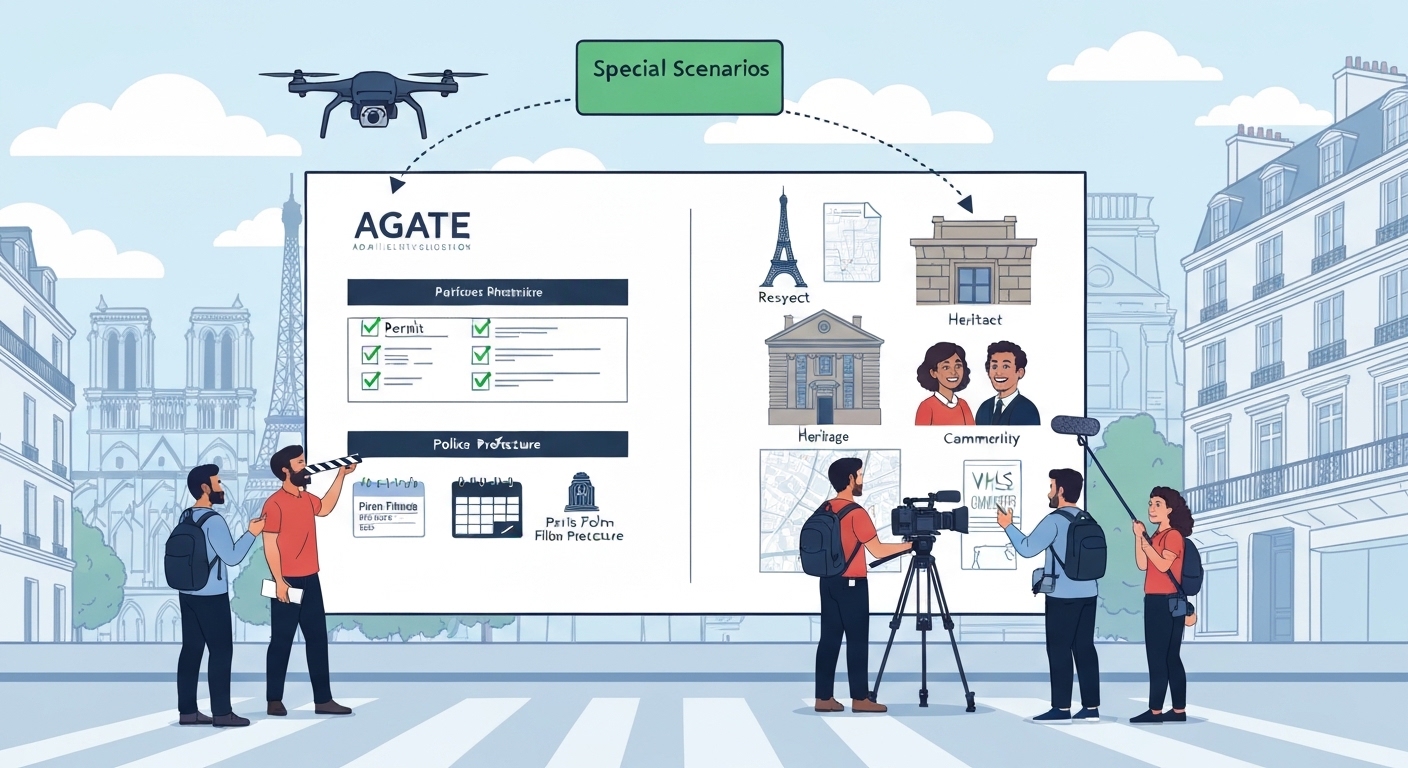
Paris location filming cultural protocol isn't just about permits. It's a 15-working-day AGATE deadline and a mandatory VHSS Charter. Get it wrong, and your shoot is cancelled.
As an insider who navigates these rules daily, I’ll show you the hidden benefits of a flawless application. This guide breaks the 2026 system into four actionable sections.
Ignoring the nuanced "unwritten rules" of heritage and resident respect risks six-figure losses and a permanent ban from Parisian locations.
Who truly approves your permit—the Paris Film Office or the Police Prefecture? What’s the specialized contact for drones or fake weapons? And how do you apply the four pillars of cultural respect beyond the paperwork?
We’ve analyzed the latest 2025-2026 decrees, from the unified AGATE delay to the eco-score QR code mandate. Our structured methodology gives you a predictable roadmap.
Read this 7-minute guide. Let’s cut through the bureaucracy and frame your success. 🎬
The 5-step agate process: your insurance against permit delays and rejections
Navigating Parisian filming permits is a precise science. The AGATE (Autorisation de Gestion des Autorisations de Tournage et d'Événements) platform is your mandatory gateway for any shoot requiring more than a simple declaration. Since September 2024, the unified legal deadline for processing is a strict 15 working days (approximately 3 weeks), a critical window that demands flawless preparation to avoid costly postponements.
Follow this 5-step process to secure your authorization predictably:
- Document Assembly: Prepare your synopsis, insurance certificate (minimum €2M civil liability), technical rider, and detailed implantation plans using the official CapGéo guide. Since January 2025, your application must also include a signed commitment to the Charte de lutte contre les Violences Sexistes et Sexuelles (VHSS).
- Platform Selection: Determine your path. For small, agile crews (under 10 people, handheld equipment), use the free déclaration préalable with a 1-week lead time. For teams over 10 people, using heavy gear, parking, or involving stunts/weapons, you must apply via the AGATE portal.
- AGATE Submission & Coordination: Submit your complete dossier via the AGATE portal at least 15 working days before filming. Simultaneously, for elements like night shoots, fake weapons, or large crowds, you must formally notify the Police Prefecture.
- City Services Liaison: The Paris Film Office coordinates internally with relevant city departments (public roads, sanitation) based on your plans. No separate application is needed.
- Authorization & Compliance: Upon approval, you’ll receive a signed arrêté municipal with specific conditions. You must then display the mandatory production notice with a QR code for resident information on set.
A real-world example: a music video shoot at Canal Saint-Martin with a 12-person crew and a Steadicam submitted its AGATE request 18 days in advance. With a complete dossier, the 10th arrondissement town hall validated it in 5 days, and the full authorization was issued in 11 days total, well within the legal window.
This structured approach transforms the AGATE process from a bureaucratic hurdle into a reliable safeguard, ensuring your production moves forward on schedule. To apply it correctly, you must first know exactly who holds the keys to each approval stage.
Paris film office vs. police prefecture: who to contact and when to avoid dead ends
A common source of fatal delay is contacting the wrong authority. Paris has two principal entities for filming authorizations, each with a distinct, non-negotiable mandate. Confusing them is a direct path to administrative dead ends.
The Paris Film Office acts as your central facilitator and the official processing body for the City of Paris. Its mandate is to receive all applications (both declarations and AGATE permits), coordinate internal city services like road closures and cleaning, and promote filming in the capital. All initial applications and general coordination must be routed through their official portal at parisfilm.fr. They are your single point of contact for the municipality.
The Police Prefecture is the sovereign authority for public order, safety, and security. Its approval is separate and mandatory for any element that impacts these domains. You must contact them directly at pp-cabinet-sdc-bvp-circul@interieur.gouv.fr for specific pre-authorizations, with a standard lead time of 10 working days. Their purview includes:
- Night filming (between 10 PM and 7 AM).
- Use of fake weapons, explosives, or pyrotechnics.
- Scenes involving actors in police or military uniforms.
- Shoots with over 50 extras in public spaces.
**The rule is clear: you file with the Paris Film Office, who manages the city's permit, but you simultaneously engage the Police Prefecture for any safety-related elements listed in your script.** Failing to do this parallel processing is a primary reason for last-minute rejections. For highly specialized scenarios beyond these core agencies, an even more precise contact map is required.
Drones, night shoots, and fake weapons: your specialized contact checklist for complex scenarios
Standard permits cover standard shoots. When your script includes complex elements, specialized rules and contacts activate immediately. Relying on generic procedures here will result in a "non-eligible" stamp. Use this checklist to navigate the most common high-stakes scenarios.
- Drone Filming: The AGATE authorization is necessary but insufficient. You must obtain separate flight clearance from the French Civil Aviation Authority (DGAC) and often need explicit, additional approval from the Police Prefecture, especially in central Paris (Security Perimeter). This process can add 15-30 days to your planning.
- Night Shoots (22h-7h): As noted, the Police Prefecture (pp-cabinet-sdc-bvp-circul@interieur.gouv.fr) is your mandatory contact. Your AGATE application must flag this, and you must provide a detailed sound management plan. The 75 dB sound limit is strictly enforced at night; real-time monitoring, as used in the Canal Saint-Martin case study, is advised to prevent resident complaints and shutdowns.
- Fake Weapons, Uniforms, or Stunts: These instantly trigger a safety protocol review by the Police Prefecture. You must provide detailed descriptions, photos of props, and stunt safety plans. Using blank-firing weapons requires even more stringent checks and on-site police supervision, which must be requested and coordinated well in advance.
- Shooting in Historic Courtyards or Private-Looking Public Spaces: While covered by AGATE, these locations often require direct, prior engagement with building caretakers (concierges) or residents' associations. The Paris Film Office can guide you, but this "social license to film" is an unwritten prerequisite.
- Traffic Stoppages or Bus Deviations: For minor traffic management, the Paris Film Office coordinates. For bus route deviations or metro station filming, you must contact the RATP Film Service directly for a separate agreement and fees.
Mastering these specialized pathways is what separates professionals from amateurs. However, even with all permits in hand, long-term success in Paris depends on adhering to a deeper set of principles that govern the city's relationship with filmmakers.
Beyond permits: the 4 unwritten rules for filming in paris (respect, heritage, safety, vhss)
The official permit is your legal baseline. Sustainable filming in Paris operates on four unwritten pillars that, if ignored, can jeopardize future projects regardless of paperwork.
- Respect for Residents: This is paramount. Beyond the mandatory QR code notice, proactive communication with local shops and apartments, managing noise scrupulously, and leaving the location spotless are non-negotiable for community goodwill.
- Heritage Stewardship: Paris is not a backdrop; it's a preserved entity. This means protecting pavements, trees, and façades. Using non-invasive mounting systems and respecting the integrity of historical sites is expected.
- Safety as a Culture: It extends beyond insurance. It means rigorous on-set safety plans, certified personnel for technical roles, and transparent coordination with emergency services.
- VHSS Charter Adherence: Since 2025, this is a formal requirement. It represents a commitment to a professional, respectful work environment free from sexist and sexual violence, which is increasingly scrutinized by institutions and funders.
These principles form the true cultural protocol of Parisian filming. They are the foundation upon which all technical permissions are granted and sustained.
Conclusion
You’ve just navigated the blueprint for a successful Parisian shoot—from the 5-step AGATE safeguard that prevents delays, through the critical split between the Paris Film Office and the Police Prefecture, down to the specialized checklists for drones, night shoots, and fake weapons. This isn’t just about securing a permit; it’s about engineering predictable, compliant, and respectful production in one of the world’s most demanding filming landscapes.
Imagine your project in 2026: your dossier is validated in 11 days, not 15. Your night shoot proceeds without a single complaint because you managed the 75 dB limit with real-time monitoring. Your team operates under the clear framework of the mandatory VHSS Charter, and the QR code on your production truck satisfies resident curiosity before it turns into conflict. This is the tangible outcome of applying the structured methodology and unwritten rules—respect, heritage, safety, VHSS—detailed above.
But this precision requires lead time. The unified 15-working-day AGATE deadline is a fixed constraint. For complex shoots requiring Police Prefecture review (night, weapons, drones), you must add their 10-working-day window. Miss these parallel tracks, and the cost of inaction is stark: a cancelled shoot, lost location fees, crew penalties, and a damaged reputation with Parisian authorities that can hinder future projects.
Before you finalize your schedule, ask yourself three critical questions:
- Have you mapped every element of your shoot (drones, stunts, uniforms) to the exact specialized contact, or are you risking a generic application?
- Is your documentation—from the CapGéo plans to the signed VHSS Charter—assembled to the 2026 standard, or could an incomplete dossier trigger a rejection?
- Does your plan proactively address the four unwritten rules (resident respect, heritage, safety, VHSS) to secure not just a permit, but the community’s goodwill?
The complexity is real, but it’s now manageable. You’re no longer deciphering the protocol from scratch; you have the actionable roadmap to move from uncertainty to a controlled, successful shoot.
Your next step is to pressure-test this framework against your specific project. Book a consultation to tailor the AGATE process, specialized contacts, and cultural principles to your script’s unique logistical and narrative demands. Let’s ensure your Paris filming is remembered for its artistry, not its administrative hurdles. 🎬
Sources
- https://www.paris.fr/pages/deposer-une-demande-d-autorisation-de-tournage-a-paris-16204
- https://www.paris.fr/pages/preparer-son-tournage-a-paris-16197
- https://avocatl.com/news/organiser-la-mise-a-disposition-dun-lieu-de-tournage/
- https://www.book.fr/article/lieux-de-tournage-autorises-a-paris-roadmap-pour-captations-sans-stress
- https://www.prefecturedepolice.interieur.gouv.fr/demarches/prises-de-vue-sur-la-voie-publique
- https://www.filmfrance.net/guide-pratique-des-tournages/tourner-en-france-faq/
- https://www.chassimages.com/forum/index.php?action=dlattach%3Battach%3D1245786