
Paris gaffer hire film production: your assurance of a perfectly lit shoot (the 3-phase method)
Introduction
A Paris gaffer hire film production isn't just about renting lights. It's a critical technical leadership role, yet 70% of producers underestimate its scope until a shoot stalls. This misjudgment costs time, budget, and creative vision.
As a seasoned lighting director, I’ll reveal the hidden benefits of a true Chief Lighting Technician and the structured 3-phase method that guarantees a perfectly lit shoot. This guide breaks down the process into three actionable sections.
The cost of hiring the wrong person—or misunderstanding the role—isn't just financial. It's a direct risk to your schedule, crew safety, and the final image, especially under Paris's complex location and regulatory constraints.
So, what are the five definitive factors that determine your final quote? Which three equipment categories make or break your lighting? And how does a gaffer act as your essential bridge from creative vision to technical reality?
We’ve analyzed the latest French production standards and union frameworks to provide this structured methodology. This isn't generic advice; it's a Paris-specific operational blueprint.
Your perfectly lit Parisian scene is 7 minutes away. Let’s illuminate your project.
Gaffer hire in paris: beyond the lights, your bridge from vision to reality
Hiring a gaffer in Paris is often misunderstood as simply renting a technician to plug in lights. The reality is more strategic. A gaffer hire service provides a Chief Lighting Technician who acts as the essential mediator between the Director of Photography's creative vision and the physical, safe, and efficient execution on set. This role is your operational bridge, transforming abstract concepts into tangible, perfectly lit scenes across Paris's diverse and often challenging locations.
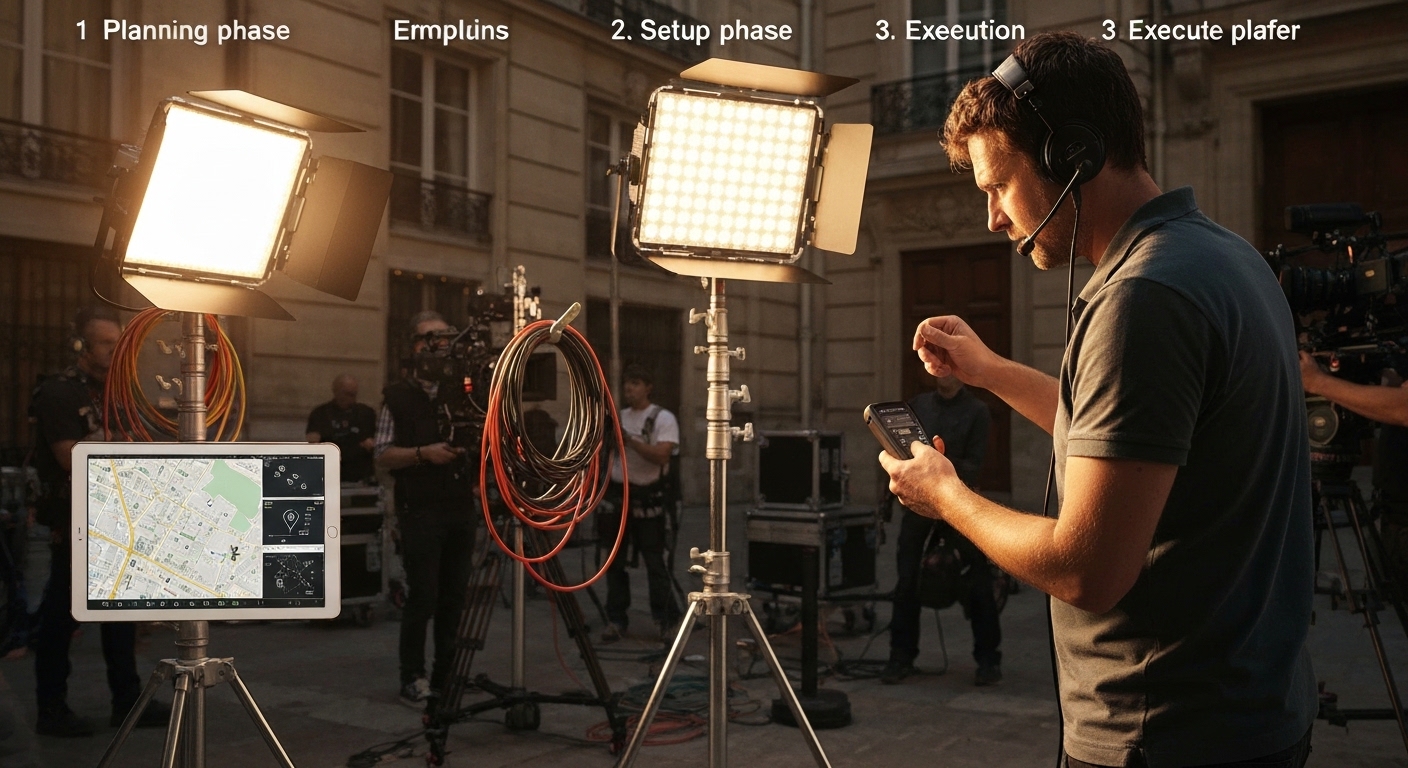
The gaffer's value is delivered through a structured, three-phase workflow that defines professional engagement:
- Pre-Production: This critical phase involves script analysis, location recces to assess power and natural light, and developing a detailed technical lighting plan and budget. The gaffer also appoints their crew, typically a best boy, to manage technicians and gear logistics.
- Production: On set, the gaffer executes the plan, directs the lighting crew, and solves real-time technical problems—all while ensuring strict compliance with French electrical safety regulations (NF C 15-100) and union protocols.
- Post-Production: The engagement concludes with systematic equipment documentation, dismantling, and return to rental houses, ensuring inventory accuracy and closing the loop on logistics.
Ultimately, the deliverable is not just illuminated actors. It's a guarantee of technical fluency—a shoot where creative ambition is realized without compromise, safety is paramount, and the complex variables of a Parisian production are managed by a single point of accountability. This foundational role directly influences the next practical consideration: understanding the investment required.
Paris gaffer hire costs: the 5 factors that determine your final quote
While specific daily rates for 2026 are pending publication of the latest French film union (CGT Spectacle) collective agreements, your final quote is never a mystery. It is precisely calculated based on five definitive, variable factors. As a veteran production manager in Île-de-France notes, "A quote that seems too simple is often incomplete. The true cost is a function of project scale, duration, and technical depth."
The primary determinants of your investment are:
- Production Scale & Gaffer Seniority: A major studio feature requiring a gaffer with 15+ years of experience commands a different rate than an indie short film. Union minimums apply for large-scale productions.
- Project Duration & Schedule: Rates are structured as daily, weekly, or project-based fees. A 12-day commercial shoot with 14-hour days will incur significant overtime premiums, often calculated at 150% of the base hourly rate after the legal limit.
- Technical Scope & Equipment Inclusion: Is the quote for the gaffer's expertise alone, or does it include a lighting package? The largest variable cost is often equipment rental, which can double or triple the base labor cost for technically complex shoots.
- Location Logistics: Shooting in a central Paris studio like the Cité du Cinéma is straightforward. A night shoot on a cobblestone street in Le Marais may require costly generators, dedicated power distribution, and special municipal permits, all adding to the line item.
- Crew Composition: The gaffer typically leads a team. Your quote must account for their best boy and additional lighting technicians (électriciens), each with their own tiered rates based on experience.
The base service usually includes the gaffer's time, local travel, and plan execution. You must budget separately for the major extras: specialized LED or HMI fixtures, generator hire, additional crew, and any location-specific power upgrades. Understanding these factors allows you to budget strategically and evaluate quotes apples-to-apples, paving the way to discuss the specific tools that budget will deploy.
The gaffer's toolkit: 3 equipment categories that make or break your lighting
The gaffer's expertise is actualized through their command of equipment. In Paris, where rental houses like TSF and Audiopole are industry staples, the gaffer manages three core categories that directly determine your image quality and on-set efficiency. A mismatch in any category can break your schedule and aesthetic.
- Lighting Instruments: This is the creative palette. The choice between tungsten for warmth, HMI for raw daylight power, and modern LED panels for energy efficiency and silent operation is fundamental. The gaffer selects the right tool to match the DP's vision and the location's power constraints.
- Electrical Infrastructure: This is the indispensable backbone. It includes distribution boxes (boîtes de distri), heavy-duty cable runs, and generators—all compliant with stringent French safety standards. A robust, well-planned infrastructure prevents catastrophic downtime and ensures crew safety.
- Support & Control Gear: This is the system for precision. It encompasses dimming consoles, wireless control systems, light stands, and grip equipment for shaping light (flags, diffusers). This category enables subtle, repeatable adjustments and the complex rigging often required in historic Parisian interiors.
The gaffer doesn't just use this gear; they are responsible for its specification, sourcing from rental partners, on-set maintenance, and safe deployment. Their deep knowledge of these three categories ensures that the right technology is available, functional, and used to its full potential, transforming the lighting plan from a document into a compelling visual reality.
Conclusion
You now possess the complete operational blueprint for a perfectly lit Parisian shoot. We’ve moved from defining the gaffer as your essential bridge from vision to reality, through the five definitive factors that structure your investment, to the three equipment categories that execute it. This framework is your strategic advantage.
Implementing this method projects you into a state of controlled execution. Your shoot adheres to schedule because the lighting plan is precise. Your budget is secure because cost factors are transparent. Your set is safe because electrical management complies with NF C 15-100 standards. Most importantly, the Director of Photography’s vision is realized without technical compromise, ensuring the final image matches the ambition.
The critical variable is your production’s unique timeline. Paris’s premier crews and equipment are booked months in advance, especially for the 2026/2027 festival and commercial cycles. The cost of inaction isn't just a missed date; it's settling for a less experienced crew, suboptimal gear, or rushed planning that risks safety and aesthetic quality.
Before you finalize any crew list, ask yourself three questions based on the variables we’ve outlined:
- Does my current budget accurately reflect the five cost factors, especially equipment rental and location logistics?
- Is my timeline aligned with the three-phase workflow to allow for proper pre-production recces and planning?
- Does my technical rider account for all three equipment categories needed to achieve the desired look?
This may seem complex, but you are now ahead of the curve. You have the structured framework to evaluate needs, communicate with professionals, and make informed decisions. The final step is to adapt this general knowledge to the specific constraints of your script, location, and budget.
To move from planning to execution, share your project’s core details for a tailored consultation on gaffer and crew sourcing. Let’s translate this blueprint into your perfect shoot. 🎬