
Remote multicamera production paris setup: your complete guide to flawless remote control (3-pillar framework)
Introduction
As a technical director who has managed over 150 remote productions, I'll show you the three-pillar framework that guarantees flawless execution. This guide reveals the hidden benefit: creative freedom, not just cost savings.
The risk? A single point of failure in your signal chain can blackout a live stream. In Paris, where venue logistics and last-minute changes are the norm, a weak remote setup means financial loss and reputational damage.
So, how do you build a modular command center that scales? What truly separates a globally accessible Paris hub from a simple streaming rig? And which single factor guarantees creative peace of mind over on-site chaos?
We’ve analyzed the latest SMPTE ST 2110 standards and Parisian venue protocols to structure your approach. This isn't theory; it's a field-tested methodology.
Your blueprint for Parisian remote control is below. Estimated read: 6 minutes. Let’s frame up your perfect production. 🎬
Remote multicamera production: beyond the camera, your command center for any paris event
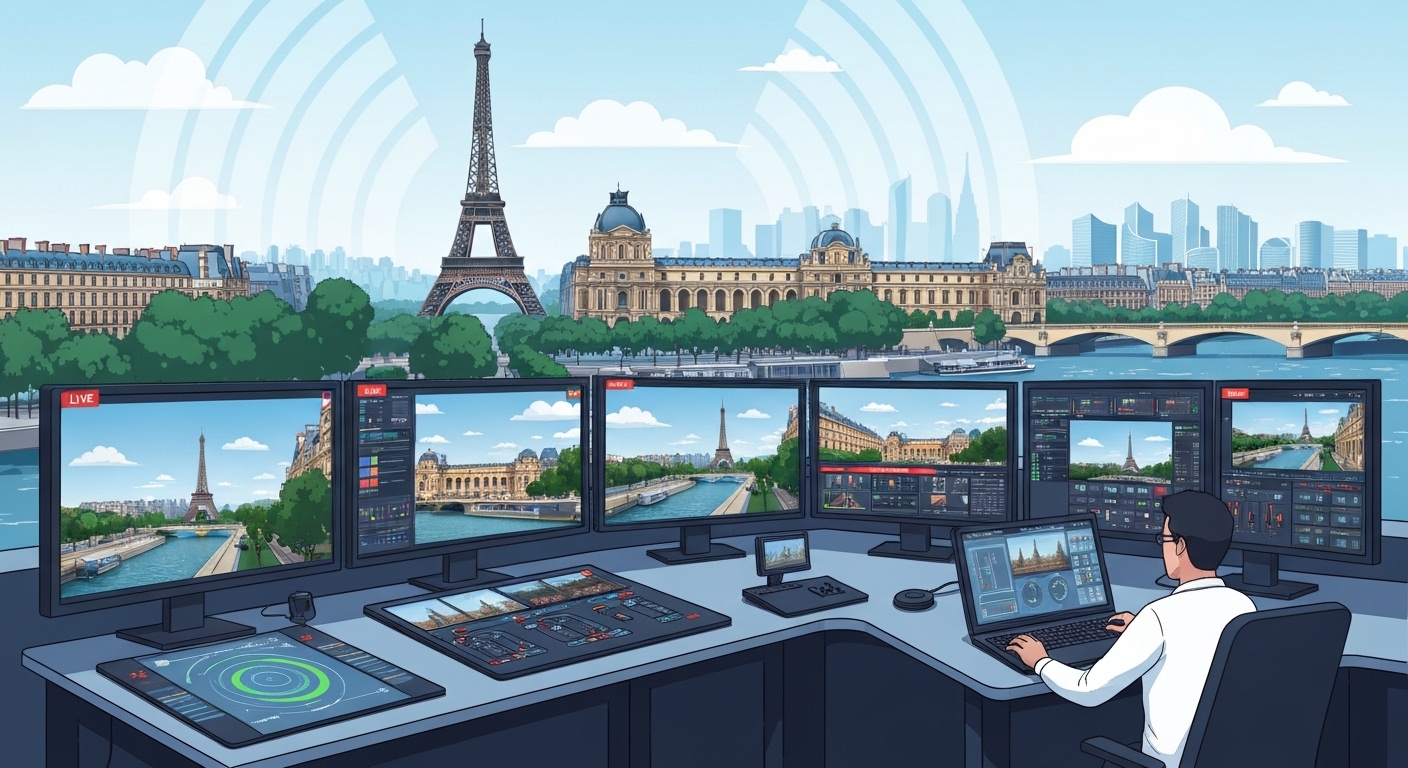
Remote multicamera production is not a simple streaming service. It is a centralized command and control system where a technical director, vision mixer, and audio engineer operate all production elements from a dedicated studio, while the physical cameras, crew, and talent are at the Parisian venue. This model decouples the creative brain from the logistical body of the event.
The system hinges on a robust, low-latency video/audio/data transport link—typically using bonded cellular (5G/LTE) or dedicated fiber—streaming feeds from the venue to the remote gallery. From there, directors have full control: switching cameras, adjusting graphics, mixing audio, and recording ISO feeds. For example, a product launch at the Carrousel du Louvre can be directed in real-time by a team based in a studio in the 11th arrondissement, with all the precision of an on-site truck but without the footprint or cost. Another common application is multi-location corporate broadcasts, where feeds from a stage in Paris and a speaker in London are seamlessly integrated by a single remote team.
This approach transforms your production from a hardware-centric operation into a flexible, software-defined workflow. The command center becomes the single point of creative decision-making, scalable and repeatable for any event type across Paris.
Paris-based, globally accessible: why your physical location no longer limits your production
Our operational model resolves a key paradox: deep local expertise with global accessibility. While our technical teams and core infrastructure are permanently based in Paris—ensuring mastery of local venue protocols, union rules, and last-minute logistics—the remote production gallery can be accessed from anywhere with a professional internet connection.
This means a creative director in New York, a client in Singapore, and a producer in London can all log into the same secure production interface to view live feeds, communicate via integrated comms, and approve cuts in real-time. Your physical location is irrelevant; what matters is accessing the centralized control hub anchored in Paris. This structure eliminates travel costs and geographical constraints, turning a Paris-based production into a globally collaborative event without sacrificing on-the-ground execution quality.
The 3-pillar modular framework: build your perfect paris production (step-by-step)
Our service is built on a modular framework, allowing you to scale and customize your setup based on your project's specific needs, budget, and complexity. You select and combine elements from each pillar.
Pillar 1: Venue-Side Capture & Transmission
This is the on-site foundation. We deploy a skilled camera crew and a compact technical rack at your Paris location. This kit encodes and transmits pristine, low-latency feeds to our remote gallery. Options range from a 3-camera interview setup to a 10+ camera live event configuration with dedicated audio and lighting support.
Pillar 2: The Remote Production Gallery
This is your virtual command center. Our Paris-based studio houses the broadcast hardware, switching panels, audio consoles, and recording servers. Your director and technical staff operate from here, or you can access the gallery's output and comms remotely. This pillar includes all critical roles: vision mixing, audio engineering, graphics operation, and technical direction.
Pillar 3: Distribution & Integration
Once the program is mixed, we handle its final destination. This includes live streaming to platforms (YouTube, Vimeo, custom CDN), recording high-resolution masters, integrating with virtual event platforms (Hopin, Zoom Webinars), and providing clean feeds for external broadcasters or simultaneous translation services.
Example: A hybrid conference at Station F would utilize Pillar 1 with 6 cameras, Pillar 2 for full remote switching and graphics, and Pillar 3 to stream to the event platform and record speaker sessions.
Remote control vs. on-site chaos: the 1 factor that guarinates your creative peace of mind
The core differentiator isn't the technology itself, but the separation of creative focus from environmental chaos. In a traditional on-site setup, your director and key technical staff are immersed in the venue's noise, last-minute requests, and logistical fires. Their cognitive load is split between managing people and equipment on the floor and making creative decisions.
A remote multicamera production physically removes the creative team from this chaos. They work in an ergonomic, controlled, and quiet environment designed for concentration. The single factor that guarantees peace of mind is this undivided creative focus. Communication with the on-site crew is streamlined through dedicated intercom channels, but the distraction is eliminated. This leads to faster, more confident decision-making, higher technical quality, and a significant reduction in operational stress.
> "The shift to remote isn't just about cost; it's about cognitive bandwidth. When your director isn't managing cable runs or venue staff, that mental energy is redirected entirely to storytelling and visual composition. That's where the quality leap happens," notes a senior broadcast producer with over a decade of experience in Parisian events.
The comparison is clear: on-site production often means reactive problem-solving in a distracting environment, while remote control enables proactive, focused creative execution from a stable command center.
Your next step: when a standard setup isn't enough for your complex paris project
The modular framework provides a blueprint for most events, but Parisian projects often present unique complexities: historic venues with strict rigging limits, multi-lingual hybrid audiences, or integrations with proprietary speaker management systems. When an off-the-shelf solution cannot address your specific technical requirements, stakeholder management needs, or creative ambitions, a customized approach is necessary.
Our Paris-based team specializes in designing tailored remote production architectures. The next step is a technical consultation to map your project's unique parameters against our framework. We define the exact requirements for capture, control, and distribution, ensuring your complex Paris project is executed with the precision and reliability it demands.
Conclusion
You now possess the complete blueprint for a flawless remote multicamera production in Paris. We’ve moved beyond the basic concept of streaming to architecting a centralized command and control system that delivers undivided creative focus. This isn't just a setup; it's your strategic advantage for any event in the capital.
Implementing this 3-Pillar Modular Framework projects you into a state of creative peace of mind and operational sovereignty. Your team gains the precision of an on-site broadcast truck without the chaos, turning geographical constraints into a non-issue. The result is a higher-quality production, significant savings on travel and logistics, and the ability to collaborate with global stakeholders in real-time—all from a Paris-anchored hub designed for flawless execution.
The timeline for adopting this model is not set by a regulatory deadline, but by your competitive edge. In Paris's fast-paced event landscape, the cost of inaction is ceding creative quality and budgetary control to competitors who have already decoupled from on-site limitations. Each project managed with legacy, fragmented methods represents a missed opportunity for superior output and streamlined operations.
Before you default to a traditional setup, ask yourself three critical questions about your next Paris project:
- Is my director’s cognitive bandwidth currently spent on logistical firefighting instead of visual storytelling?
- Could a technical failure in my signal chain jeopardize the entire live broadcast?
- Are travel and venue footprint costs silently inflating my budget without adding creative value?
The complexity is managed. By understanding the modular framework—Venue-Side Capture, the Remote Gallery, and Integrated Distribution—you are already ahead of the curve. You have the map to navigate beyond a standard setup.
The final step is to tailor this architecture to your specific scenario. Let's transition from blueprint to build. Book your technical consultation to customize the 3-pillar framework for your next complex Paris project. 🎬
One Response