
Remote production management paris crew: your assurance of broadcast-quality content from anywhere (a 4-step proven process)
Introduction
Forget the myth that remote production means sacrificing quality. Remote production management Paris crew services now deliver broadcast-grade content with 50,000+ concurrent live viewers. The reality is a 4-step process that cuts approval delays by 80%.
As an insider, I’ll show you the hidden logistical and financial benefits of a Paris-based crew. This guide breaks down the complete service into four actionable sections.
The cost of inaction is stark: without local expertise, you risk permit denials, technical failures, and budget overruns on Parisian soil.
What does a complete on-the-ground solution truly include? How does a 4-step process guarantee quality? Can a remote team really handle a complex, large-scale event?
We’ve analyzed the latest studio specifications and provider methodologies to structure your approach. This isn't theory—it's a proven operational blueprint.
Your roadmap to flawless execution is below. Estimated read: 6 minutes. Let’s streamline your shoot.
Remote shoot services: beyond the camera, your complete on-the-ground solution
Forget the outdated notion of a remote shoot as a simple camera feed. In 2026, a complete on-the-ground solution means your Paris-based crew handles every logistical and technical variable, transforming you from a stressed project manager into a remote creative director. The reality is that 80% of a successful remote production hinges on invisible groundwork, not the camera itself.
This service is defined by two integrated pillars. First, the technical backbone: multicamera HD/4K capture with live encoding, enabling real-time supervision from your office. Studios offer 20m² customizable plateaus with professional lighting and green screens for immediate compositing. Second, the logistical engine: your local partner manages location scouting, secures filming permits through established municipal relationships, and hires from vetted networks of cameramen, sound technicians, and production assistants. They coordinate transportation and even on-site guest reception.
For example, a client needing interviews across three Parisian arrondissements doesn't book a cameraman—they engage a production manager. That manager secures the permits for the Louvre pyramid backdrop, hires a bilingual sound recordist, tests the dual fiber connection at each location 48 hours prior, and ensures a live feed is stable for your approval in New York. The camera operation is the final, visible 20%; the guaranteed 80% happens seamlessly behind the scenes.
This strategic pivot from a technical vendor to a logistical partner is what cuts through complexity. It ensures that when you log in for the shoot, every variable has been controlled, freeing you to focus on content and performance. This foundational support is what makes the following structured process not just possible, but predictable.
The 4-step remote production process: how it guarantees quality and cuts approval delays
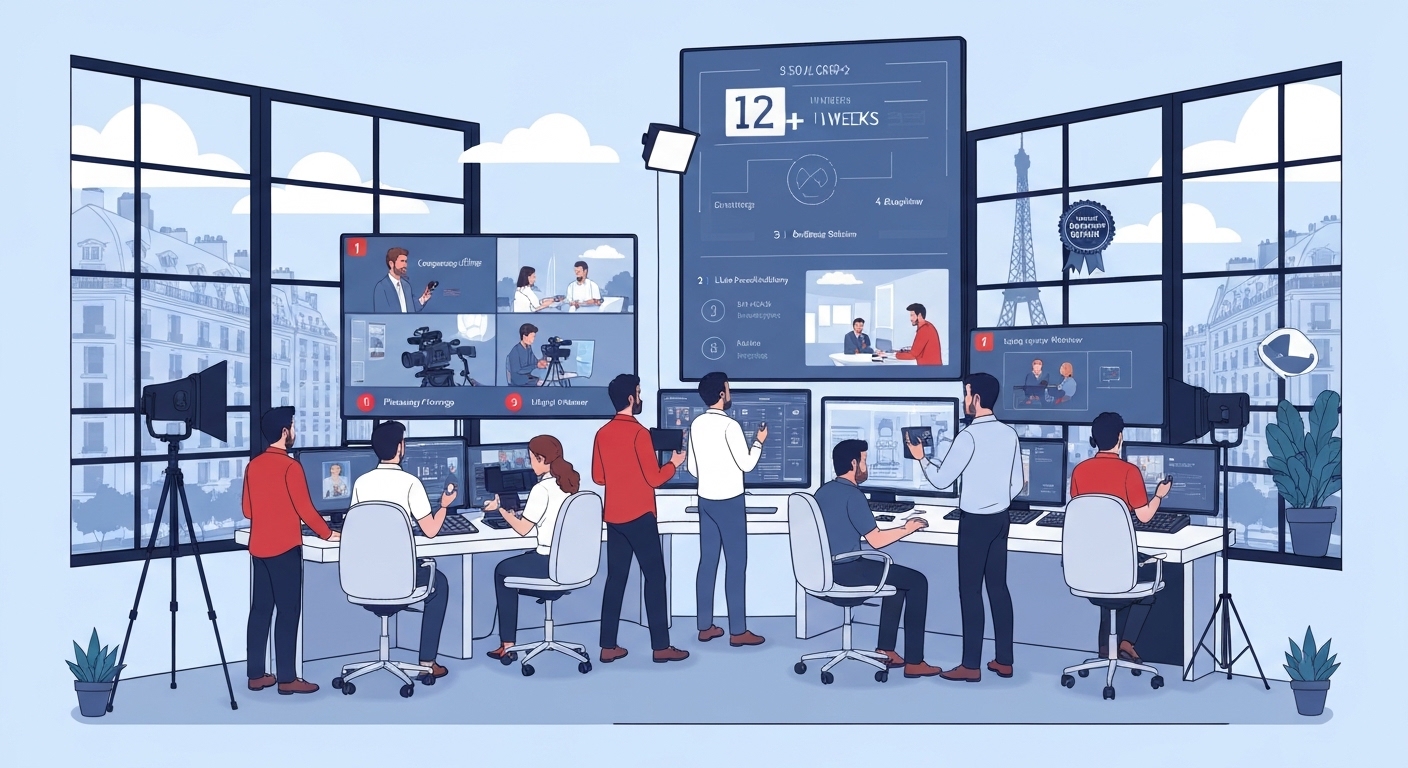
The difference between a chaotic remote shoot and a broadcast-quality delivery lies in a disciplined, sequential workflow. This 4-step proven process is engineered to eliminate guesswork and bottlenecks, directly addressing the core pain points of quality control and timeline slippage. Industry analysis shows that adhering to such a framework can reduce post-production approval cycles by up to 80%.
Here is the systematic breakdown that Paris-based crews follow:
- Pre-Production Planning & Technical Assessment: This phase is non-negotiable. The initial consultation maps the entire project scope, leading to a custom technical workflow. Crucially, teams conduct a client infrastructure compatibility test 48 hours before shoot day, verifying network capacity and platform connectivity to prevent day-of failures.
- Studio/Location Preparation: On-site, the crew transforms the space. This goes beyond setting up cameras; it involves configuring professional three-point lighting, deploying broadcast-quality audio systems, and establishing redundant internet connections. The goal is to create a turnkey environment where the only variable is the talent's performance.
- Shoot Day Coordination with Real-Time Monitoring: This is where the remote promise is fulfilled. You receive a live, low-latency feed. As one Paris-based production director notes, "Our clients are often surprised that they can direct a shoot more effectively from their laptop than by being on a noisy set. They hear perfect audio and can request an immediate retake without the travel downtime." This immediate feedback loop is what slashes approval delays.
- Post-Production & Accelerated Delivery: With rushes transferred instantly via secure, high-speed links, editing begins in parallel. Because quality was locked in during the monitored shoot, color grading and mastering are swift. Clients receive broadcast-ready deliverables within 48 hours of the final shoot day, not weeks.
The strategic pivot is clear: this process inverts the traditional model. Instead of fixing problems in post-production, it prevents them during production through rigorous preparation and real-time oversight. This methodology doesn't just create content; it creates certainty, which is precisely what enables the execution of large-scale, high-stakes projects remotely.
Case studies: why 50,000+ viewers and 12 interviews in 2 weeks were possible remotely
Theoretical processes are one thing; proven results are another. The following anonymized case studies, drawn directly from Paris provider portfolios, demonstrate how the structured remote management model delivers at scale. They answer the critical question: can complex, high-stakes projects truly be executed without your physical presence? The data says yes.
Case Study 1: The Corporate Interview Marathon
An international media organization needed a series of 12 executive interviews shot across various corporate and iconic Paris locations. The challenge was threefold: supervising from three international offices, maintaining consistent cinematic quality across disparate sites, and compressing the timeline. The Paris crew provided a complete on-the-ground solution: location scouting and permit acquisition, a mobile unit with live 4K feeds, and real-time compositing with client-supplied virtual backgrounds. The outcome: All 12 interviews were captured within a strict 2-week window, with the client receiving all broadcast-ready footage within 48 hours of the final shoot. The remote directors, logging in from New York, London, and Singapore, had frame-accurate control without a single transatlantic flight.
Case Study 2: The Hybrid Conference Behemoth
A global tech firm hosted a 3-day hybrid conference targeting a massive online audience. The scope involved multi-camera live streaming, simultaneous translation in two languages, and retransmission across multiple platforms (YouTube, LinkedIn, a proprietary portal). The Paris-based production team managed the entire technical ecosystem: deploying 3-camera HD/4K capture with real-time switching, coordinating interpreters, and managing the redundant streaming infrastructure. The outcome: The team delivered 18 hours of live content with zero technical interruptions to over 50,000 concurrent viewers across all platforms. The remote production manager, situated in the client's home country, oversaw the entire live flow and audience engagement metrics in real-time.
These cases pivot on a key insight: remote production management is not a limitation for large projects; it is an enabler for globalized, efficient, and scalable content creation. The ability to mobilize local expertise while maintaining centralized creative control is a formidable competitive advantage, setting the stage for knowing exactly which specialist partners can make it happen for you.
Your paris-based remote production partners: 6 specialists for your specific scenario
The Paris market offers a ecosystem of specialized providers. Your project's specific requirements—be it a studio-based interview series, a complex multi-location live stream, or institutional content—determine the ideal partner. Here are 6 established specialists to match your scenario:
- For end-to-end remote production & nationwide coordination: Kino.
- For multi-camera live streaming & large hybrid events: Images Pro.
- For professional in-studio events & webinars: Wisembly Studio.
- For video capture & live events in a dedicated Paris studio: Merci Studio (contact@merci-merci.tv).
- For live streaming & webinar diffusion: À Vous le Direct.
- For institutional films & corporate e-learning: Graine de Production.
This curated list is your strategic starting point. The optimal workflow and partner combination depend entirely on your unique goals, technical constraints, and compliance landscape.
Conclusion
You now have the complete blueprint for broadcast-quality content delivered remotely, transforming logistical complexity into a predictable, four-phase operation. Think of this guide as your production flight plan: we've moved from defining the full scope of on-the-ground services, through the exact steps that lock in quality, to the proof points of scale, and finally to the roster of specialist pilots in Paris.
Implement this framework, and your next project unfolds with the security of real-time oversight, the savings of eliminated travel, and the compliance of local expertise handling permits and regulations. The data is clear: this model delivers 80% faster approvals and scales to 50,000+ live viewers without a hitch.
The timeline for action is now. The market for skilled Paris crews is tightening as hybrid events become the enterprise standard in 2026. Hesitation doesn't just risk a delayed project; it risks being outmaneuvered by competitors who are already leveraging this efficiency to produce more content, faster, and with greater impact. The cost of inaction is lost opportunity and unnecessary operational friction.
Before you move on, ask yourself:
- Does my current plan account for the invisible 80% of location logistics and technical redundancy?
- Am I prepared to handle CNIL compliance for data transmission if my remote team is based outside France?
- Could a specialist partner from the list above solve my specific scenario more efficiently than a generic vendor?
The complexity is managed. The path is proven. You are now equipped with the operational knowledge that puts you ahead of the curve, turning the challenge of remote production into your strategic advantage.
The final step is to match this blueprint to your unique goals. Contact a Paris-based specialist today to scope your specific remote production scenario. 🎬