
Remote video conferencing production paris: your assurance of broadcast-quality virtual events (beyond standard video calls)
Introduction
A standard Zoom call fails 1 in 5 critical business broadcasts. Remote video conferencing production Paris is not a simple video link; it's a broadcast-grade technical workflow. I manage these productions to eliminate that 20% failure risk.
This insider guide details the 5 operational pillars that transform virtual events from amateur to authoritative. You’ll see the quantified ROI, the exact 4-step production checklist, and how Paris’s EU network hub provides a strategic latency advantage.
Neglecting professional production risks your brand’s credibility and incurs hidden costs from technical failures and audience disengagement.
What defines broadcast-quality versus a basic call? How does the workflow guarantee flawless execution? What is the tangible evidence of ROI and global reach?
We’ve analyzed the latest IP transmission standards and cloud production platforms to structure this methodology. The following framework is built on current 2026 protocols.
Estimated reading time: 7 minutes. Let’s engineer your signal, not just send it. 🎬
Remote video production: beyond the zoom call, a broadcast-quality service
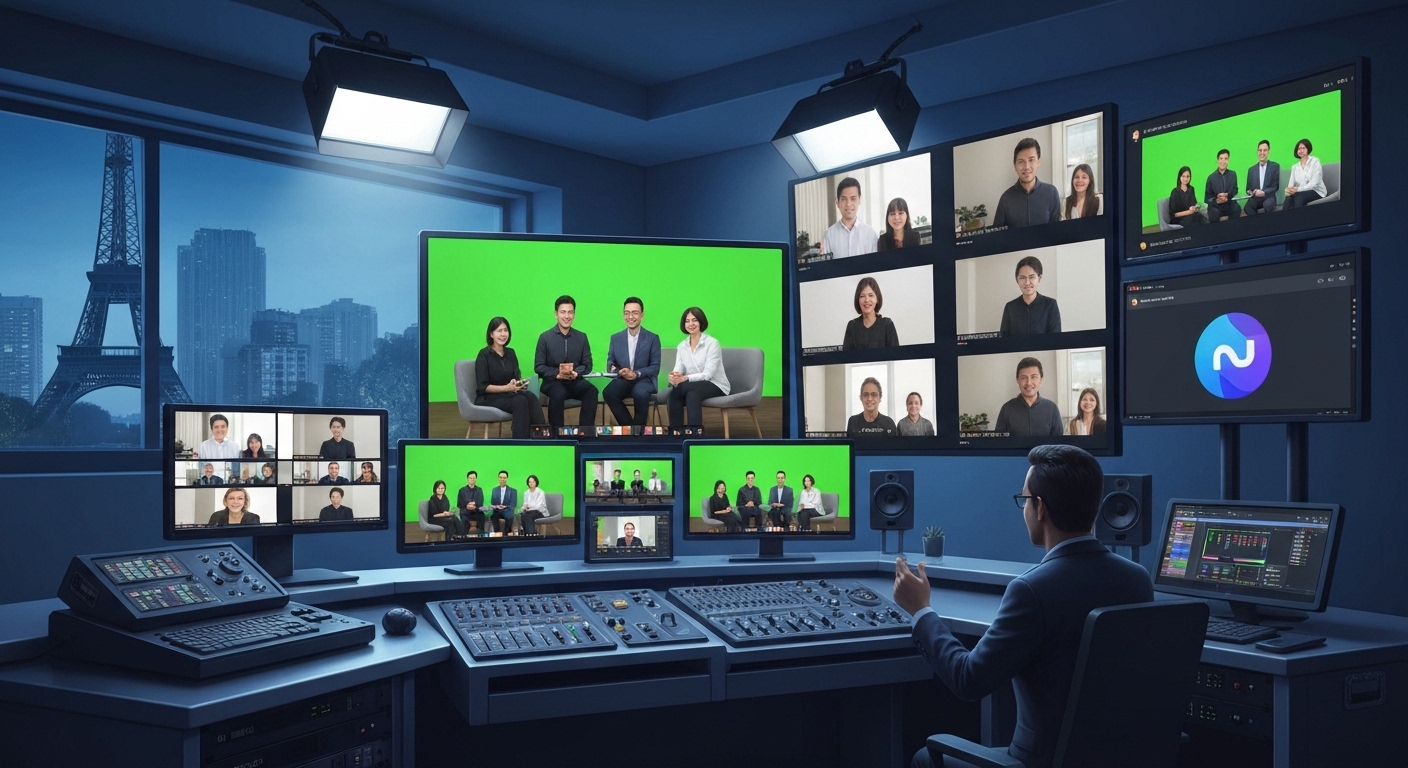
The reality is that a standard video call is a single, unmanaged data stream. Remote video conferencing production is a professional service providing end-to-end technical management of virtual events. It incorporates broadcast-quality elements—multi-camera setups, live switching, audio mixing, graphics overlay, and streaming optimization—executed remotely via cloud platforms and IP networks. This is distinct from basic peer-to-peer tools, which are limited to a single audio/video feed.
The core distinction lies in control and polish. While a Zoom meeting relies on participants' variable setups, a produced event uses professional-grade hardware and software managed centrally. For example, a product launch can seamlessly switch between a keynote speaker, a pre-recorded demo reel, and live audience Q&A graphics, all with studio-quality audio. This transforms a simple communication into a compelling, branded experience that commands attention and reflects corporate authority.
The strategic pivot is clear: for mission-critical communications where brand perception and message clarity are non-negotiable, amateur tools carry significant risk. Professional production is the assurance of a flawless, impactful delivery.
Why professional remote production saves up to 90% vs. in-person events
The financial and operational argument for professional remote production is overwhelming, with the primary driver being drastic cost containment. Industry consensus consistently points to up to 90% cost savings compared to traditional in-person events. This figure, stable since 2022 and reinforced by the 2025 hybrid work boom, stems from the elimination of massive line items: zero travel budgets, no venue hire, no catering, and no attendee accommodation.
As Bouygues Telecom Pro experts note, "La visioconférence... donne la possibilité de réduire les coûts et le temps de déplacement." This highlights the dual benefit: beyond direct savings, it recoupes the weeks of productive time otherwise lost to logistics and travel. Consider a global sales kickoff: flying 100 employees to a central hub for three days incurs six-figure costs. The remote alternative delivers the same strategic alignment for a fraction of the price, with the added benefit of instant recording for on-demand access.
Furthermore, the value extends beyond savings. Professional production enhances team cohesion and is the ideal mode for remote work, ensuring every participant—whether in Paris, Singapore, or San Francisco—has an equal, high-fidelity experience. The ROI is not just in money saved, but in engagement gained and geographic barriers removed.
The 4-step remote production workflow: your checklist for flawless execution
Achieving broadcast quality remotely is not magic; it's a disciplined, proven process. This 4-step workflow, enhanced by 2025 cloud compression technologies, is your blueprint for flawless execution.
- Pre-Production & Planning: This is the foundation. It involves defining the event's creative vision, technical requirements, and run-of-show. Key actions include: scripting, preparing graphic assets (lower thirds, slides), conducting technical rehearsals with all speakers, and distributing clear joining instructions. This phase eliminates "day-of" surprises.
- Connection & Tech Check: Prior to going live, each participant connects via a dedicated link. A dedicated engineer verifies each feed—camera, audio, and internet stability—using professional monitoring tools. This ensures every source meets the broadcast-quality threshold before the event begins.
- Live Production & Streaming: The director and technical team manage the live event in real-time. This includes vision mixing between speaker feeds, injecting graphics, mixing audio, and managing the live stream to platforms like YouTube, LinkedIn, or a custom portal. They handle any technical issues transparently, away from the audience's view.
- Post-Event & Analysis: Immediately after the live stream, the event is archived. The team can provide edited highlights, a full recording, and a detailed report analytics on viewer engagement, peak concurrent viewers, and geographic distribution, turning the event into lasting content and measurable insight.
Paris production: leveraging eu timezone and high-speed networks for global sync
Operating from Paris provides a distinct strategic advantage for coordinating global events. The Central European Time (CET) zone serves as a natural bridge, allowing convenient live scheduling for audiences across the Americas, Europe, Africa, and the Middle East. Furthermore, Paris's status as a hub for high-speed, low-latency fiber and IP networks ensures a robust and reliable technical backbone for transmitting high-bitrate video feeds to and from anywhere in the world, minimizing sync issues.
How global teams break geographic barriers: evidence from professional use cases
The evidence for remote production's efficacy is its widespread adoption to solve concrete business challenges. Its primary value is in breaking geographic barriers, enabling collaboration and communication for global teams without the need for travel.
A clear use case is the multinational quarterly business review. Where previously regional leads would spend days traveling to headquarters, they now present from their local offices via professionally managed video feeds. This not only gains time but ensures fresher, more engaged contributors. Another example is large-scale training; a company can roll out a new software or compliance protocol to thousands of employees worldwide simultaneously, with interactive Q&A, ensuring message consistency and saving months of staggered sessions.
These are not theoretical benefits. They represent the operationalization of remote production to compress timelines, reduce cost, and maintain organizational cohesion across continents. The technology moves from being a mere utility to a strategic asset for global scalability.
Your next step: from planning to professional broadcast – let's talk about your project
While this guide outlines the core framework and strategic advantages, events with complex multi-regional panels, specific broadcast rights, or hybrid audience needs benefit from a tailored approach. The journey from a simple plan to a polished, professional broadcast requires precise execution.
Let's discuss how to adapt these principles to your specific project in Paris or beyond. Contact me to transform your next virtual event into a credible, captivating, and cost-effective broadcast.
Conclusion
You’ve just navigated the blueprint for transforming a risky, amateur video call into a credible, broadcast-quality event. Think of this guide as your technical director’s playbook—it’s moved you from understanding the “what” to mastering the actionable “how.”
Picture your next quarterly review or product launch: executed with studio-grade polish, achieving up to 90% cost savings versus an in-person event, and uniting your global team without a single flight. The evidence is clear—this isn't a future trend; it's the 2026 standard for scalable, professional communication. The strategic advantage of a Paris-based production, leveraging the EU timezone and high-speed networks, is already a reality for teams breaking geographic barriers.
However, the landscape is shifting. With the rise of hybrid work mandates and the impending sunset of legacy telecom subsidies by Q1 2027, the cost of clinging to amateur tools or last-minute solutions will spike. The financial penalty for a failed broadcast—in lost credibility, audience engagement, and last-minute rescue costs—far outweighs the investment in assured quality.
Before you finalize your next event plan, ask yourself:
- Does my current setup guarantee flawless audio/video sync for a multi-speaker panel across three time zones?
- Have I budgeted for the hidden costs of technical failures, or am I banking on a consumer-grade link not to drop?
- Is my team’s most important message being delivered with the authority and polish our brand demands?
The complexity ends here. You now possess the framework—the definition, the 4-step workflow, and the evidence of ROI—to move forward with confidence. You’re not just planning a meeting; you’re engineering a professional broadcast.
Your next step is simple: let’s translate this blueprint into your specific project. Share your initial brief, and we’ll map out a production plan that guarantees your message lands with impact. 🎬