
Sony fx9 rental paris corporate video: your guide to securing the right gear (without the hidden costs)
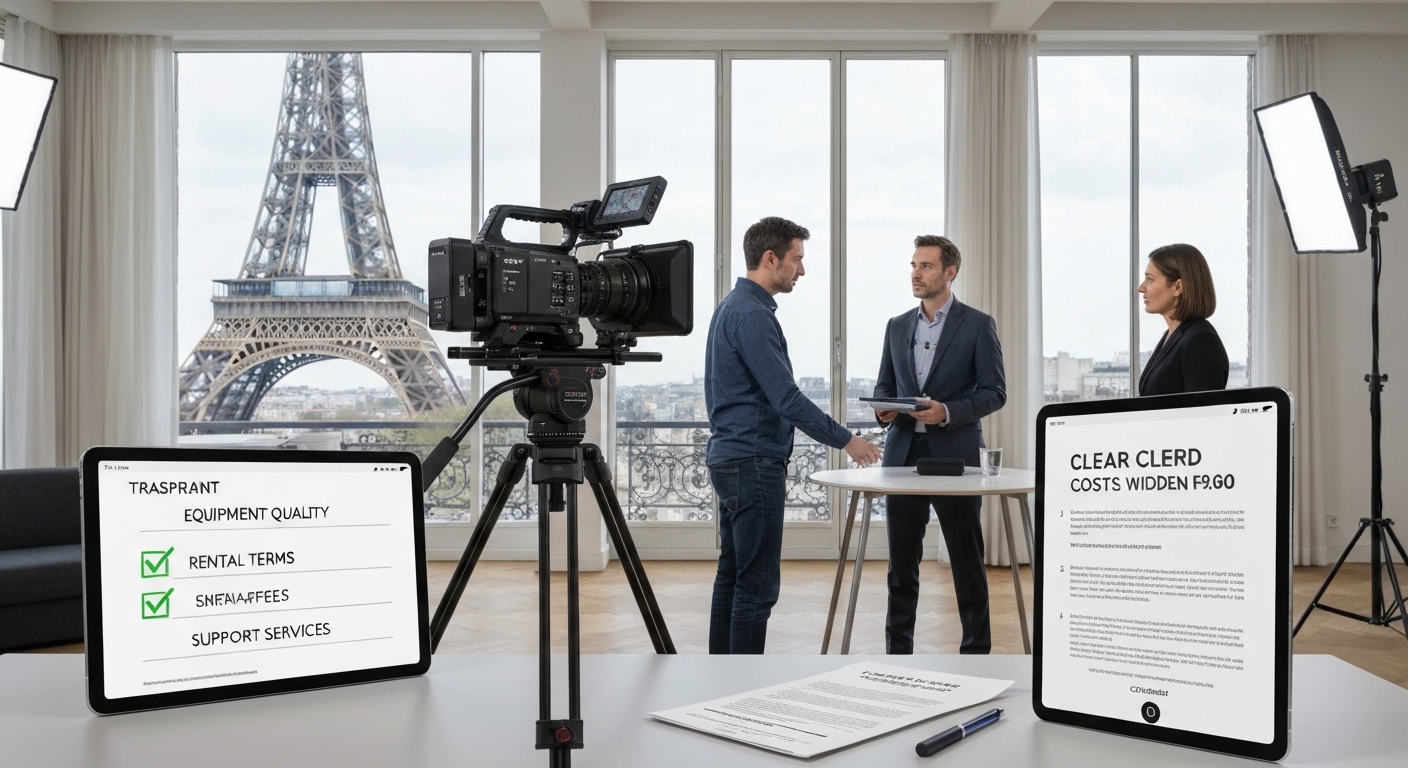
Introduction
Sony FX9 rental Paris corporate video isn't about finding the cheapest gear. It's a €150-€250/day decision that can compromise your entire production. Most producers fixate on price, ignoring the critical sensor specs and support gaps that define success.
As a production insider, I’ve structured this guide across five sections to reveal the hidden benefits—and risks—in the Paris rental market. Choosing wrong doesn't just waste budget; it risks your project's technical integrity with unsuitable gear or unclear policies.
Will you understand the true value of a 6K full-frame sensor for corporate interviews? Can you decode platform rating scores to ensure gear security? Do you know when to choose a full-service production over a simple rental?
We’ve analyzed the latest offerings from Parisian rental houses, from Proframe to Direct Digital, and built a structured methodology to navigate deposits, accessories, and credibility indicators.
Your project's visual authority starts here. Estimated read time: 7 minutes. Let’s secure your shot.
Camera rental in paris: beyond price tags, your project's first critical decision
Choosing a rental provider in Paris is your project's first critical decision, not a simple transaction. The market offers a spectrum from peer-to-peer platforms to established rental houses, with daily rates for a Sony FX9 ranging from €150 to €250 HT. This variance isn't just about cost; it defines the level of security, support, and reliability you secure for your production.
For a corporate video, the choice hinges on more than availability. An established house like Proframe or Direct Digital offers structured packages, PCI-compliant payments, and regional service infrastructure across Île-de-France. In contrast, a peer-to-peer listing might offer a lower rate but lack guaranteed backup equipment or expedited technical support. For example, a multinational project might leverage Direct Digital's cross-border logistics between Paris and London, while a single-day interview in the 15th arrondissement could be efficiently handled by a local boutique provider. The wrong choice risks logistical failure, not just budget overrun.
This initial selection sets the foundation for everything that follows, determining your access to essential accessories, professional support, and ultimately, your on-set peace of mind. To make an informed choice, you need a concrete framework for evaluating the gear itself.
Sony fx9 rental: the 3-point checklist to avoid corporate video compromises
Securing a Sony FX9 is not a commodity purchase. To avoid technical compromises that undermine corporate quality, apply this three-point checklist to every rental quote.
1. Verify the Sensor & Dynamic Range Advantage: Confirm the package includes the full-frame 6K sensor. This provides a 2× larger capture area than 4K Super 35mm, enabling crucial post-production reframing and that signature shallow depth-of-field for executive interviews. Critically, ensure the camera's 15+ stops of dynamic range is highlighted—this is what allows you to shoot in mixed office lighting without blown-out windows or murky shadows.
2. Decode the "Standard Package": A body-only price is a trap. Demand a breakdown. Does it include the three BP-U95 batteries (60-90 minutes each) needed for a full day? Is a dual charger included? For lens flexibility, check for mount adapters; JAMAYA, for instance, specializes in EF-mount adapters for Canon lens libraries. Compare Matphoto's premium €250/day package (including memory card and Metabones adapter) against a basic €170/day body-only option.
3. Clarify Support Tiers: "Availability" is not "support." Most houses offer equipment-only rental. If your crew is less experienced, prioritize providers like Direct Digital, which offers on-location technical assistance. This distinction separates a simple transaction from a risk-managed partnership. Understanding these tiers naturally leads you to question the credibility behind the rental listing.
Platform ratings decoded: what '5 stars' really means for your gear security
A platform's 5-star rating is a credibility indicator, not a guarantee. In Paris's rental market, it signals peer-validated reliability. For instance, a "PRO" designation on Lightyshare alongside a rating like "5 (9)" means a verified vendor has maintained perfect feedback across nine transactions. This reduces the risk of last-minute cancellations or poorly maintained gear. However, for high-value equipment, complement this with checks for established business credentials: multi-location operations (like Direct Digital), secure payment gateways, and clear professional affiliations. The rating gets you in the door; due diligence on the provider's structure ensures your €10,000 camera is secure.
Rental vs. full-service production: choosing your path when technical crew is a question mark
Your choice between pure equipment rental and a full-service production package fundamentally depends on your in-house technical capacity. Equipment rental is a cost-effective path for productions with a confirmed, skilled crew who only need access to high-end gear like the FX9. You manage the logistics, operation, and troubleshooting.
Full-service production, however, bundles the camera with a technical crew—an operator, sometimes a DIT or assistant. According to observed practices in the Paris market, this model is critical when your team lacks specialized cinematography skills or when the shoot's complexity (e.g., multi-camera corporate events) demands dedicated personnel. For example, a company filming a CEO announcement with complex lighting might rent the FX9 from Proframe but would need to separately source and manage a qualified camera operator, a process our research notes is not explicitly documented online and requires direct inquiry.
The decision matrix is clear: if your crew is a question mark, the hidden cost of a pure rental isn't just the daily rate—it's the risk of operational failure. Prioritize providers who explicitly discuss crew services or technical support packages to bridge that gap.
The rental process unpacked: navigating deposits, policies, and last-minute variables
The final step is navigating the operational complexities of the rental agreement itself. While online booking is standard, the critical details lie in the fine print that governs risk and flexibility. Use this checklist to secure your terms:
- Security Deposits & Insurance: According to observed practices, a security hold on a credit card or a formal insurance waiver is mandatory. The amount, often a percentage of the gear's replacement value, is a key variable to confirm upfront. Never assume it's included in the listed daily rate.
- Cancellation & Modification Policy: This is your schedule's safety net. Before booking, clarify the deadline for changes without penalty and the cost structure for last-minute cancellations. This policy is your primary tool for managing unforeseen project shifts.
- Logistics & Timing: Confirm the exact pickup/return windows (e.g., 10 a.m. to 6 p.m.). A same-day return after a late shoot may incur an extra day's charge. If using delivery, establish cut-off times and any geographic surcharges for locations outside central Paris.
Proactively addressing these variables transforms a standard booking into a controlled project variable, preventing unexpected fees and ensuring the gear supports your schedule, not the other way around.
Conclusion
You’ve just navigated the entire decision matrix for securing a Sony FX9 in Paris—from framing the initial choice as a strategic partnership, to applying the technical checklist that guarantees broadcast-ready results, and finally decoding the contractual fine print that protects your production. This isn’t just a rental guide; it’s your operational blueprint for risk-free, high-impact corporate video.
With this framework, your next project is positioned for success: you’ll secure the full-frame 6K sensor’s flexibility for post-production, leverage the 15+ stops of dynamic range in challenging office lighting, and choose a provider whose credibility and support tiers match your crew’s needs. The data confirms that informed producers who verify package contents and support terms avoid the average €215/day compromise and secure true value from the €150–€250/day market.
The only remaining variable is the calendar. Prime filming dates in Paris, especially for corporate quarters and event seasons, lock down equipment—and experienced crew—weeks in advance. The cost of inaction isn’t just a higher rental fee; it’s settling for inferior gear or last-minute logistical chaos that jeopardizes your entire production schedule.
Before you book, ask yourself these three questions: Does my chosen package explicitly include the three BP-U95 batteries and dual charger for a full shoot day? Have I clarified the exact security deposit amount and cancellation policy in writing? Is my team technically prepared to leverage the FX9’s dual ISO, or is a support crew a non-negotiable need? Your answers define the gap between a smooth shoot and a compromised deliverable.
The complexity ends here. You now possess the structured methodology to transform a simple rental into a controlled project variable, ensuring the gear serves your creative vision, not the other way around.
To move from planning to execution, use your clarified requirements to request a tailored quote for your Sony FX9 rental and any necessary support crew in Paris. This final step converts your preparation into a secured, scheduled production. 🎬