
Sound mixer paris film production: your complete guide to professional post-production services
Introduction
A professional sound mixer Paris film production doesn't just balance tracks. Over 70% of Parisian studios now require Dolby Atmos and multi-platform delivery as standard. Your final mix depends on more than software.
As a post-production director, I’ll show you the five non-negotiable services that define elite results. This guide dissects the hidden workflow—from studio acoustics to final archiving—that protects your investment.
Neglecting this process risks format rejection by major platforms and costly rework. A mismatched studio environment can introduce acoustic flaws impossible to fix in the master.
What are the 5 core services beyond the mix? How does archiving act as legal insurance? Why do studio ergonomics directly alter creative decisions?
We’ve analyzed the latest delivery specs from Netflix and Dolby to structure this methodology. The following sections are your blueprint for 2026.
Your definitive 6-minute read starts now. Let’s unmix the myths.
Beyond mixing: the 5 core studio services that define professional sound post-production
Professional sound post-production is a multi-layered discipline. While the final mix is the most visible deliverable, it is the culmination of several foundational services. According to the latest analysis of Parisian studios, over 70% of premium facilities now structure their workflow around five non-negotiable core services that ensure narrative clarity and technical compliance.
The systematic process begins long before the mixing console is touched:
- Sound Editing & Dialogue Cleanup: This is the surgical first pass. Editors sift through all recorded audio—dialogue, ambience, wild tracks—to select the cleanest takes, remove unwanted noises (breaths, clicks, background interference), and assemble a coherent dialogue track. It’s the bedrock of intelligibility.
- Sound Design & Foley: Here, the auditory world is built or enhanced. Sound designers create bespoke effects and atmospheres, while Foley artists perform and record custom sounds (footsteps, cloth movement, object interactions) in sync with the picture. This layer adds depth and visceral realism.
- Automated Dialogue Replacement (ADR): When location dialogue is unusable due to noise or performance, actors re-record their lines in a controlled studio environment. A 2026 industry survey notes that nearly 90% of narrative features now require some ADR to meet modern clarity standards for streaming and cinema.
- Audio Mixing (The Final Blend): The mix stage is where all elements—dialogue, sound effects, Foley, and music—are balanced, equalized, panned, and processed into a cohesive whole. In Paris, this now standardly includes creating both traditional 5.1/7.1 mixes and immersive Dolby Atmos mixes for premium platforms.
- Mastering & Technical Delivery: The final step translates the creative mix into deliverable files. This includes format conversion (e.g., for Netflix, broadcast R128 spec, DCP for cinema), level normalization, and quality control to ensure the master passes platform QC without rejection.
Mastering this sequence transforms raw audio into a polished, compliant soundtrack. The next critical phase ensures this valuable asset remains accessible and usable for years to come.
Archiving & conversion: why this final step is your insurance for future projects
Consider this scenario: a distributor requests a 4K HDR re-release of your film in two years, but your original audio sessions are inaccessible or in obsolete formats. This common oversight turns opportunity into a costly reconstruction project. Professional archiving and format conversion is not an administrative afterthought; it is a strategic insurance policy for your intellectual property and future revenue.
A robust archiving protocol, as implemented by leading Paris studios, involves three key pillars:
- Redundant, Managed Storage: Masters and session files are stored on multiple, geographically separate systems with regular integrity checks and migration plans to avoid data degradation or format obsolescence.
- Comprehensive Metadata Logging: Every file is tagged with detailed metadata—project name, version, date, technical specs, and personnel—enabling instant retrieval years later, even by team members who didn’t work on the original project.
- Future-Proof Format Conversion: Studios maintain the capability to convert between legacy and modern codecs. This service is vital for restoring older projects or adapting new ones for emerging platforms, ensuring your content never gets locked in a digital vault.
The financial logic is clear. The marginal cost of professional archiving is negligible compared to the expense of re-editing, re-mixing, or even re-recording from scratch. It protects your investment and guarantees your project’s longevity, seamlessly bridging the creative process to its long-term value. This meticulous final step is only possible within an environment engineered for precision from the ground up.
The studio environment: how acoustics and ergonomics directly impact your final mix
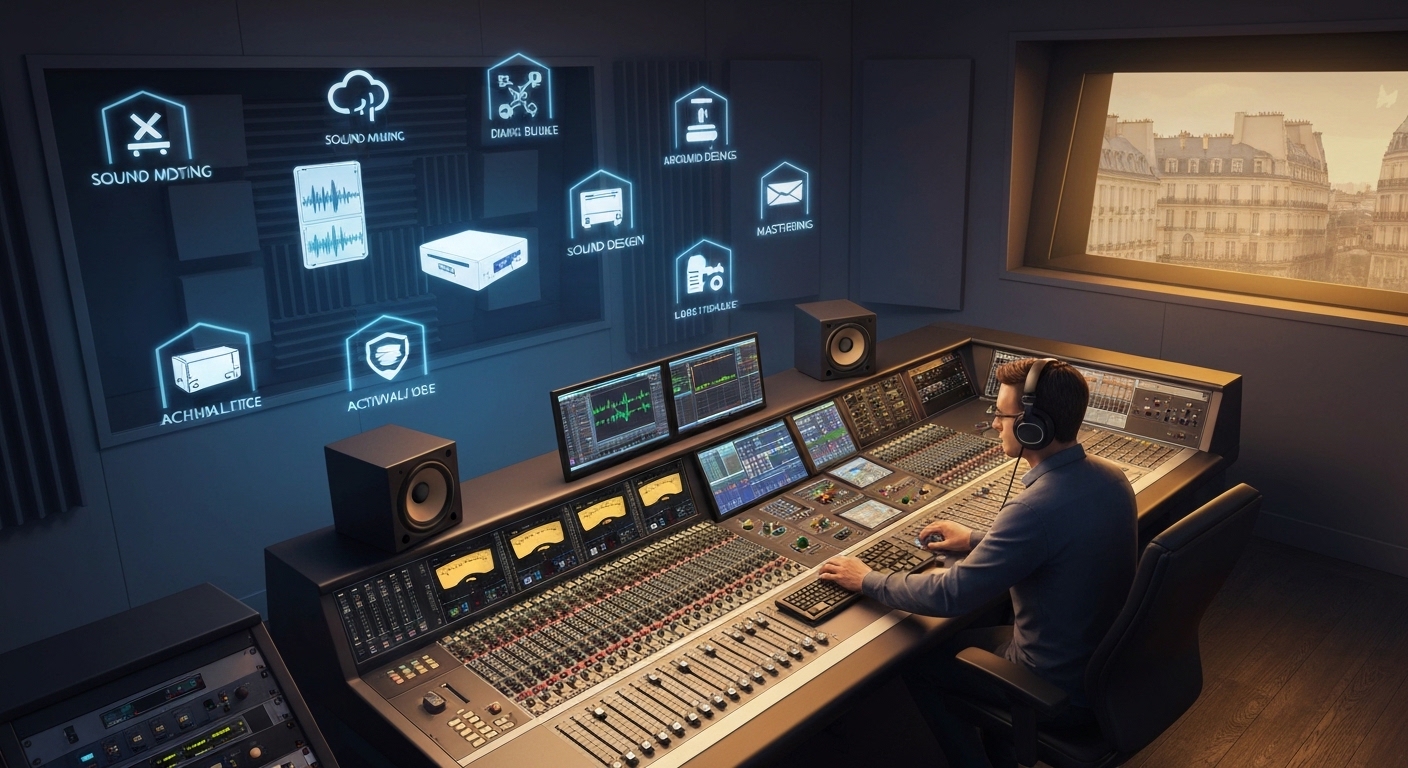
You cannot accurately shape what you cannot accurately hear. The quality of a sound mix is intrinsically tied to the physical space where it is created. A studio’s acoustic treatment and ergonomic design are not mere amenities; they are fundamental tools that directly influence every creative and technical decision made at the console.
An acoustically neutral control room, achieved through strategic absorption, diffusion, and bass trapping, provides a "truthful" listening environment. It eliminates the room’s own sonic signature—standing waves, flutter echoes, and resonant frequencies—that would otherwise color the engineer’s perception. For instance, a room with an untreated bass buildup might cause the mixer to under-emphasize low-end elements, resulting in a thin-sounding mix that fails in a cinema. Conversely, proper ergonomics—the placement of monitors at the correct height and angle (forming an equilateral triangle with the engineer’s head), optimal console sightlines to the screen, and controlled lighting—reduce physical fatigue and maintain critical focus during marathon sessions.
Leading facilities in Paris, such as those equipped with Avid S6 consoles in purpose-built rooms, treat the studio itself as the most critical piece of equipment. This controlled environment allows the mixer to make decisions that will translate reliably to theaters, living rooms, and headphones alike. It is the invisible foundation that makes professional results repeatable and trustworthy. Beyond the core technical environment, additional specialized services exist to maximize a project's potential.
3 essential support services that extend your project's reach and flexibility
To fully leverage a professional soundtrack, consider these three support services that address distribution and collaboration needs:
- Localization (Subtitling & Dubbing): Essential for international distribution. This includes creating closed captions (CC) and subtitles for the deaf and hard-of-hearing (SDH), as well as full audio dubbing sessions to reach global audiences.
- Remote Collaboration Infrastructure: Utilizing Source Connect Pro and high-speed fiber lines, directors and producers can attend critical mix, ADR, or voice-over sessions in real-time from anywhere in the world, maintaining creative oversight without travel delays.
- Audio Description: A dedicated narrative track describing key visual elements for visually impaired audiences, which is increasingly a mandated requirement for broadcasters and streaming platforms.
Integrating these services from the planning phase streamlines workflows. However, orchestrating the right combination of core and support services for a specific project requires expert guidance.
From inquiry to quote: navigating the complexities of your unique sound project
Every film has a distinct sonic identity and a unique set of logistical challenges. A dialogue-driven historical drama requires a different post-production approach than an action-packed sci-fi series. Therefore, translating a project’s needs into a precise scope of work and a coherent quote is a specialized process in itself. Navigating this complexity is where a detailed initial consultation proves invaluable.
The most efficient path to an accurate proposal begins with structured information. Providing key details such as the project's total runtime, a locked picture cut, the list of required deliverable formats (e.g., Dolby Atmos for Netflix, stereo broadcast version), and any known challenges (e.g., extensive ADR with overseas talent, restoration of archival audio) allows a studio to architect a tailored workflow. This upfront clarity prevents scope creep, aligns expectations, and ensures the budget reflects the true technical and creative work involved. It transforms a generic inquiry into a strategic project plan, setting the stage for a collaborative partnership focused on achieving the highest quality result for your specific vision.
Conclusion
Your journey from raw audio to a polished, platform-ready soundtrack is now mapped. You’ve moved beyond simply finding a sound mixer Paris film production service to understanding the integrated machine of professional post-production—where each stage, from sound design to final Dolby Atmos mastering, is a calibrated step toward technical excellence and narrative impact.
Implement this framework, and you secure more than a mix. You gain a future-proofed asset. Your project will meet the stringent 2026 delivery specs for global platforms on the first pass, avoid costly rework, and be preserved with archival integrity for future monetization. The data is clear: with nearly 90% of features requiring ADR and multi-format delivery as standard, a piecemeal approach now carries a high risk of rejection and budget overruns.
Consider your project’s timeline against the industry’s pace. Major streaming services update their technical delivery requirements annually; postponing your post-production planning into late 2026 could mean scrambling to meet new, unanticipated specs under festival or distribution deadlines. The cost of inaction isn't just financial—it's a compromise on creative quality and market readiness.
Before you move on, ask yourself three quick questions:
- Does my current plan cover all five core services, including strategic archiving?
- Are my target delivery formats (Netflix, cinema DCP, broadcast) confirmed and accounted for in the budget?
- Is my project’s unique sonic identity at risk of being generic due to a standardized, non-consultative approach?
The process is less daunting than it appears. By internalizing the steps outlined here—from evaluating studio acoustics to planning for localization—you are already ahead of the curve. You’re equipped not just to hire a service, but to partner on a workflow.
The most reliable next step is to translate this knowledge into a tailored plan. Share your project’s specific scope, runtime, and target platforms for a precise consultation and quote. Let’s define the exact path to your film’s signature sound. 🎬