
Video production budget guide: your 2026 blueprint to avoid costly pitfalls (5 proven steps)
Introduction
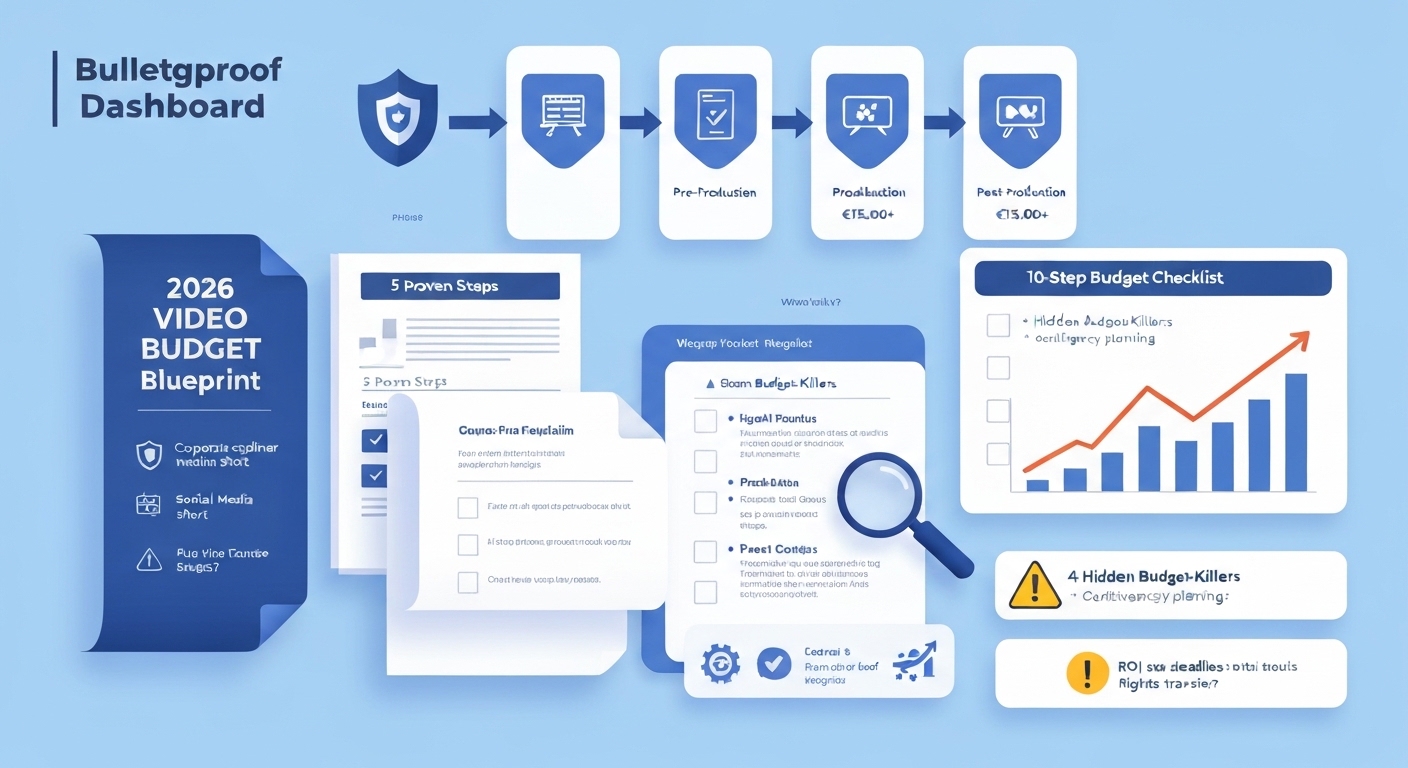
60% of video budgets are wasted on inefficiencies. The myth? That a video production budget guide is just about camera rates. The 2026 reality is defined by AI-driven post-production and one-shot, multi-format shoots.
As an insider, I’ll reveal the hidden levers that cut costs by 50-70%. This blueprint distills the latest 2026 production guides into 5 actionable sections.
Without this strategic view, you risk a €15,000 quote for a €1,500 project. Unplanned location fees, talent overtime, and endless revisions will bleed your resources dry.
Do you know the three core phases that dictate every euro spent? Can you spot the four budget-killing contingencies most plans miss? And how do you leverage AI automation to slash post-production by 30%?
We’ve analyzed the latest 2026 pricing decks and efficiency reports. Our methodology provides a step-by-step framework, from modular scripting to rights management.
Your optimized budget is 7 minutes away. Let’s roll camera. 🎬
Video production costs: beyond the camera, the 3 phases that determine your budget
Forget the camera rental price tag. In 2026, a professional video production budget is a strategic allocation across three distinct, interdependent phases. According to the latest industry guides, these phases are pre-production (20-30%), production (40-50%), and post-production (20-40%). The distribution isn't fixed; it's a dynamic equation where investing more in planning directly reduces costly surprises later.
Let's break down what each phase truly costs:
- Pre-Production (20-30%): This is your project's blueprint. Costs here cover creative strategy, scriptwriting, storyboarding, location scouting, and casting. A detailed script and mood board might represent an investment of ~€800 for a 2-minute corporate video, but this upfront work is proven to prevent the 60% of budgets typically wasted on inefficiencies.
- Production (40-50%): This is the execution phase, where daily rates accumulate. Key drivers are crew size (€400-1,000/day per specialist), equipment packages (€200-500/day), and location fees. This phase consumes the largest share because it combines high-day-rate talent and fixed technical costs.
- Post-Production (20-40%): Here, raw footage becomes the final product. Costs include editing, color grading, motion graphics, and voiceover. The 2026 shift is the integration of AI-driven tools, which are reducing these costs by 20-30% through automated editing and asset generation, making high-quality output more accessible.
Understanding this tri-phase structure is the first step toward financial control. It moves the conversation from a single intimidating quote to a manageable, phase-by-phase investment. Now, let's apply this framework to see what specific video types actually cost in the current market.
Budget breakdown: 5 video types and their real 2026 price tags (from €5 to €15,000+)
Armed with the three-phase model, you can now decode any quote. Prices vary wildly based on scope, but 2026 data reveals clear brackets. The era of one-video, one-budget is over; optimized "one-shot, multi-format" shoots are slashing per-unit costs. Here’s what you can realistically expect to invest.
| Video Type | Typical Scope | 2026 Price Range (Ex. VAT) | Key Cost Drivers & Notes |
|---|---|---|---|
| Corporate Brand Video | 1-3 minutes, for website/PR | €1,200 – €15,000+ | Script depth, crew size (director, DP, sound), location permits, professional voiceover. A mid-tier 2-minute video averages ~€8,000. |
| Customer Testimonial | 60-90 seconds, edited package | $10,000 – $15,000 | Talent coordination, multi-camera setup for authenticity, higher-end editing for emotional impact. |
| Explainer / Animated Video | 60-90 seconds, mixed media | €100 – €200 per finished hour of work | Style complexity (2D vs. 3D), script length, original illustration vs. template-based. AI animation tools are expanding the lower end. |
| Commercial / TV Ad | 15-30 seconds, broadcast quality | €100 – €300+ per hour | Highest crew rates (director, gaffer, stylist), talent fees (SAG/equity), licensing for music/stock, strict legal reviews. |
| Social Media Shorts | 9:16 vertical, <60s | < €1,000 for 10+ clips from one shoot | The 2026 efficiency champion. A single 4-hour "one-shot tournage" can yield 10+ formats for under €1,000, leveraging a freelance team and AI post-production for a unit cost as low as €5-€20 per clip. |
The Strategic Takeaway: Professional projects typically range from $5,000 to $50,000. The variance hinges on your choices in pre-production planning and production scale. The most significant 2026 trend is content repurposing: planning a modular shoot from the outset to feed corporate, social, and ad formats simultaneously can yield a 50-70% reduction in cost per asset. This requires a disciplined process, which is exactly what our next section provides.
Best practices: the 10-step checklist to bulletproof your video budget in 2026
Quoting Spirit Juice Studios' 2026 guide: "The true cost driver is not gear but the creative strategy behind the story." A bulletproof budget is built on process, not guesswork. This 10-step checklist, synthesized from leading 2026 production methodologies, ensures every euro is allocated with purpose and protection.
- Define Core Objectives & KPIs: What is the single measurable goal? Brand awareness, lead generation, sales?
- Audit & Repurpose Existing Assets: Can existing footage, logos, or B-roll be used to reduce shoot days?
- Develop a Modular Script: Write a master script designed to be segmented into multiple deliverables (e.g., one interview yields a testimonial, three social quotes, and a webinar snippet).
- Choose the Right Production Model: Decide between a full-service agency, a boutique studio, or a curated freelance team based on scale and control needs.
- Plan the "One-Shot" Shoot: Maximize the production day. Schedule to capture all angles, formats, and assets needed for all planned outputs in a single session.
- Get Detailed Line-Item Quotes: Demand transparency. Quotes should separate pre, prod, and post costs, with clear day rates for each crew member.
- Lock the Creative (Before Shooting): Approve final script, storyboard, and talent. Changes on shoot day cost 10x more.
- Formalize Rights & Deliverables: Contractually confirm who owns the final footage, raw files, and music licenses.
- Limit Post-Production Revision Cycles: Define the number of revision rounds (e.g., 2) in the contract to avoid endless, unbilled editing.
- Allocate a 10-15% Contingency Fund: This is non-negotiable for logistics, weather delays, or unforeseen permit costs.
Following this framework transforms your budget from a static number into a dynamic management tool. However, even the best plan must account for the unexpected. Let's expose the most common budget-killers.
Hidden costs: the 4 budget-killers most projects forget (and how to plan for them)
The difference between an estimated budget and the final invoice often lies in overlooked line items. These four categories are the silent assassins of video finances.
- Location & Logistics: Permits for public spaces, parking fees for production vehicles, power generators, and location manager fees. Plan: Conduct a full tech scout and budget for official permits and power access.
- Talent & Crew Overtime: The shoot runs an hour late? That triggers overtime rates (often 1.5x) for the entire crew and talent. Plan: Build a realistic, padded shooting schedule and include a meal penalty clause.
- Audio & Specialized Gear: High-end wireless lavalier mics, drone operators with insurance, specialized gimbals, or telephoto lenses. Plan: Discuss audio and shot requirements explicitly in pre-production to ensure the quote includes the right gear.
- Post-Production Creep: Additional revision rounds, last-minute soundtrack changes, custom motion graphics not in the scope, and color grading for HDR deliverables. Plan: Use the checklist above—lock the scope and revision limits contractually.
As one seasoned producer notes, "The contingency fund isn't for what you know; it's for what you discover on the day." Allocating 10-15% for these unknowns is the hallmark of a professional budget. With costs and contingencies mapped, let's address the nuanced questions that arise at the intersection of budget, law, and technology.
Faq: legal deadlines, ai savings, and rights transfer – your top 5 budget questions answered
Q1: What’s the realistic starting budget for a professional video in 2026?
A: For a fully custom project with professional crew and post-production, plan for a minimum of $5,000 to $20,000. This covers the core three-phase process for a single key deliverable, like a 2-minute brand video. Costs scale linearly with crew size, shoot days, and VFX.
Q2: Can AI tools really cut my budget significantly?
A: Yes, but strategically. AI is most effective in post-production, automating editing, generating subtitles, and upscaling footage, leading to 20-30% savings in that phase. It cannot replace the creative strategy and human direction of the pre-production and production phases, which are your primary value drivers.
Q3: Who owns the copyright to my video?
A: This is a contractual must-resolve. Typically, you pay for a full buyout or license of the final edited video. However, the production company often retains copyright to the raw footage unless a separate "raw footage buyout" is negotiated and paid for—a frequent hidden cost if needed later.
Q4: How long does production take from start to finish?
A: For a standard corporate video, allocate 4-8 weeks. This allows 1-2 weeks for pre-production, 1-3 days for shooting, and 2-4 weeks for post-production and revisions. Rushed timelines often incur expedited fees.
Q5: Are payment schedules negotiable?
A: Absolutely. A standard structure is 50% upfront to secure dates, 25% on the first day of shooting, and 25% upon final delivery. This aligns interests and manages cash flow for both parties. Never agree to 100% payment upfront.
Conclusion
You now have the complete blueprint. You’ve moved from seeing a video budget as a single, daunting quote to understanding it as a strategic, three-phase investment. You’ve seen the real 2026 price tags for five core video types and armed yourself with a 10-step checklist to bulletproof your financial plan. Most importantly, you’ve identified the hidden costs that derail projects and learned how a 10-15% contingency fund is your essential safety net.
Imagine the outcome: launching a campaign with not one, but 10+ polished video assets, all derived from a single, efficiently planned shoot. By applying the one-shot, multi-format strategy outlined here, you can achieve 50-70% cost savings per asset, turning a €15,000 budget into a scalable content engine instead of a one-off expense. The data is clear: in 2026, AI-driven post-production alone can slash that phase’s costs by 20-30%, making high-quality output more accessible than ever.
However, the strategic window for planning these efficient, multi-output projects is finite. The most significant cost isn't just money—it's lost opportunity. Every week spent without a clear production plan is a week your competitors are capturing audience attention with fresh, compelling video content. The inefficiency tax is real; industry reports consistently show that 60% of video budgets are wasted on poor planning and scope creep.
Before you move forward, ask yourself these three critical questions:
- Does my current project scope leverage a modular script to maximize output from a single production day?
- Have I contractually locked revision limits and rights ownership to avoid post-production creep and future licensing fees?
- Is my contingency fund realistically sized to cover the logistical unknowns of location, talent, and delays?
Do not let perceived complexity hold you back. You are now equipped with a professional framework that demystifies the entire process. By following the steps in this guide, you’ve already done the heavy lifting to get ahead of the curve.
The next step is to translate this framework into a precise, actionable budget for your specific goals, timeline, and scale. Let’s turn your blueprint into a production-ready plan. Share your project brief with our team for a tailored consultation and a detailed quote. 🎬
Sources
- https://vidico.com/news/video-production-cost/
- https://www.spiritjuicestudios.com/sjs-knowledge-base/professional-video-production-cost-in-2026/
- https://www.topovideo.com/blog/tarif-video-entreprise
- https://www.clakprod.com/blog/marketing-communication-24/guide-2026-produire-10-formats-courts-dun-tournage-unique-sans-exploser-les-couts-1005
- https://www.clakprod.com/blog/marketing-communication-24/guide-2026-de-1-tournage-a-50-contenus-video-sans-exploser-le-budget-1017