
Video production budget planning: your complete guide to avoiding costly pitfalls (5 proven steps)
Introduction
58% of video budgets fail before the camera rolls. The myth? That video production budget planning is just about adding line items. The reality is a 10-20% contingency buffer isn't optional—it's your financial lifeline for 2026's unpredictable shoots.
As a producer who has managed seven-figure productions, I’ll show you the hidden levers that protect your budget. This guide distills that expertise into 5 proven steps across 8 detailed sections.
Without this framework, you risk a 35-50% cost explosion from uncoordinated shoots and endless revision cycles. Your project's ROI evaporates.
So, how do you build a 4-Pillar Budget Framework that acts as insurance? What’s the one calculation method that guarantees accuracy? And which cost-saving strategies go beyond basic negotiation to slash costs by up to 72%?
We’ve analyzed the latest production standards and vendor rate cards for 2026 to give you a structured, actionable methodology. This isn't theory—it's a field-tested playbook.
Your roadmap to total financial control starts now. 📽️ Let's roll the tape on your next successful project. (Est. reading time: 8 minutes)
Why your video budget fails before the camera rolls (and how to fix it)
The most common budget failure isn't a line item oversight—it's a planning failure that occurs before a single frame is shot. Professional video production budgeting is the foundational control mechanism for project success, directly impacting timeline adherence, quality delivery, and ROI optimization. A well-structured budget prevents the cascading cost increases that occur when departments operate in silos. For instance, when marketing books a shoot without coordinating with HR or training, a second production day scheduled months later can inflate total video spend by 35-50%.
Industry consensus, as reflected in 2026 production standards, mandates a 10-20% contingency buffer not as a suggestion, but as a financial lifeline for the inevitable unforeseen events. As a senior producer with over a decade of experience notes, "The budget isn't just a spreadsheet; it's the first creative document. It defines what's possible and protects the vision from financial chaos." This process-driven approach transforms budgeting from reactive accounting to proactive project design, ensuring your resources are aligned with your strategic goals from day one.
Mastering this shift from cost tracking to strategic planning is your insurance against the most common pitfalls. It sets the stage for the structured framework you need to guarantee accuracy and control.
The 4-pillar budget framework: your insurance against surprise costs
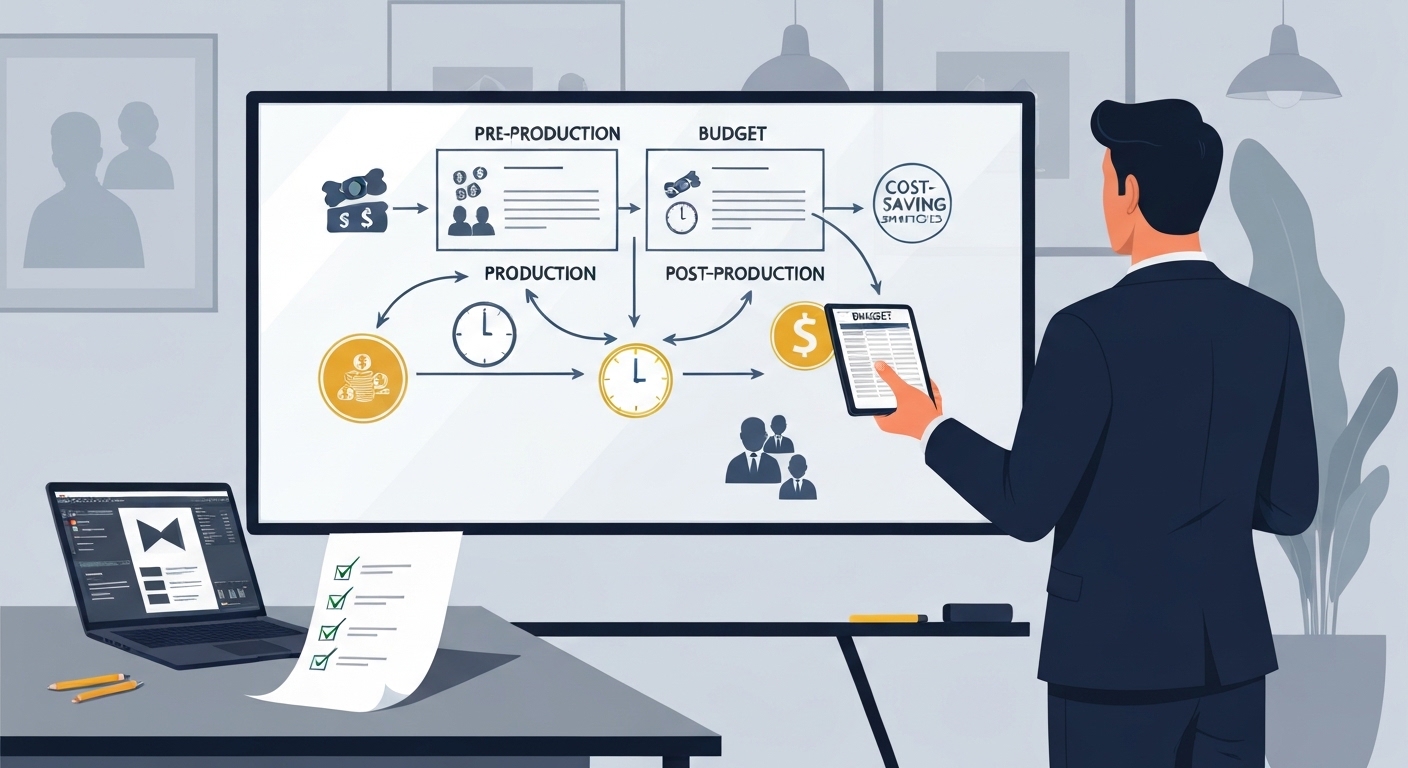
To build a budget that withstands real-world production pressures, you need a framework that covers every potential cost. The industry-standard model divides expenses into four distinct pillars, each representing a critical phase and its associated financial risks.
| Pillar | Typical Allocation | Core Cost Drivers | 2026 Cost Range Example |
|---|---|---|---|
| Pre-Production | 10-15% | Scripting, location scouting/permits, casting, legal. | $1,000 - $3,000 for a corporate video. |
| Production | 25-30% | Crew wages, equipment rental, location fees, talent, catering. | $5,000 - $15,000+ depending on shoot days. |
| Post-Production | 20-25% | Editing, color grading, sound design, motion graphics, licensing. | $2,000 - $5,000 for professional editing & finishing. |
| Contingency Reserve | 10-15% | Unforeseen delays, weather, equipment failure, scope changes. | Non-negotiable buffer applied to the total budget. |
This structure moves beyond a simple list. For example, a $20,000 project would allocate approximately $3,000 to pre-production, $6,000 to production, $5,000 to post-production, and hold a $3,000 contingency. The power of this framework is its clarity: it forces you to account for the entire lifecycle, not just the visible shoot costs. By planning each pillar separately, you identify cost drivers early, such as a multi-location shoot doubling transportation fees or complex animations significantly increasing post-production time.
Adopting this four-pillar approach is your first strategic defense. The next critical decision is choosing the right method to populate it with accurate numbers.
Top-down vs. bottom-up: the method that guarantees accuracy
With your framework in place, you must choose a calculation methodology. The choice between top-down and bottom-up estimation is the difference between a hopeful guess and a guaranteed accurate plan. Each serves a distinct purpose in the 2026 production landscape.
The Bottom-Up Method is the gold standard for accuracy. It involves summing detailed costs for every single line item—from the director's day rate to the cost of a memory card. You start from zero and build up based on actual quotes and requirements.
- Pros: Delivers high accuracy, identifies specific cost drivers, enables targeted negotiations, and provides a defensible, detailed audit trail.
- Cons: Time-intensive and requires granular knowledge of all production elements.
- Best For: Final approved budgets, complex shoots, and whenever financial accuracy is non-negotiable.
The Top-Down Method works in reverse. You start with a total figure (e.g., a $15,000 project cap) and allocate percentages to each pillar or phase.
- Pros: Extremely fast, useful for early-stage pitches or proposals, and aligns spending with overall project ROI targets.
- Cons: Risk of major miscalculation, can overlook specific expensive elements, and offers little detail for management.
- Best For: Initial client discussions, internal feasibility checks, or projects with a rigid, pre-defined total spend.
For guaranteed accuracy, the bottom-up method is non-negotiable for execution. It transforms your framework from a template into a precise financial model. For instance, rather than allocating a generic 30% to production, you'll list: Director ($800/day), Cinematographer ($750/day), 2x Sony FX6 rental ($600/day), etc. This precision is what allows for the dramatic savings showcased in real-world applications.
Case study: how one company saved 72% by consolidating shoots
A mid-sized tech company needed three videos: a corporate "About Us" piece, recruiting content, and onboarding materials. The traditional, siloed approach would require three separate shoots at $8,000–$12,000 each, totaling $24,000–$36,000.
By using a bottom-up budget to plan a consolidated strategy, they coordinated marketing, HR, and training needs upfront. A single, efficiently planned 10-hour production day captured all necessary footage for $10,000. The editor, briefed in advance, then created three distinct cuts from the same material. The result? All departments received high-quality content, achieving savings of $14,000–$26,000—a 58-72% reduction in production costs. This proves that strategic budgeting, not just cost-cutting, unlocks exponential value.
7 cost-saving strategies that pros use (beyond just negotiating)
True budget mastery extends beyond haggling over day rates. It's about structural efficiency. Here are seven professional strategies that leverage smart planning to reduce costs without compromising quality.
- Consolidate Cross-Departmental Shoots: As the case study shows, aligning needs across marketing, HR, and training for a single shoot day prevents the 35-50% cost of a second day months later. This is the single most impactful saving.
- Plan Multi-Version Editing Upfront: Brief your editor to create multiple cuts (e.g., a long-form video, social clips, internal snippets) from the outset. Re-editing months later to extract clips costs significantly more in re-familiarization time.
- Optimize Shoot Schedules Logistically: Group all scenes at the same location on the same day, even if they appear at different times in the final video. This minimizes crew call times, equipment rental days, and travel costs.
- Leverage Existing Assets & Resources: Use in-house locations, employee testimonials instead of paid actors, and existing music or graphic libraries where appropriate to reduce outsourcing fees.
- Implement a Strict Revision Protocol: Define and budget for a specific number of revision rounds (e.g., two rounds of edits) in the contract. Clear creative briefs and stakeholder sign-off prevent costly, endless revision cycles.
- Explore Hybrid Production Techniques: For certain segments, consider using cost-effective motion graphics or strategic stock footage instead of expensive live-action shots, blending them seamlessly with your original material.
- Bundle Services with Preferred Vendors: Build long-term relationships with a core crew and rental house. Negotiate package rates for bundled services (e.g., camera package + operator) rather than pricing every element separately.
Applying these strategies requires a tool to track every dollar. That's where a disciplined template turns strategy into executed savings.
Your actionable budget template: the 20-line checklist for total control
Theory is useless without execution. Use this condensed, 20-line checklist as your actionable template to populate the 4-Pillar Framework. Copy it into your spreadsheet, and ensure every line has an estimated cost, actual cost, and notes.
Pre-Production (Lines 1-5):
- Scriptwriting & Creative Development
- Storyboarding / Pre-Visualization
- Location Scouting & Permit Fees
- Casting & Talent Booking (Non-Union)
- Legal & Contract Administration
Production (Lines 6-12):
- Director / Producer Fees
- Camera Crew & Operator(s)
- Sound Recordist & Equipment
- Lighting Gear & Gaffer
- Equipment Rental (Cameras, Lenses, Support)
- Talent / Actor Fees & Usage Rights
- Location Fees, Catering, & Logistics
Post-Production (Lines 13-18):
- Video Editing & Assembly
- Color Correction & Grading
- Sound Design, Mixing & Music Licensing
- Motion Graphics & VFX
- Voiceover Recording & Production
- Project Management & Client Reviews
Administrative & Buffer (Lines 19-20):
- Insurance, Permits, & Sundries
- CONTINGENCY RESERVE (10-15%)
This checklist forces comprehensiveness. When your project grows in complexity, managing this template efficiently requires the right digital tools.
Software showdown: when to upgrade from spreadsheets to pro tools
For single projects or small teams, a detailed Google Sheets or Excel template is sufficient. However, a problem arises when managing multiple, complex projects—tracking changes, managing union rate cards, and handling multi-currency payments becomes cumbersome and error-prone.
- Spreadsheets (Excel/Sheets): Best for freelancers and small teams. They are customizable, collaborative, and low-cost but lack automation and industry-specific integrations.
- Dedicated Film Budgeting Software (e.g., Movie Magic): Essential for studios, agencies with 10+ annual projects, or union shoots. They offer standardized line items, rate databases, and robust reporting, but come with a steep learning curve and cost.
- Project Management Platforms (Asana, Monday.com): Ideal for integrating budget tracking with timelines and task management. They provide visibility but often lack deep financial modeling features.
Upgrade when your spreadsheet becomes a source of friction—when tracking revisions across versions eats more time than creative planning.
From plan to action: your 6-step roadmap for budget success
You now have the complete framework. Here is your condensed roadmap to implement it:
- Adopt the 4-Pillar Framework for your next project plan.
- Build a Bottom-Up budget using the 20-line checklist.
- Apply 2-3 Cost-Saving Strategies from the list above.
- Secure stakeholder sign-off on the budget and scope before pre-production.
- Track every variance between estimated and actual costs in real-time.
- Review the budget post-project to refine estimates for next time.
This guide provides the universal foundation for video budget mastery. However, projects with unique constraints—like multi-national shoots, complex union crews, or intricate VFX—benefit from personalized planning.
Conclusion
You now possess the complete blueprint for video production budget planning—a strategic framework that transforms financial guesswork into a predictable, controlled process. You’ve moved from understanding why budgets fail to building a 4-Pillar Framework that acts as your insurance policy, selecting a calculation method that guarantees accuracy, and arming yourself with cost-saving strategies that can slash expenses by up to 72%.
Imagine your next project: a budget that not only holds firm but becomes a tool for strategic decision-making. You’ll have the 10-20% contingency already allocated, not as a panic fund, but as a planned buffer that empowers you to handle the unexpected without compromising quality or timeline. The data is clear—projects built on this structured approach avoid the 35-50% cost explosions from uncoordinated, reactive planning.
The timeline for action is now. While there’s no external regulatory deadline, your internal project calendar is the urgency driver. Every day of inaction on a structured budget plan increases the risk of your next video initiative being derailed by unforeseen costs, rushed vendor negotiations, and compromised creative scope. The cost of waiting is measured in wasted resources, missed opportunities, and eroded ROI.
Before you move forward, ask yourself three critical questions:
- Does my current planning method account for all four pillars, or am I risking a major oversight in pre-production or post?
- Have I identified opportunities to consolidate shoots across departments, or am I budgeting for avoidable, duplicate production days?
- Is my contingency reserve a genuine 10-20% of the total, or just a hopeful afterthought?
This may seem complex, but you are now ahead of the curve. You have the complete methodology—from the universal template to the insight on when to upgrade from spreadsheets to professional tools. The principles here provide a formidable foundation. However, projects with unique constraints—like multi-national shoots, complex union crews, or intricate VFX pipelines—benefit from personalized planning to adapt this framework perfectly.
Your next step is to apply this framework to your specific project scope. Download our detailed budget worksheet and start populating it with your line items today. 📝