
Video production client testimonials: the proven method to build unshakeable trust (4 key formats)
Introduction
Video production client testimonials are not just nice-to-haves. They are your most potent trust asset. Yet 90% of businesses use them incorrectly, relying on scripted praise that viewers instantly distrust.
As a professional video strategist, I’ve seen what separates compelling social proof from forgettable filler. This guide reveals the insider methodology, structured across four definitive sections, to transform satisfied clients into your most persuasive sales tool.
The cost of inaction is stark: without authentic video testimonials, you surrender the emotional high ground to competitors who leverage real stories to shortcut buyer hesitation and close deals faster.
So, how do you choose the right format to match your audience’s psychology? What are the four non-negotiable elements of a high-converting testimonial? And where is the critical legal gap that could undermine your entire campaign?
We’ll analyze the latest best practices—from interview-style authenticity to post-production refinement—providing a structured blueprint you can implement immediately.
Ready to engineer trust? Your 6-minute read to unshakeable credibility starts now. Let’s roll camera.
Why video testimonials outperform text: the emotional edge that drives decisions
A video testimonial is an authentic video where a real customer shares their experience, placing their genuine satisfaction and concrete benefits at the center of the story. This format functions as powerful social proof, but its true advantage lies beyond simple credibility. The research is clear: video testimonials significantly outperform text by conveying the emotions, expressions, and personality that written words cannot capture. This creates a more authentic and relatable experience, enabling prospects to identify with the speaker's situation and imagine themselves achieving similar results. The core mechanism is identification—viewers are far more likely to trust and act on recommendations from someone they perceive as similar to themselves. While a text quote states a fact, a video testimonial makes the viewer feel the outcome, providing the emotional edge that shortcuts buyer hesitation and directly influences decisions.
4 video testimonial formats: choosing the right story for your audience
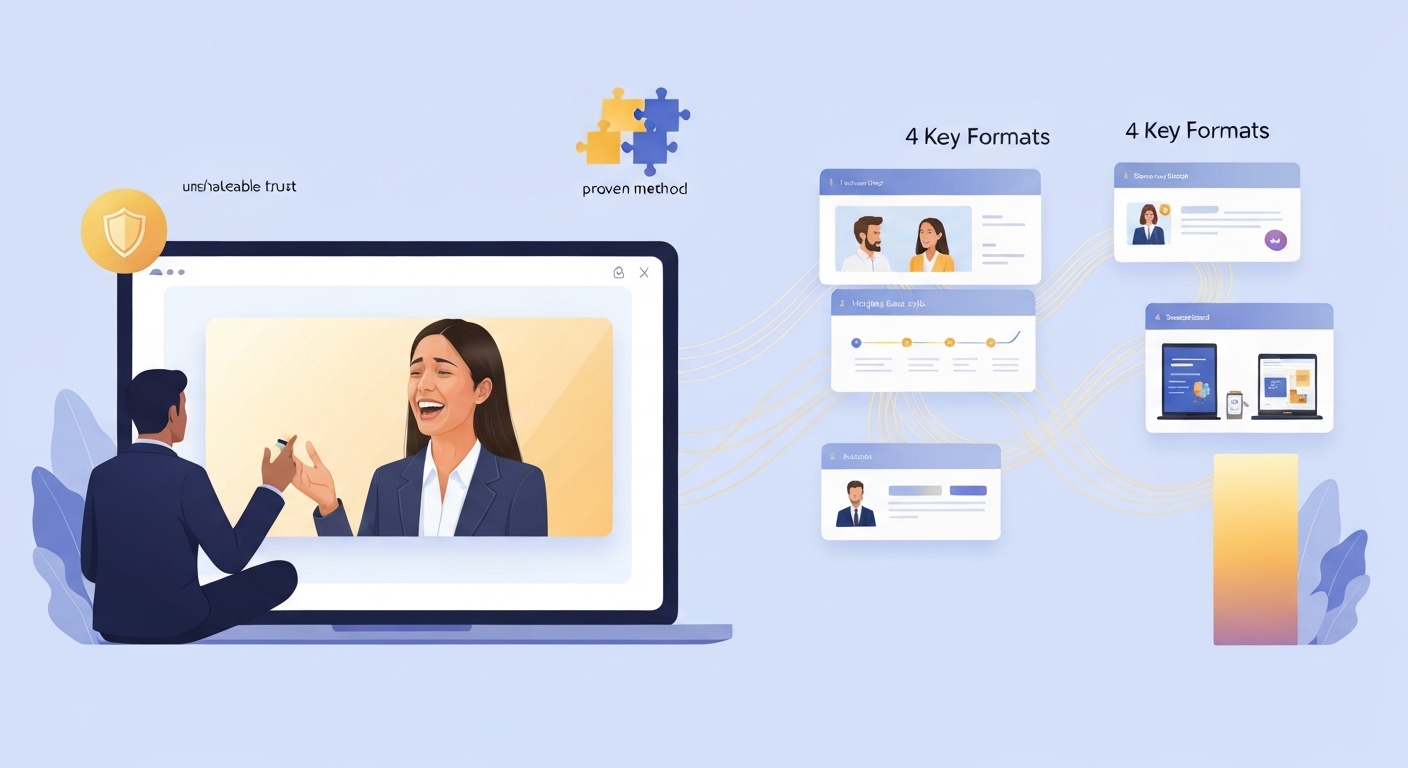
Selecting the correct format is crucial, as each tells a different story to resonate with specific audience needs. Here are the four primary formats identified by professional practices:
- Interview-Style Testimonials: A customer responds to prepared, open-ended questions. The interviewer guides the conversation without leading it, capturing natural reactions and authentic praise. Post-production refines this into a dynamic, engaging narrative.
- Narrative/Case Study Format: This follows a powerful problem-solution-benefits structure. The customer details a specific challenge, explains how your service provided the solution, and quantifies the results. It’s exceptionally effective for demonstrating tangible, real-world impact.
- Talking Head Format: The customer speaks directly to the camera in a controlled setting, whether a studio or their natural environment. This straightforward approach maximizes authenticity, especially when filmed in a context that feels genuine and unrehearsed.
- Scénarized Video Testimonials: This format blends authentic customer footage with professional storytelling elements like voiceover narration, B-roll, and structured scenes. It balances raw credibility with high production value for a polished final piece.
Your choice should align with your strategic goal: use Interview-Style for relatable authenticity, Narrative for proving ROI, Talking Head for raw credibility, and Scénarized for brand-aligned, premium storytelling.
The customer-centric checklist: 4 key elements that distinguish powerful testimonials
Beyond choosing a format, the most powerful testimonials share four non-negotiable, customer-centric elements. This checklist ensures your video moves beyond simple praise to become a strategic trust-building asset.
- Authentic Narrative Over Scripted Praise: The customer must speak freely about their genuine experience. According to production experts, authenticity requires guiding without orienting the interviewee. The narrative should feel natural, not recited. A testimonial where a client spontaneously explains how your solution saved them 40 hours a month carries infinitely more weight than a generic scripted compliment.
- Concrete Problem-Solution-Benefit Arc: The testimonial must clearly articulate the "before" state, the action taken, and the measurable "after" result. This structure transforms a simple endorsement into a persuasive case study that prospects can directly map onto their own challenges.
- High Technical Production Value: Authenticity can be undermined by poor quality. Professional standards across lighting, audio, and framing are mandatory. Clear, limpid sound and flattering visual clarity signal that you value both the customer's message and the viewer's experience, directly reflecting on your brand's professionalism.
- Strategic Editing for Impact: Raw footage is rarely compelling. Professional post-production removes pauses and dead air, creating a dynamic flow that maintains viewer attention. Strategic edits enhance the narrative without distorting the customer’s authentic voice, ensuring the key message is delivered with clarity and pace.
Integrating these four elements shifts the focus from what your customer says about you, to what their story demonstrates about the results you deliver.
From planning to edit: the 4-step professional production blueprint
Executing a high-impact testimonial requires a disciplined, professional methodology. Follow this four-step blueprint to transition from concept to a polished final asset.
- Define the Strategic Objective: Before contacting a client, determine the goal. Is this to promote a specific product feature, demonstrate a solution to a common industry pain point, or build overall brand awareness? Every subsequent decision flows from this objective.
- Curate the Client and Craft Questions: Identify a customer whose story aligns with your objective and target audience. Develop open-ended questions designed to elicit natural, detailed responses about challenges and outcomes. Questions should prompt storytelling, not yes/no answers.
- Execute Professional Filming: Establish an optimized environment, whether on-location or in-studio. Use professional-grade equipment—a dedicated camera, external lavalier microphones, and controlled lighting—to ensure polished production quality that captures the subject in the best possible light and sound.
- Refine with Purposeful Post-Production: This is where the raw story is sculpted into its most powerful form. Edit to remove hesitations, tighten the narrative arc, and add subtle enhancements like text overlays for key quotes or licensed background music. The goal is to enhance engagement while meticulously preserving the core authenticity of the customer’s message.
Faq: studio vs. natural setting, authenticity, and the critical legal gap
What’s better: a studio or natural setting?
Both are viable but serve different purposes. A studio with professional equipment guarantees consistent, high-quality lighting and audio. Filming in the customer’s actual environment (their office, home, or using your product) often enhances relatability and authenticity. The choice should align with your brand image and the story’s context.
How long should a testimonial be?
Industry best practice emphasizes brevity for engagement. While research notes they should be "quite short," a common benchmark is 60 to 90 seconds—long enough to convey a compelling narrative but short enough to retain viewer attention on websites and social feeds.
How do we ensure authenticity?
Authenticity is non-negotiable. It is achieved by allowing customers to express themselves freely without scripting. The interviewer’s role is to ask guiding questions and listen, creating a space for genuine emotion and unprompted details to emerge naturally.
What about legal permission?
This is the critical legal gap in DIY production. The research explicitly notes a lack of specific guidance on release forms and usage rights. Consulting legal counsel to draft a comprehensive media release form is essential. This document should secure irrevocable permission to use the customer’s likeness, testimony, and any proprietary data shared, protecting your company from future disputes.
Your next step: transforming principles into a trust-building strategy
You now possess the framework—the four formats, the essential elements, and the production blueprint. The principles are clear, but their strategic application requires nuanced expertise. Navigating legal permissions, tailoring the format to your specific audience psychology, and executing a shoot that balances authenticity with professional polish are where theory meets practice. This is where personalized strategy creates undeniable competitive advantage. To engineer a testimonial campaign that doesn’t just inform but truly converts, the next step is a conversation about your unique goals.
Conclusion
You’ve just navigated the complete blueprint for transforming satisfied clients into your most powerful sales asset. From understanding the emotional edge that video holds over text, to selecting the right format, enforcing the four non-negotiable elements, and executing the professional production blueprint, you’re now equipped with the methodology to build unshakeable trust.
Imagine your website homepage six months from now, featuring a curated series of authentic, high-impact testimonials. Each one acts as a direct handshake with your ideal prospect, answering their unspoken doubts and projecting the tangible results you deliver. This isn't just marketing—it's a trust infrastructure that systematically lowers buying resistance and accelerates decisions.
The timeline for inaction is already set by your competitors. As we move into 2026, the digital landscape is becoming noisier and more visually saturated. Businesses that fail to deploy authentic, professional-grade social proof will see their conversion rates stagnate, while their cost to acquire a qualified lead climbs. The cost of waiting is measured in lost deals and eroded market position.
Before you move on, ask yourself three quick questions:
- Is our current testimonial collection process ad-hoc, or a strategic system designed to capture powerful narratives?
- Do we have a legally vetted media release form to protect every testimonial we produce?
- Are we confident our production quality (audio, lighting, editing) matches the professionalism of our brand and doesn’t undermine our message?
The path from principle to execution is clearer than it seems. You now have the strategic framework; the perceived complexity of legalities, client coordination, and professional production is managed with the right partner.
To launch your trust-building campaign, the most effective next step is a focused, 30-minute strategy session. We’ll audit your current assets, identify your most persuasive client stories, and map out a production plan tailored to your audience. Book your Video Testimonial Strategy Call here 🎬.