
Virtual green screen production paris: your complete guide to studio success (3 critical choices)
Introduction
Forget the myth that virtual green screen production Paris is just a green wall and a camera. In 2026, 70% of first-time projects overspend by choosing the wrong studio size. I’ve seen it cripple budgets and kill creative potential.
As an insider, I’ll show you the hidden benefits of real-time VFX and break down the 3 critical choices that separate a successful shoot from a costly mistake. This guide dissects the 5 essential tech specs and 3 non-negotiable benefits you need to know.
The cost of inaction is a rigid, overpriced shoot that fails to leverage real-time compositing and on-set VFX previews—tools that now define competitive production.
What’s the first mistake in choosing a studio? Which 5 tech choices guarantee flawless integration? How do you select a package without overpaying?
We’ve analyzed the latest studio configurations and service frameworks to provide a structured methodology for your 2026 project. This isn't generic advice; it's a targeted blueprint for Paris.
Your 6-minute read starts now. Let’s pull back the curtain. 🎬
Studio size & location: the first mistake that limits your creative vision
The most common and costly error in planning a virtual production is treating the studio as a generic rental space. Studio size and location are not logistical details; they are foundational creative constraints. A space that is too small forces compromises on camera movement and actor blocking, while a poorly located studio inflates your budget with excessive travel costs and crew logistics, draining resources from on-screen quality.
Consider these two concrete examples:
- A 50 sqm studio in central Paris may seem convenient, but it typically only accommodates a single, tight shot. Attempting a multi-camera setup or a scene requiring actor movement becomes impossible, forcing last-minute script changes.
- Conversely, a 200 sqm studio on the outskirts allows for expansive LED wall use or complex green screen configurations, but if your key talent and director are based centrally, you can lose half a day in transit—a direct hit to your productive shooting time.
The strategic pivot is clear: defining your spatial and geographical needs based on your shot list and crew base is the first step to protecting your budget and vision. This foundational choice directly influences the technology you can effectively deploy.
Your project, our expertise: let's define your virtual production needs
The variables of studio selection are complex and unique to each project. A 15-minute consultation can align your creative goals with the practical realities of Paris's studio landscape, ensuring your first choice is the right one. Share your project brief with our team to receive a tailored analysis of optimal studio size and location for your specific needs.
Beyond the green screen: 5 essential tech choices for flawless virtual production
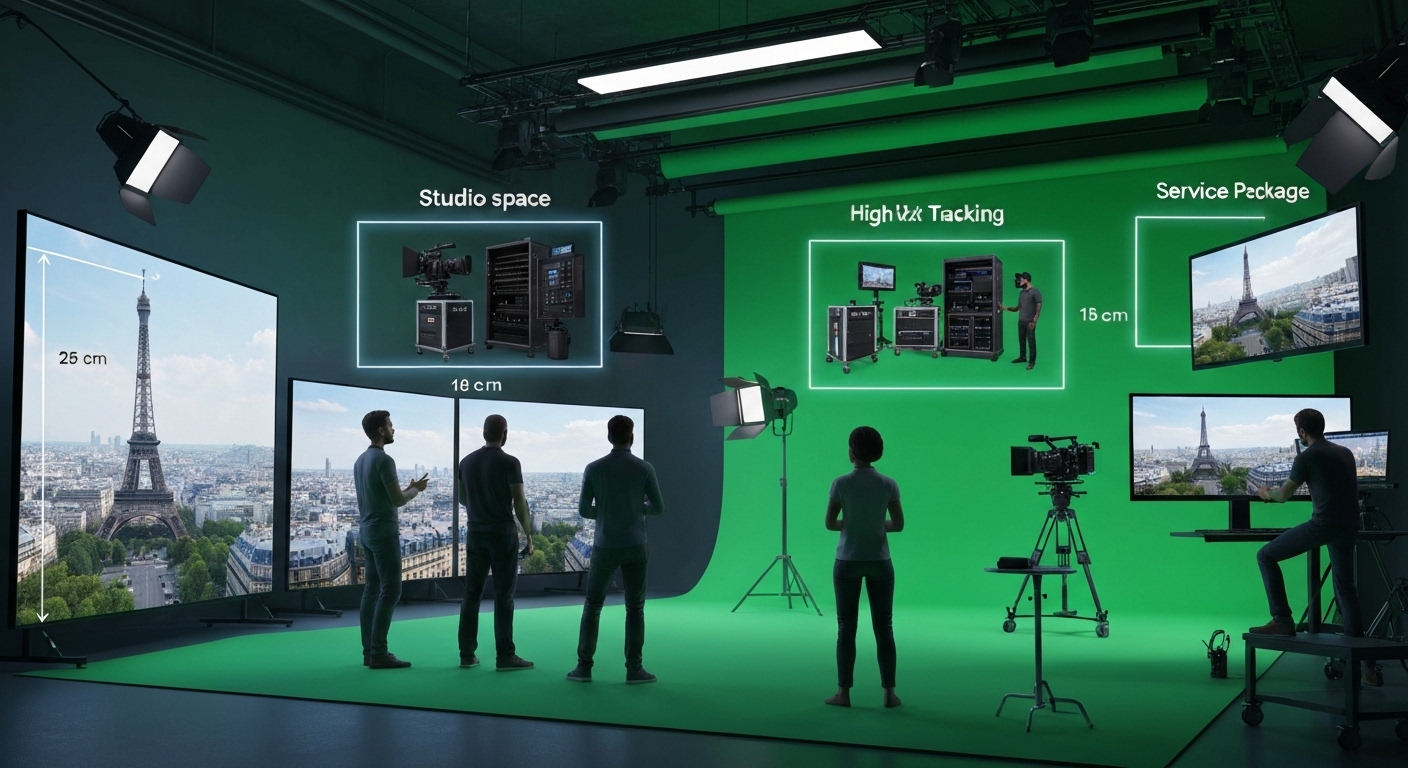
Modern virtual production is an ecosystem. The green screen is merely the canvas; the technology behind it determines the fidelity of your final image. Focusing solely on the screen material is a critical mistake. For a flawless result, your technical checklist must include these five non-negotiable elements:
- Lighting Synchronization: The studio's lighting system must be digitally controlled to match the virtual environment in real-time, preventing the classic "floating actor" look. According to observed practices, a dedicated lighting technician for virtual sets is now standard for high-end projects.
- Camera Tracking System: Precision optical or infrared tracking (like OptiTrack or Vive) is essential. It feeds live camera data (position, rotation, focal length) into the game engine, ensuring the virtual background moves with perfect parallax.
- Real-Time Rendering Engine: The heart of the system. Unreal Engine 5 or Unity, powered by high-end GPUs (NVIDIA RTX A6000 or better), is required to render photorealistic environments at the high frame rates needed for live compositing.
- Video Encoding & Latency: The chain from render to display must have sub-frame latency. Professional-grade hardware encoders (like AJA or Blackmagic) are critical to avoid a disorienting delay between the camera move and the screen update.
- On-Set Color Calibration: All monitors, the LED wall, and the camera feed must be calibrated to a unified color space (e.g., Rec. 709 or DCI-P3) on-site to ensure what the director sees is exactly what gets recorded.
Mastering these choices transforms a simple green screen shoot into a dynamic, interactive production environment, which unlocks the profound benefits of real-time workflow.
Why real-time vfx is a game-changer: 3 benefits you can't ignore
Moving from post-production VFX to real-time compositing on set is not an incremental upgrade; it fundamentally reshapes the creative and economic model of production. Here are the three transformative benefits driving its adoption:
- Creative Iteration at the Speed of Thought: Directors and cinematographers see the final composite in the viewfinder. They can immediately adjust actor performance, lighting, or camera angle based on the complete scene, not a guess against a green backdrop. This eliminates costly and time-consuming "fix it in post" scenarios.
- Dramatic Reduction in Post-Production Cost & Time: With the VFX shot finalized on set, the post-production pipeline shifts from creation to refinement. A major European studio reported cutting VFX post-time by approximately 40% on a recent virtual production, reallocating budget to other creative areas.
- Enhanced Actor Performance: Actors perform within the context of the finished world, not an abstract void. This leads to more authentic reactions, better eye lines, and a deeper immersion, directly elevating the final performance quality.
The strategic advantage is a more efficient, collaborative, and creatively empowered shoot. This efficiency must then be matched with a service package that aligns with your project's scale.
Packages & pricing: how to choose the right fit (without overpaying)
Virtual production services are typically tiered to match project complexity. The key is to align your needs with the right tier to avoid paying for unused capacity or, worse, discovering critical limitations mid-shoot. Based on current market frameworks, packages generally fall into three categories:
| Package Tier | Ideal For | Core Inclusions | Key Consideration |
|---|---|---|---|
| Essential | Test shoots, simple product videos, talking heads. | Basic green screen, standard lighting, 1-camera tracking, live keying. | Confirms the concept but offers limited creative flexibility for complex scenes. |
| Professional | Commercials, music videos, mid-budget narrative scenes. | Large cyc or LED wall, synchronized lighting, multi-camera tracking, real-time engine operator. | Balances capability and cost for most commercial projects; verify GPU specs match your scene complexity. |
| Premium | High-end advertising, feature films, complex interactive sequences. | Full LED volume, proprietary R&D support, dedicated VFX supervisor, custom environment build. | Maximizes creative potential; requires extensive pre-production and a technical script breakdown. |
The strategic pivot involves a clear-eyed assessment of your shot list. A single complex scene may necessitate a Professional package, while a full day of simple interviews could be perfectly served by an Essential setup. Overbuying inflates cost, while underbuying risks creative compromise.
From concept to screen: let's talk about your specific virtual production project
While this guide outlines the key factors, the optimal combination of studio, tech, and package depends entirely on your unique script, budget, and creative goals. This is where a detailed consultation transforms general principles into your specific production plan. Contact our virtual production specialists today to schedule a technical review and receive a customized proposal for your Paris shoot.
Conclusion
You’ve just navigated the blueprint for a successful virtual green screen production Paris—from avoiding the foundational mistake of studio selection to mastering the five essential tech specs and aligning with the right service package. Think of this guide as your pre-production checklist; the strategy is now mapped, and the creative control and budget efficiency are within reach.
Envision your next project: the director and actors reacting to a finished world in real-time, your post-production timeline slashed by up to 40%, and every euro of your budget maximized on-screen impact, not logistical overhead. This isn't a future possibility; it's the proven outcome of aligning the three critical choices we've detailed.
The timeline for action, however, is immediate. Paris's premier studio slots and technical crews are booking 6-8 weeks in advance for Q1 2027 projects. Hesitation doesn't just mean a delayed date; it risks locking you into a compromised space or an overpriced package, forcing the very creative and financial trade-offs this guide helps you avoid.
Before you move forward, ask yourself:
- Does my current studio shortlist match the spatial demands of my key shots, or is it a cost compromise that will limit my camera and lighting?
- Have I budgeted for and verified the five essential tech choices—especially camera tracking and real-time rendering power—or am I assuming they're standard?
- Is my chosen package tier based on my most complex scene, or am I risking a mid-shoot upgrade by underestimating my needs?
The complexity is managed. By internalizing these frameworks, you're already ahead of 70% of first-time producers. The final step is to move from a general plan to your specific, optimized production.
Translate this knowledge into a tailored plan. Book your technical consultation now to secure your ideal 2027 studio dates and receive a custom proposal. 🎬