
How to choose a video production company: the 5-step framework to avoid costly mistakes
Introduction
Choosing the right video production company determines 80% of your project's ROI. The cheapest bid often costs you more.
As an insider, I’ll show you the hidden green flags that separate strategic partners from mere vendors. This 5-step framework dissects the latest industry standards for 2026.
The wrong choice risks a 30% budget overrun, legal headaches from unclear rights, and content that fails to convert.
Do you know the 6-point checklist to vet a portfolio? Can you spot the contractual red flags before you sign? What does post-selection partnership management truly entail?
We’ve analyzed current agency workflows and client-side data to build a systematic methodology.
Master the selection in 7 minutes. Let’s roll camera on your success.
Why your video partner choice determines 80% of your project's success
The opening figure isn't hyperbole. In 2026, your choice of a video production partner is the single greatest determinant of whether your investment yields a return or becomes a costly lesson. This partner is not merely a vendor executing a task list; they are a strategic extension of your team, responsible for translating your vision into a compelling asset that achieves specific business goals. To fully grasp why this choice is so critical, it helps to first understand what constitutes a true video production partner.
As Levitate Media's 2026 guide emphasizes, "Selecting the perfect partner involves more than just price or portfolio. Consider these essential factors: Define Your Video Goals... Review Portfolios... Assess Client Experience... Communication and Collaboration... Scalability and Flexibility... Transparent Pricing and Timelines." This holistic view underscores that the right partner manages the entire ecosystem of your project—from creative strategy and legal rights to on-set logistics and post-production polish. A misalignment in any one of these areas can compromise the final product.
Consider the example of a business seeking high-volume product demo videos. By partnering with Lemonlight, a company known for its scalable, collaborative model, they achieved on-brand content for clients like Amazon and Airbnb delivered within transparent timelines. The result was high production quality without the delays that plague 30% of mismatched partnerships. Conversely, a partner who views the project as a simple transaction often fails to grasp the underlying marketing objective, leading to a visually appealing video that doesn't resonate or convert.
The Strategic Pivot: Recognizing that your partner dictates creative alignment, budget integrity, and ultimate ROI transforms this from a procurement task to a core strategic decision. This foundational understanding is what allows you to effectively apply the specific criteria we'll examine next.
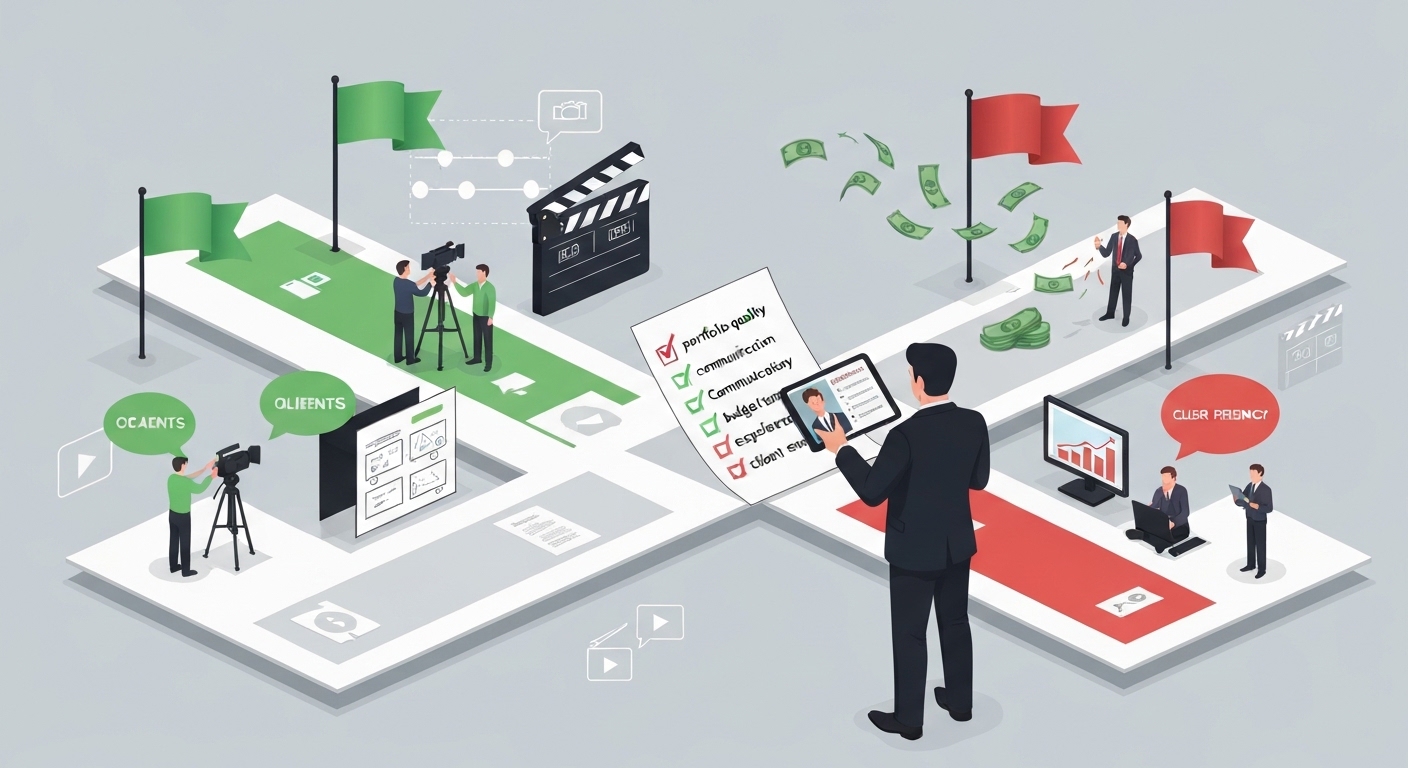
The 6-point checklist: green flags vs. red flags in a production partner
Moving from theory to practice requires a concrete framework for evaluation. Based on 2026 industry standards, the most critical differentiators between a strategic ally and a risky vendor can be distilled into six key criteria. Use this comparative checklist to objectively score potential partners.
| Criterion | Green Flags (Indicators of Strong Fit) | Red Flags (Warning Signs) |
|---|---|---|
| Portfolio & Expertise | Diverse, relevant work aligning with your brand voice (e.g., explainer videos if that's your need). Shows mastery of narrative and technical quality. | A limited, outdated showreel with no examples matching your specific goals. A strong portfolio isn't just a showreel; it's a story of solved problems. To learn how to critically analyze one, see our guide on analyzing a portfolio. |
| Process Transparency | Clear, upfront budgeting with realistic timelines. Offers full-service capabilities (scripting, production, post) under one roof. | Vague pricing, hidden fees, or an opaque workflow that leaves you guessing about next steps. |
| Pricing & Value Model | Provides value-focused estimates that maximize your budget's impact, justifying cost with ROI-based reasoning from past successes. | The lowest bid with no justification, or immediate pressure to upsell services not in the initial scope. Transparent budgeting is a major green flag, as it prevents the kind of financial surprises that can derail a project. For a deeper dive, review our guide to avoid costly budget mistakes. |
| Communication & Collaboration | Asks probing questions about your target audience and business objectives from the first meeting. Establishes protocols for proactive updates. | Poor responsiveness or a transactional attitude that shows no curiosity about your goals. |
| Marketing & Strategic Savvy | Demonstrates insight into your niche (e.g., healthcare compliance, tech SaaS). Partners on strategy from concept to distribution. | Focuses conversation solely on camera gear and technical specs, with no mention of audience or conversion goals. |
| Client Proof & Scalability | A proven track record with recognizable clients and case studies. Has a flexible model to handle project pivots or scale for future needs. | No notable client references, or a rigid structure that seems ill-equipped to handle change. |
The impact is measurable. Industry analysis indicates that 70% of high-performing video projects begin with a partner who excels in marketing savvy and audience targeting. The negative case is clear: a firm without niche focus, for instance in healthcare, will produce generic content that fails compliance checks and misses the mark with patients.
The Strategic Pivot: This checklist moves you from subjective impression to objective assessment. Once you know what to look for, you need a disciplined process to uncover these flags, which is where a systematic vetting framework comes in.
How to systematically vet a production company in 6 proven steps
Knowing the criteria is one thing; uncovering the truth behind a company's marketing requires a proven, methodical approach. This six-step framework, refined from 2026 best practices, ensures no critical question goes unasked and mitigates the risk of a poor fit.
- Define Your Needs with Precision: Before any outreach, crystallize your goals. Specify the video type (e.g., brand anthem, event recap), core audience, key messages, budget range, and must-have services (e.g., 3D animation, original scoring). This clarity becomes your benchmark.
- Research & Create a Shortlist: Investigate companies whose portfolios directly align with your defined needs. Scrutinize client reviews on third-party platforms and prioritize those with expertise in your industry.
- The RFQ & Initial Interview: Send a detailed Request for Quote. The most effective way to implement this 6-step framework is with a prepared set of questions. We've created a comprehensive systematic vetting questionnaire to guide your conversations. Use the meeting to assess strategic alignment, not just hear a sales pitch.
- Evaluate Proposals Holistically: Compare responses not just on cost, but on the transparency of their pricing breakdown, the realism of their timeline, their understanding of your vision, and the quality of past work relevant to you.
- Conduct Rigorous Reference Checks: Contact past clients, especially those with projects similar to yours. Ask specific questions about communication, problem-solving, budget adherence, and final outcomes.
- Negotiate the Final Agreement: Finalize a contract that explicitly details scope, deliverables, revision rounds, payment schedule, intellectual property ownership, and protocols for handling changes. Ensure it includes clear communication plans.
The Strategic Pivot: This structured vetting process dramatically increases your odds of a successful partnership. However, even the most rigorous process can miss the nuanced, human factors that truly separate good partners from great ones—factors often hidden in plain sight.
Beyond the portfolio: the insider insights that separate good from great
A stellar portfolio and a flawless vetting call can still lead you to a competent but ultimately limiting partner. The true differentiators are often the intangible, experience-driven factors that only surface through deeper digging. As one industry expert from People Productions notes, "Do they get you? Does the team have an understanding of your market and business model? Do they have a vision of what your video could be, and how it will accomplish your goals? The vision thing can be a great barometer."
This "vision alignment" is paramount. A great partner doesn't just execute a brief; they challenge and refine it, bringing strategic ideas you hadn't considered. For example, a company specializing in corporate events won't just quote for cameras; they'll proactively plan for hybrid live-streaming redundancy to avoid a single point of technical failure—a insight born from painful experience. As the expert noted, the real story is often in the details of past collaborations. Learning how to read between the lines of insider insights from client testimonials reveals these crucial insights.
Furthermore, assess their problem-solving posture. When asked about a past project challenge, do they blame the client or weather, or do they explain their adaptive process? The latter indicates a partner focused on solutions, not excuses. Also, observe the team dynamic during your interactions. Is your main contact the person who will actually manage the project, or will you be handed off to a junior team? Consistent, senior-level engagement is a hallmark of a high-value partnership.
The Strategic Pivot: Securing a partner with these insider qualities sets the stage for exceptional work. But the responsibility for success doesn't end at the contract signature. Protecting that investment requires active, informed partnership management from day one.
After you sign: 4 practices to protect your investment and ensure success
The contract is the starting line, not the finish line. Proactive management is essential to ensure the partnership delivers on its promise.
- Kick Off with Aligned Expectations: Host a formal kickoff meeting with all key stakeholders from both sides. Review goals, timelines, communication channels, and approval workflows in detail. Protecting your investment starts with the contract. Knowing which essential contract clauses are non-negotiable is your first line of defense.
- Institute Milestone Reviews: Don't wait for the final edit to provide feedback. Schedule concrete checkpoints (e.g., after script approval, rough cut) to ensure the project remains on strategy and avoid costly late-stage revisions.
- Maintain Open, Structured Communication: Use agreed-upon tools (e.g., a project management platform) for all feedback and updates. This creates a clear record, prevents miscommunication, and keeps the project moving efficiently.
- Plan for the Future at the Wrap-Up: Conduct a formal post-project review. Discuss what worked, what could be improved, and explore potential needs for future content. This turns a single project into a scalable, long-term asset.
A prime example is ASL Productions, which not only delivers robust live streaming for high-profile corporate events but also follows up with rapid post-event highlight reels, ensuring the client's investment continues to generate value long after the event ends.
Conclusion
You’ve just navigated the complete strategic blueprint for selecting a video production partner—from understanding why this choice dictates 80% of your project’s ROI, through applying the definitive 6-point checklist, to executing a systematic 6-step vetting process. This isn’t just about hiring a vendor; it’s about architecting a partnership that transforms your vision into a tangible asset that drives results.
Imagine the outcome six months from now: a video campaign that not only looks exceptional but achieves its core KPIs—whether that’s a 40% increase in lead quality, flawless compliance for a regulated industry launch, or a seamless multi-location shoot delivered on budget. The data is clear: 70% of high-performing video projects start with a partner who masters the strategic alignment and marketing savvy detailed in our checklist. Your path to that result is now mapped.
However, the landscape waits for no one. The competitive advantage you gain by acting on this framework today erodes with each passing quarter. In 2026, the cost of inaction isn't just a missed opportunity; it's the tangible financial drain of a 30% budget overrun, the legal entanglement of unclear IP rights, and the brand damage of a generic video that fails to connect. Your competitors are already applying these filters.
Before you move to the next tab, ask yourself these three questions:
- Does my current shortlist stand up to the "Green Flags vs. Red Flags" checklist?
- Am I confident in my ability to spot the nuanced, "beyond-the-portfolio" insights that prevent post-signing surprises?
- Is my RFQ and vetting process robust enough to protect a five or six-figure investment?
If any hesitation exists, remember this: the perceived complexity of making the perfect choice is now gone. You hold the proven framework used by leading marketing teams. You are no longer guessing; you are strategically evaluating.
The final step is to convert this knowledge into action. Implement the first phase of the framework today: clearly define your project goals, audience, and non-negotiable requirements as outlined in Section 1. This foundational clarity is what transforms a hopeful search into a targeted, results-driven selection process.
Ready to pressure-test your project plan with an expert who’s navigated these waters for a decade? Let’s discuss your specific goals, timeline, and audience in a 20-minute consultation. 👇