
French filming permit system: your complete guide to navigating authorizations (5 key steps)
Introduction
Forget the myth of a single national permit. The French filming permit system is a decentralized puzzle of 15-day deadlines and local decrees.
As a production coordinator who’s navigated these waters from Marseille to Paris, I’ve secured the hidden benefits: smoother shoots, stronger municipal partnerships, and ironclad insurance compliance. This guide distills that process into five key sections.
Misunderstanding this system isn't just an admin headache—it’s a direct financial and legal risk. An unpermitted shoot can halt production, incur fines, and void your liability coverage.
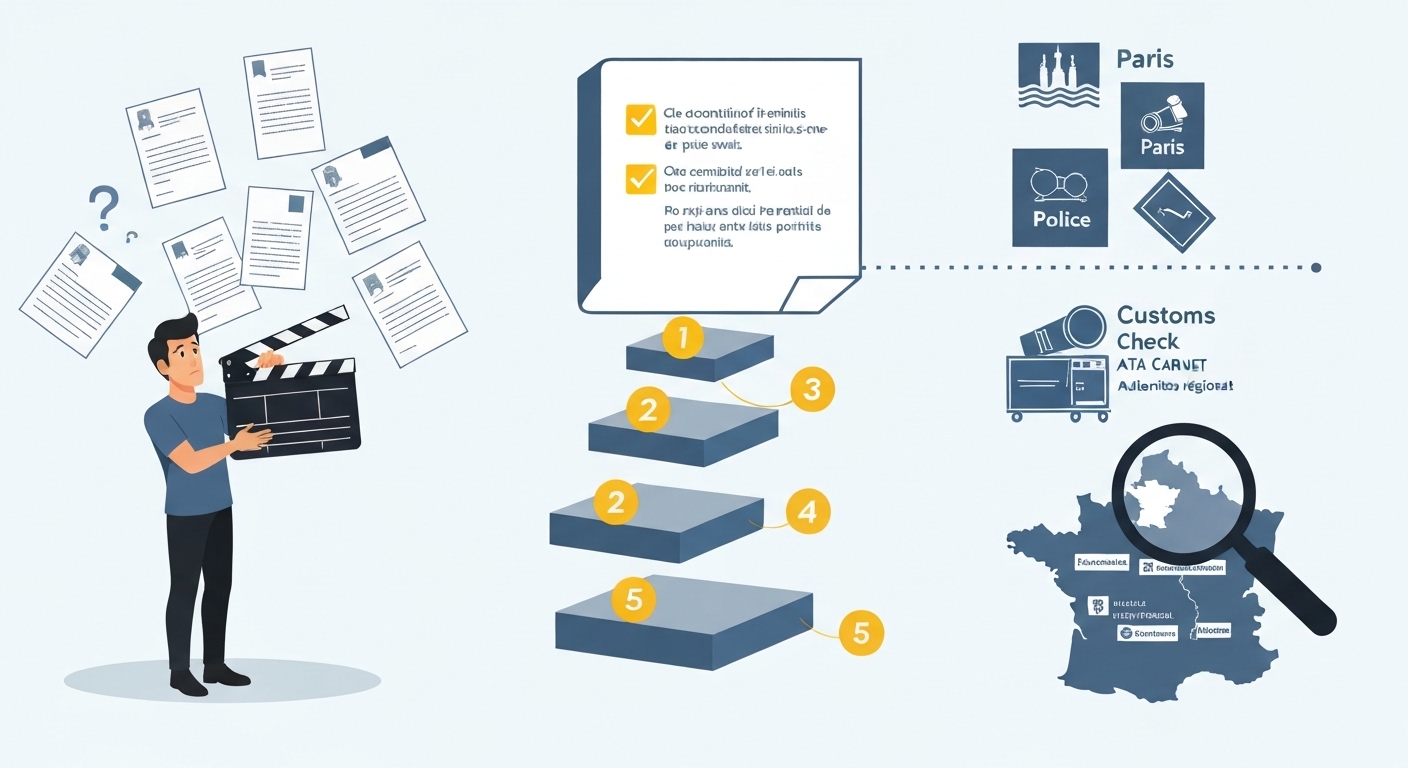
So, how do you decode the scope of authorizations across different communes? What is the 5-step checklist for a guaranteed permit outside Paris? And critically, why does the capital’s dual-permit requirement trip up even seasoned producers?
We’ve analyzed the latest municipal decrees and 2026 customs guidelines to give you a structured, actionable methodology. You’ll move from confusion to control.
Your roadmap to a compliant shoot starts now. Estimated read: 7 minutes. Let’s get your production the green light. 🎬
Filming permits in france: why there's no 'one-size-fits-all' rule
Contrary to a common assumption, there is no single, nationwide "filming permit" in France. The system is fundamentally decentralized, meaning authorization is required from the specific authority that governs each filming location. This is the core principle of the French filming authorization system. According to official 2026 guidelines from Film France and the French Ministry for Europe and Foreign Affairs, a permit is mandatory for any activity in public spaces, use of public property, or any occupation impacting traffic or public order. This includes streets, parks, sidewalks, and the deployment of equipment like cranes or generators.
The competent authority changes based on the site:
- Municipal Public Domain: The city mayor (e.g., for a shoot on a town square or local street).
- State Roads and Highways: The Prefect of the department.
- Private Property: The owner or manager of the site.
This means a multi-location shoot across different cities and a national highway could require separate permits from three different authorities. Understanding this decentralized scope is the first strategic step in planning, as it dictates your entire application strategy and timeline.
How to secure your filming permit: the 5-step checklist for success
Navigating France's decentralized permit system requires a methodical approach. Based on validated procedures from municipal and prefectural sites, here is your essential 5-step checklist to secure authorization.
1. Identify the Exact Competent Authority.
This is the critical first filter. Determine who governs your specific location: the municipal town hall for local streets, the Prefecture for national roads, or a private owner. For a shoot spanning multiple jurisdictions, you must identify and contact each one.
2. Prepare a Complete Dossier.
Authorities require a standardized set of documents. Your application must include:
- Project title, director, and production company details.
- Shoot type, budget, exact dates, and filming hours.
- A synopsis or script excerpt.
- Team size (number of technicians and actors) and a full equipment list.
- A valid certificate of civil liability insurance.
- A technical rider or site plan.
3. Submit with Ample Lead Time.
Processing is not instantaneous. Standard review times are typically 15 working days, as confirmed by cities like Marseille and Ivry for 2026. Some cities offer a simplified 5-day procedure for very small teams (e.g., under 10 people with no traffic impact), but planning for the full window is safest.
4. Manage the Review and Iteration Process.
After submission, the authority reviews your dossier. They may request clarifications or modifications. Maintain open communication to address these promptly to avoid delays.
5. Receive Written Authorization and Comply On-Site.
Approval comes as a formal, written permit. You must have this document on-site during filming and adhere strictly to its conditions regarding hours, parking, and public safety.
Following this checklist transforms a complex administrative task into a clear, sequential process, significantly increasing your chances of a smooth, authorized shoot.
Paris filming: the critical dual-permit system you can't afford to miss
Filming in the French capital introduces a unique and non-negotiable complexity: you must secure authorization from two distinct city authorities, not one. Missing this dual-permit system is a primary reason for production delays and shutdowns in Paris. As outlined by the French Ministry for Europe and Foreign Affairs, both the Préfecture de Police and the Mairie de Paris (City Hall) must grant approval, each with separate responsibilities.
| Authority | Core Responsibilities | Process & Threshold |
|---|---|---|
| Préfecture de Police | Public order, security, and traffic management. | Full authorization required for teams of 10 people or more. |
| Mairie de Paris | Occupation of the public domain (e.g., parking, sidewalk use). | Simple declaration for small teams (<10 pax) or a formal AGATE request for larger crews. |
Your application must address both sets of concerns. The Préfecture will focus on security plans and traffic impact, while the City Hall reviews parking and occupation logistics. The key strategy is to initiate both applications in parallel as soon as your dates are locked. Understanding this dual-permit system is crucial for any production filming in the capital. For a detailed breakdown of Paris's specific process, see our guide on the dual-permit system.
Importing film gear: the ata carnet rules that protect your budget
For international productions bringing equipment into France, navigating customs is as important as securing filming permits. The primary tool for a smooth, cost-effective import is the ATA Carnet. This is an international customs document that allows for the temporary, duty-free import and export of professional goods, including all filming equipment. Without it, you risk paying substantial import duties and VAT upfront, which are often non-refundable.
The process is strict and must be followed precisely:
- Obtain the Carnet Before Travel: Apply through your national issuing body (e.g., Chamber of Commerce) with a detailed list of all equipment, including serial numbers and values.
- Present at EU Entry: Have the carnet stamped by French customs upon arrival.
- Comply with Key Rules: All listed equipment must be re-exported from the EU before the carnet expires. It cannot be sold, modified, or left behind.
- Explore the Alternative: For smaller kits, a "bona fide" temporary admission via your embassy is a simpler, though less common, option.
To navigate these rules smoothly and avoid costly delays, a thorough understanding of the ATA Carnet process is essential. Proper planning here directly protects your production's bottom line.
Finding the right authority: your 3-point strategy for reliable contacts
With a decentralized system, knowing who to contact is half the battle. Since specific email addresses and phone numbers for local prefectures or town halls can change and are not always published centrally, you need a reliable methodology to find them. This 3-point strategy will guide you to the correct, authoritative contacts every time.
1. Start with the Central Hub: Film France.
Film France is the national film commission and the most authoritative starting point. Their practical guide provides the foundational framework and often directs you to regional film commissions, which are invaluable local partners.
2. Drill Down to the Specific Jurisdiction.
Once you know the location, search for the official website of the governing body:
- For a city: Search "[City Name] Mairie autorisation de tournage".
- For a departmental prefecture: Search "Préfecture de [Department Name] tournage film".
- Look for dedicated "tournage" or "autorisation" pages within these .gouv.fr or .fr sites, which contain the official procedures and contact forms.
3. Leverage Regional Film Commissions.
France has a network of regional film commissions (e.g., Paris Film Office, Film Commission Provence-Alpes-Côte d'Azur). Their core function is to assist productions. Contacting them can provide direct liaison with local authorities and clarify the specific contact point for your project.
Once you've identified the type of authority you need, finding the specific, reliable contacts is your next move. By following this strategy, you move from guessing to targeted, efficient outreach, ensuring your application lands on the right desk from day one.
Conclusion
You now possess the complete map to navigate France's decentralized filming authorization landscape. You've moved from the foundational truth—that there is no single national permit—through the actionable 5-step checklist for securing local authorizations, and into the critical complexities of Paris's dual-permit system and international ATA Carnet procedures. This isn't just theory; it's a proven framework for securing on-schedule, compliant shoots.
Implement this framework, and you project yourself into a state of operational certainty: your production calendar is protected by adhering to the confirmed 15-working-day lead times, your budget is shielded from unexpected customs duties, and your entire shoot operates under the legal safety of written authorizations from the correct Préfecture, Mairie, or municipal office. The data is clear—cities like Marseille have formalized these timelines, and the dual-requirement in Paris is a non-negotiable standard.
The timeline for action is dictated by your own production schedule, but the cost of inaction is calculable. A last-minute application that misses a 15-day deadline means delays. Overlooking the need for an ATA Carnet can result in equipment being held at customs, accruing storage fees and jeopardizing your shoot days. In Paris, missing one half of the dual authorization can bring your entire operation to a standstill.
Before you finalize your production schedule, ask yourself three concrete questions:
- Have you mapped every filming location to its specific competent authority (municipal, prefectural, or private)?
- Does your timeline build in the full 15-working-day review period for each permit, starting from the moment your complete dossier is submitted?
- For Paris shoots, are your applications prepared for both the Préfecture de Police (security) and the Mairie de Paris (occupation)?
This may seem like a web of procedures, but you are now equipped with the strategic checklist to navigate it. The perceived complexity dissolves when you follow the step-by-step process you've just mastered. You're no longer reacting to surprises; you're proactively building a compliant, secure production.
Your next move is to apply this framework to your specific project. Download our comprehensive, interactive France Filming Checklist & Timeline to cross-reference every step from this guide against your own dates and locations. This is the tool that transforms knowledge into executed plan.
Sources
- https://www.filmfrance.net/guide-pratique-des-tournages/autorisations-de-tournage-generalites/
- https://www.diplomatie.gouv.fr/fr/salle-de-presse/conditions-de-tournage-en-france/
- http://cinema.marseille.fr/pages/autorisations-de-tournage
- https://www.ivry94.fr/600/autorisation-de-tournage.htm
- https://www.seine-et-marne.gouv.fr/Demarches/Toutes-les-demarches/Declaration-manifestations/Tournages-de-films-sur-la-voie-publique