
What is film and video production: beyond the camera, your guide to the craft and the business
Introduction
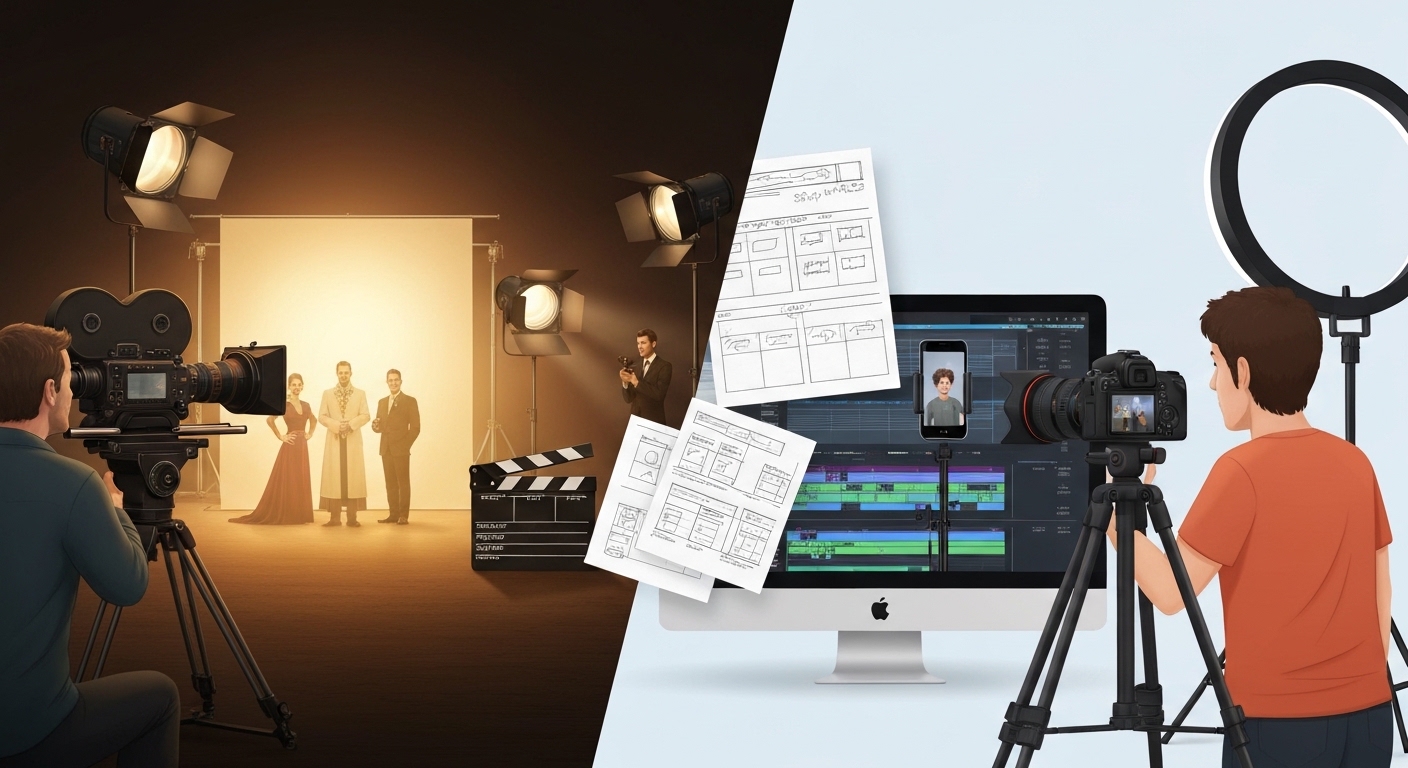
Forget the myth that film and video are the same. What is film and video production is a $100M+ budget question that determines your project's fate.
As an industry insider, I’ll reveal the hidden benefits of each path. This guide breaks down the craft and business into six critical sections.
Choosing the wrong path isn't a creative misstep—it's a financial and strategic risk that can sink your project before the first shot.
Is your project defined by theatrical artistry or agile marketing? Do you need a 5-stage journey or a 3-phase sprint? What unseen foundational principles apply to both?
We’ve analyzed the latest standards, from ARRI Alexa workflows to social media specs, to give you a structured, side-by-side methodology.
Ready to decode your production path? This 7-minute read is your final call sheet. Let’s roll.
Film vs. video: why the distinction determines your project's success
Choosing the wrong path isn't a creative misstep—it's a strategic and financial risk. At its core, film production is the creation of feature-length narratives for theatrical or premium streaming audiences, defined by its artistic focus, high-end tools, and meticulous, multi-stage journey. In contrast, video production is the agile creation of digital content for marketing, training, or online platforms, prioritizing speed, flexibility, and direct audience engagement. Understanding this critical distinction is the first step in aligning your project's goals with the right production path, budget, and team.
Film vs. video: the 5 critical differences that shape budget, tools, and audience
While modern digital tools have blurred some lines, the fundamental distinctions between film and video production remain decisive for project planning. These differences directly dictate your budget, toolkit, and final audience.
- Core Objective & Scale: Film production is centered on long-form, artistic storytelling, often with a runtime of 80 minutes or more, designed for immersive theatrical or premium streaming experiences. Video production targets specific, practical outcomes—like boosting brand awareness, explaining a product, or training staff—typically in formats under 10 minutes for digital consumption.
- Budget & Funding Structure: The financial scales are orders of magnitude apart. A typical independent feature film budget starts in the $10M+ range, funded by studios, grants, or private equity. A corporate marketing video, however, can be successfully produced for $1K to $100K, directly funded by a client with a clear business objective. These differing scales of production have direct budgetary implications that can determine a project's feasibility.
- Technical Toolset: The pursuit of the "cinematic look" drives film toward specialized, high-end equipment like ARRI Alexa cameras and anamorphic lenses, often shot in widescreen aspect ratios like 2.39:1. Video production leverages more accessible, versatile tools—from professional DSLRs and drones to smartphones—optimized for quick setups and formats like 9:16 for social media.
- Production Timeline & Process Rigor: A film follows a rigid, linear 5-stage journey (Development, Pre-production, Production, Post-production, Distribution) that can span years, with no instant playback on set to preserve a focused, artistic workflow. Video production utilizes an agile 3-phase method (Pre-pro, Production, Post-pro) where projects can move from brief to delivery in weeks, with instant review and adjustments on shoot days.
- Distribution & Audience: Film aims for curated channels: theatrical releases, film festivals, and premium streaming platforms. Video is distributed through direct, broad channels: YouTube, social media, company websites, and broadcast TV, targeting viewers in a quick-consumption mindset.
As a veteran producer notes, "Choosing video for a cinematic epic or film for a quick social ad isn't just inefficient—it misallocates every resource and guarantees the project won't connect with its intended audience."
The unseen common ground: 3 foundational principles every creator must master
Beneath the stark differences in scale and output lies a shared bedrock of craft. Whether you're shooting a 30-second ad or a two-hour feature, mastering these three universal principles is non-negotiable for professional results.
- The Primacy of Storytelling & Planning: Every successful project begins with a clear vision. This means rigorous pre-production: a solid script or detailed brief, storyboards, shot lists, and mood boards. This planning phase is where the project's creative and logistical foundations are laid, preventing costly missteps later. Whether crafting a short ad or a feature film, the ability to master these foundational principles separates amateurs from professionals.
- Collaborative Discipline: Both fields are team sports. They rely on clearly defined roles—Director, Producer, Cinematographer, Editor—working in concert. Seamless communication and respect for each specialist's domain are essential for navigating the pressures of any shoot and post-production schedule.
- Technical Command of Image & Sound: While tools differ, the core techniques translate. Understanding composition, lighting (like the classic three-point setup), and camera movement is crucial. Similarly, prioritizing clean, professional audio recording and mixing is paramount; poor sound will undermine even the most beautiful visuals instantly. Software like Adobe Premiere Pro and DaVinci Resolve forms the common post-production ground for both worlds.
Video production decoded: the agile 3-phase method for marketing, training, and online content
Video production is the process of creating visual content for immediate, practical communication, utilizing digital tools for efficiency and broad distribution. Its hallmark is agility, adapting to goals like product launches, internal training modules, or viral social media clips. This definition comes to life through a practical, agile 3-phase method that ensures efficiency from concept to delivery.
- Phase 1: Pre-production. This is the strategic blueprint. It involves dissecting the client brief, writing a concise script or outline, creating shot lists and storyboards, and securing locations and talent. A well-executed pre-production phase is the single biggest predictor of a smooth, on-budget shoot.
- Phase 2: Production. This is the execution day(s). Using versatile cameras, the team captures all planned footage (A-roll) plus supplemental B-roll for flexibility. The digital workflow allows for instant playback to verify shots, enabling real-time adjustments—a key advantage over traditional film sets.
- Phase 3: Post-production. Here, the raw footage is crafted into the final product. The editor assembles the story, adds graphics (like lower-thirds), performs color correction, and integrates sound design and music. The focus is on clarity, pace, and achieving the specific objective set out in the brief.
For example, a software company might use this method to produce a 2-minute explainer video: a week of planning (pre-pro), a single shoot day capturing a presenter and screen recordings (production), and a week of editing for a polished launch (post-pro).
Film production unveiled: the meticulous 5-stage journey from script to theatrical release
Film production is the large-scale, artistic undertaking of creating narrative motion pictures for theatrical or equivalent premium viewing, characterized by extended timelines, significant budgets, and specialized, cinema-grade technology. This scale and ambition are realized through a meticulous 5-stage journey that transforms a script into a cinematic experience.
- Development: This is the genesis stage, often taking months or years. It involves securing rights to a script, writing and rewriting, packaging talent (director, lead actors), and most critically, securing financing to get the official "greenlight."
- Pre-production: With funding secured, the machine mobilizes. This involves final casting, detailed location scouting, set and costume design, and creating an intricate shooting schedule. Every department plans in minute detail for the upcoming shoot.
- Production: Also known as principal photography, this is the most visible phase. Over several weeks or months, the script is shot scene by scene using heavy, specialized camera rigs for steady, controlled movement. The workflow is disciplined, with no instant video playback to maintain the director's cinematic focus on performance and lighting.
- Post-production: This is where the film is built. It includes editing the picture, adding visual effects (VFX), composing and recording the musical score, sound design, and audio mixing. This stage is iterative, often involving test screenings to refine the cut, and can last longer than the shoot itself.
- Distribution: The final stage brings the film to its audience. This involves marketing campaigns, securing theatrical releases, film festival submissions, and licensing deals with streaming platforms.
A contemporary example is an independent drama that spends a year in development to secure a $15M budget, shoots for 40 days on location, and undergoes six months of post-production before premiering at a major festival like Sundance.
From brief to screen: your side-by-side comparison of video and film workflows
To visualize how the core distinctions play out in practice, here is a side-by-side breakdown of the key stages, highlighting the divergence in pace, process, and mindset.
| Stage | Video Production (Agile Method) | Film Production (Meticulous Journey) |
|---|---|---|
| Initiation | Client Brief: A business-oriented document with clear goals, KPIs, target audience, and message. | Script & Greenlight: An artistic screenplay must attract talent and secure major financing (studio/independent) to proceed. |
| Planning | Fast-paced Pre-pro: Storyboards, shot lists, and talent booking are completed in days or weeks. Focus is on logistical efficiency. | Extended Pre-production: A months-long process of detailed scheduling, casting, location scouting, set building, and technical rehearsals. |
| Shooting | Flexible & Adaptive: Use of DSLRs, drones, gimbals. Instant playback allows for on-the-spot corrections and approval. Shoots last hours to a few days. | Structured & Deliberate: Use of cinema cameras (e.g., ARRI) on dollies and cranes. No instant playback to maintain artistic focus. Principal photography lasts weeks to months. |
| Assembly & Polish | Streamlined Post: Linear editing, basic color correction, graphic overlays, and clean audio mix. Turnaround is measured in days or weeks. | Complex Post-production: Non-linear editing, extensive VFX, orchestral scoring, detailed sound design, and multiple color grading passes. Can take 6 months to a year. |
| Delivery | Direct Distribution: Upload to YouTube, social media, company intranet, or broadcast as a finished asset. The cycle is complete. | Phased Distribution & Exhibition: Theatrical release windows, festival circuits, then streaming/VOD licensing. The film is marketed as an "event." |
The video workflow is a sprint—linear, efficient, and designed for a quick, measurable return on investment. The film workflow is a marathon—iterative, layered, and designed to build a lasting artistic and cultural artifact. With these workflows clearly compared, the next logical step is to choose the right path for your project based on its specific goals and constraints.
Conclusion
You now possess the complete blueprint. You’ve moved from a surface-level question to a strategic framework that maps the entire territory—from the critical distinction that defines your project's ambition to the granular, side-by-side comparison of workflows. The core benefit is clear: choosing the correct production path is the single most important decision for aligning your creative vision with practical reality, budget, and audience impact.
Imagine the clarity of launching a project with absolute confidence. Your script isn't just a document; it's a roadmap validated by the correct process. Your budget is an investment, not a gamble, because every dollar is allocated within a proven framework—whether that's the agile 3-phase method for a product launch video or the meticulous 5-stage journey for a narrative short. The data is unequivocal: misalignment at this stage is the primary cause of budget overruns, missed deadlines, and creative misfires.
Consider your project's timeline not as a vague deadline, but as a countdown to a strategic launch window. The convergence of digital distribution and audience expectations isn't slowing down; it's accelerating. In 2026, the cost of launching with an undefined or mismatched production methodology isn't just financial—it's the opportunity cost of being late to a market that rewards precision and professional polish.
Before you move forward, ask yourself these three questions:
- Does my current plan account for the fundamental budgetary and logistical chasm between a film's multi-year journey and a video's sprint?
- Have I objectively assessed whether my core objective demands the theatrical artistry of film or the agile, goal-oriented nature of video?
- Is my team—or my own skill set—structured to navigate the specific rigor of a 5-stage film process or the iterative speed of a 3-phase video workflow?
The complexity you perceived at the start is now a structured decision tree. You are no longer comparing vague ideas; you are evaluating defined pathways with clear inputs and outputs. You have the map; the territory is no longer uncharted.
The next step is to apply this framework to your specific vision, goals, and constraints. Discuss your project brief with an expert to validate your chosen path and build a bulletproof plan. 🎬